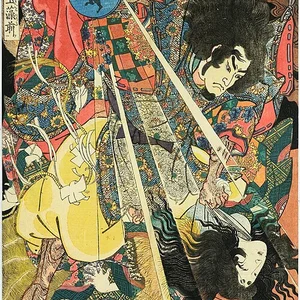

Tamamo-no-Mae is a figure from Japanese mythology, a nine-tailed fox (kitsune) who transformed herself into a court lady of incomparable beauty and intelligence. She bewitched Emperor Toba in the 12th century before being unmasked and slain, at which point she became the Killing Stone (Sessho-seki), said to poison anyone who approaches it.
Tamamo-no-Mae
Tamamo-no-Mae
Japon
8 min read
Frequently asked questions
Key Facts
- Tamamo-no-Mae appeared at the court of Emperor Toba (reigned 1107–1123) in the form of a young woman of exceptional beauty and knowledge
- She was identified as a nine-tailed kitsune (malevolent fox spirit) by the diviner Abe no Yasunari through a revealing ritual
- Hunted across the Nasu plain, she was struck down by the warriors Miura-nosuke and Kazusa-nosuke
- After her death, her malevolent spirit took the form of a boulder known as the Sessho-seki (Killing Stone), which poisoned both humans and animals
- According to legend, the Killing Stone cracked in 2022 in Tochigi Prefecture, potentially releasing the spirit of Tamamo-no-Mae
Works & Achievements
An illustrated tale from medieval Japanese popular literature that established the canonical version of the legend. It presents Tamamo-no-Mae as the most dangerous of Japan's three great calamities, alongside the demon Shuten-dōji and the vengeful spirit of Sugawara no Michizane.
A classical nō theater play in which the spirit of Tamamo-no-Mae, imprisoned within the Killing Stone, appears to the monk Gennō and recounts her story before accepting her spiritual release.
A kabuki play adapting the legend for the popular Edo stage. It amplifies the dramatic elements — fatal beauty, betrayal, and transformation — reflecting the audience's taste for the supernatural.
Numerous illustrated editions of the Tamamo-no-Mae legend published during the Edo period, spreading the story across all levels of Japanese society and establishing its classic iconography.
Woodblock prints depicting Tamamo-no-Mae in her various forms — court lady, fox, Killing Stone — which helped fix the character's visual image in the Japanese popular imagination and beyond.
Anecdotes
Tamamo-no-Mae appeared at the court of Emperor Toba around 1130, taking the form of a lady-in-waiting of supernatural beauty. She could answer every question posed by scholars and poets, regardless of their field of expertise — which quickly aroused suspicion: no one could possess such knowledge without being a supernatural creature.
The onmyoji (master of the calendar and omens) Abe no Yasuchika was summoned when Emperor Toba fell mysteriously ill. After performing a divination ceremony, he identified Tamamo-no-Mae as the source of the affliction. Legend has it that as he recited his incantations, the beautiful lady's mask cracked, briefly revealing the snout of a fox.
Unmasked, Tamamo-no-Mae fled to the plains of Nasuno (in the province of Shimotsuke, present-day Tochigi Prefecture). The emperor dispatched two renowned warriors, Miura no Suke and Kazusa no Suke, to pursue her. The hunt lasted several weeks before they finally managed to bring her down during a great chase.
Upon her death, Tamamo-no-Mae's malevolent spirit transformed into a boulder known as the Sessho-seki, or "Killing Stone." It was said that any living being — human, animal, or plant — would perish if it came too close, due to the toxic fumes the stone emitted. In March 2022, the stone split in two, reigniting Japanese legends about the spirit's release.
According to some versions of the tale, Tamamo-no-Mae was originally a nine-tailed fox who had come from China or India, where she had already sown discord among several rulers, including King Zhou of the Shang dynasty. This figure of the "international malevolent fox" illustrates the cultural exchanges between East Asia and medieval Japan.
Primary Sources
It is reported that a woman of incomparable beauty appeared at court, knowledgeable in all sciences and arts, but that a diviner discovered within her the spirit of a nine-tailed fox who had come to disrupt the emperor's reign.
It is said that the lady known as Tamamo-no-Mae, a handmaiden of Emperor Toba, was in truth a nine-tailed kitsune who drained the sovereign's vital energy to feed her malevolent nature.
The spirit of the Killing Stone appears before the monk Gennō and recounts her story: she was once a fox spirit who seduced the emperor, was driven away and slain, before transforming into a poisoned boulder on the moors of Nasu.
Travelers who approach the rock at Nasu report the smell of sulfur and the deaths of birds and insects nearby, which the people have attributed for centuries to the curse of Tamamo-no-Mae.
Key Places
Japan's imperial capital from 794 to 1868, this is where Tamamo-no-Mae infiltrated the court of Emperor Toba. The imperial palace (Dairi) and its gardens were the setting for her bewitchment.
A vast volcanic moorland in northern Kantō where Tamamo-no-Mae was hunted down and slain by imperial warriors. The region is dotted with sulfurous hot springs that gave rise to the legend of the Killing Stone.
A volcanic rock located at the Nasu-Yumoto hot spring resort, revered and feared as the vessel containing the spirit of Tamamo-no-Mae. It split naturally in March 2022, reigniting debate about the legend.
A major Shinto shrine dedicated to Inari, the deity of foxes and harvests. The fox (kitsune) serves as its sacred messenger, and Tamamo-no-Mae belongs to the ambivalent kitsune tradition — at once guardian and demon.
A Buddhist temple in the Nasu region associated with the legend of the Killing Stone. The monk Gennō Shinshō is said to have stayed there before performing the ritual believed to break the curse of Tamamo-no-Mae.
Typical Objects

A sacred object in Japanese culture, the mirror is associated with spirits and the revelation of truth. The court lady used her reflection to perfect her human appearance, but a magical mirror could betray her true animal nature.

An indispensable accessory of the Heian aristocracy, the fan served as much for coded communication as for seduction. Tamamo-no-Mae used it to charm courtiers and conceal her face during ceremonies.

The ceremonial garment of high Heian aristocratic ladies, composed of multiple layered silk robes. Wearing it with grace and elegance was an art in itself — one that Tamamo-no-Mae had mastered to perfection in order to maintain her disguise.

A volcanic rock in the Nasu region (Tochigi) in which Tamamo-no-Mae's spirit was said to have been imprisoned after her death. The area's naturally toxic volcanic gases fueled the legend of her curse.

A purification tool used by practitioners of onmyōdō (the way of yin and yang) to drive away evil spirits. It was through rituals employing such instruments that Abe no Yasuchika unmasked the fox spirit.

The asymmetrical bow of Japanese warriors, used during the great hunt of Nasuno to bring down Tamamo-no-Mae in her fox form. The bow is the noble weapon of the samurai, a symbol of the military power that was asserting itself during this era.
School Curriculum
Vocabulary & Tags
Key Vocabulary
Tags
Daily Life
Morning
In her human guise, Tamamo-no-Mae rose before dawn to take part in the court's purification rituals. She spent long hours at her toilet: applying white powder to her face, blackening her teeth (ohaguro), and arranging her long black hair according to the strict conventions of Heian aristocracy.
Afternoon
Afternoons were devoted to poetry contests (uta-awase), calligraphy practice, and board games such as go or sugoroku. Tamamo-no-Mae stood out for her ability to answer any question with uncanny erudition, leaving the court's most learned scholars and monks utterly astonished.
Evening
Court evenings were filled with koto and biwa concerts, readings from the Man'yōshū or Kokinshū, and incense-guessing games (kōdō). It was during these intimate, enchanting evenings that Tamamo-no-Mae most effectively tightened her hold over Emperor Toba.
Food
Heian court cuisine was austere and ceremonial: steamed rice, dried fish, pickled vegetables, broths, and seaweed, served on lacquered trays. Meals followed strict purification rules (imi), and courtiers avoided certain foods according to the esoteric calendar of onmyōdō.
Clothing
The junihitoe — a robe of twelve layered silk garments in colors carefully chosen to reflect the seasons — was the ceremonial dress of court ladies. Each color combination carried poetic meaning; Tamamo-no-Mae chose hers to evoke the autumn moon and chrysanthemums, symbols of refinement and melancholy.
Housing
The apartments of the imperial court at Heiankyō were open spaces partitioned by painted folding screens (byōbu) and silk curtains (kichō). Ladies-in-waiting lived in relative closeness behind these screens, communicating through poetic notes slipped beneath the curtains, in a world of half-light and suggestion.
Historical Timeline
Period Vocabulary
Visual Style
Esthétique de la cour Heian raffinée — soies superposées, laques dorées, peintures Yamato-e — contrastant avec les éléments surnaturels du kitsune : feux follets, neuf queues lumineuses et vapeurs sulfureuses des landes de Nasu.
Sound Ambience
Contraste entre la sophistication feutrée de la cour impériale de Heiankyō et la désolation minérale et sulfureuse des landes volcaniques de Nasu où l'esprit de Tamamo-no-Mae fut piégé.
Liens externes & ressources
Références
Œuvres
Tamamo no Mae (otogi-zōshi)
XVe siècle
Pièce de nō Sesshōseki (殺生石)
XIVe-XVe siècle
Kabuki Tamamo no Mae Asahi no Tamoto (玉藻前曦袂)
1751
Ehon (livres illustrés, période Edo)
XVIIe-XIXe siècle
Ukiyo-e de Utagawa Kuniyoshi
XIXe siècle