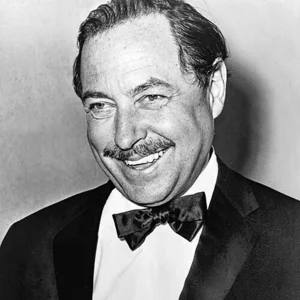

Tennessee Williams (1911-1983) was one of the greatest American playwrights of the 20th century. His plays, marked by psychological tension and the decline of the American South, profoundly reshaped modern theatre.
Tennessee Williams(1911 — 1983)
Tennessee Williams
États-Unis
6 min read
Frequently asked questions
Key Facts
- Born on March 26, 1911, in Columbus, Mississippi, and died on February 25, 1983, in New York
- Achieved his first major success with The Glass Menagerie (1944)
- Received the Pulitzer Prize in 1948 for A Streetcar Named Desire (premiered in 1947)
- Won a second Pulitzer Prize in 1955 for Cat on a Hot Tin Roof
- Several of his plays were adapted for the screen, notably A Streetcar Named Desire by Elia Kazan (1951) starring Marlon Brando
Works & Achievements
A largely autobiographical “memory” play that launched Williams. It established an intimate, poetic theater blending recollection and illusion.
A masterpiece about the downfall of Blanche DuBois in the face of Stanley Kowalski's brutality. Winner of the 1948 Pulitzer Prize and a landmark of modern theater.
A dramatic comedy about a Sicilian-American widow, sunnier than his other works. It earned Williams a Tony Award.
A family drama about lies (“mendacity”), desire, and money on a Southern plantation. The author's second Pulitzer Prize.
A short, dark play haunted by the specter of lobotomy, echoing the tragedy of his sister Rose.
A tragedy about decline, lost glory, and the ravages of time. One of his last great Broadway successes.
Williams's last major critical success, set on the Mexican coast and adapted for the screen by John Huston.
A remarkably candid autobiography about his life, his addictions, and his homosexuality — rare for the time.
Anecdotes
His real first name was Thomas, but his college classmates nicknamed him “Tennessee” because of his strong Southern accent and his father's roots in that state. He kept the nickname all his life and made it his pen name.
For several years, the young Williams worked in a warehouse for the International Shoe Company in St. Louis, a job he hated. He wrote at night, exhausted, and later turned this experience into dramatic material in *The Glass Menagerie*.
His older sister Rose, mentally fragile, underwent a lobotomy in 1943 from which she never recovered. This family tragedy haunts his entire body of work: its echo can be found in the character of Laura (*The Glass Menagerie*) and Catharine (*Suddenly, Last Summer*).
During the Broadway premiere of *A Streetcar Named Desire* in 1947, an unknown young actor named Marlon Brando played Stanley Kowalski under the direction of Elia Kazan. The role made him famous overnight and left its mark on the history of American theater.
Williams died in 1983 in a room at the Hotel Elysée in New York, choking on the cap of a bottle of eye drops that he is said to have held between his teeth. A strange end for one of the greatest playwrights of the century.
Primary Sources
I give you truth in the pleasant disguise of illusion.
Whoever you are, I have always depended on the kindness of strangers.
Mendacity is a system that we live in.
Expressionism and all other unconventional techniques in drama have only one valid aim, and that is a closer approach to truth.
Key Places
Tennessee Williams's birthplace, in the rectory where his grandfather, a minister, lived. He spent his earliest years there in the Deep South.
The city where the family settled in 1918 and where Williams grew up, studied, and worked in a factory. The contrast with the rural South fed *The Glass Menagerie*.
Home of the University of Iowa, where Williams earned his degree in 1938 and trained in playwriting.
Williams's adopted city, whose sensual, fading atmosphere permeates *A Streetcar Named Desire*. He lived there on several occasions.
The island where Williams owned a house and wrote much of his work, drawn by the light, the sea, and the quiet.
The Manhattan hotel where Tennessee Williams died in 1983. He stayed there regularly in his final years.
Typical Objects

Williams's everyday work tool, on which he typed his plays early in the morning. He went through several, carrying them along on his moves to New Orleans and Key West.

A dramatic text annotated with lengthy stage directions. Williams took particular care over sets, lighting and music, which he regarded as a “plastic theatre.”

A real New Orleans streetcar line that inspired the title A Streetcar Named Desire. Its name became a symbol of the destructive desire at the heart of the play.

A program and poster announcing the premieres of his plays in Broadway theaters. These documents bear witness to the golden age of New York theater.

A collection of miniature blown-glass animals around which The Glass Menagerie is built. Its fragile unicorn embodies the vulnerability of the character Laura.

The belongings of the bohemian writer, moving between neighborhood cafés and Southern porches. Williams constantly jotted down lines and impressions throughout his travels.
School Curriculum
Vocabulary & Tags
Key Vocabulary
Tags
Daily Life
Morning
Williams woke up early and devoted his mornings to writing, sitting at his typewriter with a cup of coffee and often a cigarette. This was his most productive time, which he jealously protected no matter where he was living.
Afternoon
In the afternoon, he loved to swim — an almost daily ritual, especially in Key West — and to stroll through the lively streets of New Orleans or along the seaside. He would meet friends, actors, and directors to talk about his plays.
Evening
Evenings were given over to the theater, dinners, and socializing, sometimes late into the night. During his difficult years, alcohol and medication accompanied these evenings and undermined his health.
Food
Williams enjoyed the Southern and Creole cuisine of New Orleans, hearty and spicy. A great lover of strong coffee, he also drank heavily, especially in the latter part of his life.
Clothing
He wore light-colored linen suits and lightweight shirts suited to the hot climate of the South and Florida, with a casual elegance. His air of a bohemian gentleman contrasted with his tormented inner life.
Housing
Williams moved around a great deal: hotels, apartments, and above all his house in Key West, modest and surrounded by greenery. These spaces, often bathed in Southern light, echoed the stifling interiors of his plays.
Historical Timeline
Period Vocabulary
Liens externes & ressources
Références
Œuvres
La Ménagerie de verre (The Glass Menagerie)
1944
Un tramway nommé Désir (A Streetcar Named Desire)
1947
La Rose tatouée (The Rose Tattoo)
1951
La Chatte sur un toit brûlant (Cat on a Hot Tin Roof)
1955
Soudain l'été dernier (Suddenly Last Summer)
1958
Doux oiseau de jeunesse (Sweet Bird of Youth)
1959