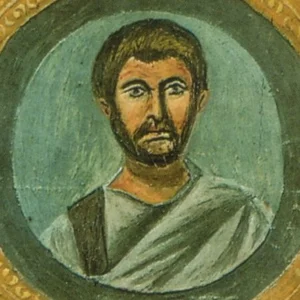

Terence was a Roman comic playwright of African origin, freed by his master. He wrote six comedies inspired by Greek New Comedy, celebrated for their elegant Latin style and psychological depth.
Terence(184 av. J.-C. — 158 av. J.-C.)
Terence
Rome antique
8 min read
Frequently asked questions
Famous Quotes
« Homo sum, humani nihil a me alienum puto. (I am human, and I think nothing human is alien to me.)»
Key Facts
- Born around 184 BC in Carthage, he was brought to Rome as a slave and later freed
- He wrote six comedies between 166 and 160 BC, including The Woman of Andros and The Brothers
- He drew directly from the works of the Greek comic playwright Menander (New Comedy)
- Died around 158 BC, probably during a journey to Greece
- His work profoundly influenced European literature through the Renaissance
Works & Achievements
Terence's first comedy, adapted from Menander. It centers on a young man in love with a poor foreign girl against his father's wishes, introducing themes of thwarted love and generational conflict.
A comedy with a turbulent history, performed three times before finally receiving a fair hearing. It stands out for its subtle characterization and an unusually sympathetic portrait of the mother-in-law, a figure typically played for laughs.
Adapted from Menander, this play contains the famous line "Homo sum, humani nihil a me alienum puto" — one of the most quoted maxims in Latin literature on the theme of universal humanity.
The most popular of Terence's plays during his lifetime, it was the only one to be performed again on the very day of its premiere. It won the prize and an exceptional fee, reflecting the playwright's public success.
An intrigue comedy featuring a crafty parasite who manipulates two old men. It inspired Molière's Les Fourberies de Scapin, illustrating Terence's lasting influence on Western theater.
Terence's masterpiece, contrasting two opposing approaches to raising children — strict authority versus liberal indulgence. Performed at the funeral of Lucius Aemilius Paullus, it raised questions about education that remain relevant today.
Anecdotes
Terence was originally from Carthage, in North Africa. He arrived in Rome as a slave belonging to the senator Terentius Lucanus, who freed him after recognizing his exceptional talents. His nickname "Afer" (the African) reflects his origins, making him one of the rare ancient authors whose non-Roman background is clearly attested.
His comedies were first submitted for approval to the aedile Lucius Ambivius Turpio before being performed. According to Suetonius, Terence enjoyed the active support of the circle of Scipio Aemilianus, a group of cultivated aristocrats with a passion for Greek culture. Envious rivals even claimed that his plays were actually written by these noblemen — an accusation he refuted with irony in his own prologues.
The first performance of Hecyra (The Mother-in-Law) was a resounding failure: the audience abandoned the theater to watch gladiatorial contests and acrobats taking place nearby. Terence had to restage it twice before it was finally given a proper hearing. This episode vividly illustrates the fierce competition that playwrights faced in Republican Rome.
Terence died under mysterious circumstances during a journey to Greece, around 158 BC, at just 26 years old. According to some sources, he may have perished at sea along with the manuscripts of new translations he was bringing back from Athens. His early death robbed Rome of a talent at the height of his powers, and only his six comedies survive — all of them preserved in their entirety.
Primary Sources
"I confess that I have transferred into the Andria and the Perinthia, which are two plays by Menander, whatever seemed fitting to me."
"Homo sum, humani nihil a me alienum puto." (I am human, and I think nothing human is alien to me.)
"The first time I wished to stage this play, the fame of some boxers, the prospect of a tightrope walker, the noise of their supporters crowding in, forced us to abandon it."
"He was of medium height, dark complexioned, and slender in build. He died, according to Vulcatius, on his return from Greece, at Leucadia, or according to others at Stymphalus, a town in Arcadia."
Key Places
The presumed birthplace of Terence, a great Mediterranean city and rival of Rome. His birth in this African metropolis makes him one of the few Latin authors of non-Italian origin.
Terence lived on the Palatine as a freed slave of the senator Terentius Lucanus, in one of Rome's most aristocratic neighborhoods. It was there that he became part of the cultivated circle of Scipio Aemilianus.
Terence's comedies were performed during the Ludi Romani and the Ludi Megalenses, on temporary stages erected in Rome's public spaces. These religious and civic festivals brought together the entire Roman people.
Terence traveled to Greece to study the original works of Menander and the Greek comic playwrights firsthand. Athens, the birthplace of New Comedy, represented an inexhaustible intellectual source for him.
According to ancient sources, Terence died on his return from Greece, either at sea near Leucas or at Stymphalos in Arcadia. The very uncertainty surrounding his death speaks to how suddenly he disappeared.
Typical Objects

Roman actors wore wooden or leather masks representing stock character types: the old man, the young man, the courtesan. Terence, like his contemporaries, wrote his plays with these stereotyped masks in mind — though he strove to give each type greater psychological depth.

Terence drafted and revised his comedies on papyrus scrolls imported from Egypt. It was on this medium that he carried his new translations during his fateful journey to Greece.

The soccus — a low, lightweight shoe — was the trademark of comic actors (comoedia), as opposed to the elevated cothurnus worn in tragedy. It became a symbol of the comic genre to which Terence devoted his entire body of work.

Used for drafts and notes, these wax-coated tablets allowed writers to inscribe text with a stylus and erase it easily. An everyday tool for any educated Roman of the Republican era.

Terence's comedies were performed entirely sung or recited to the rhythm of the tibiae, a wind instrument with two pipes. The stage directions preserved in his plays specify precisely which type of flute was used for each act.

Terence drew directly from the plays of the Greek comic playwright Menander (342–290 BC). These Greek texts, which he consulted in Roman libraries or during his travels, were his primary source of inspiration.
School Curriculum
Vocabulary & Tags
Key Vocabulary
Daily Life
Morning
Terence rose at dawn in the insula or domus where he resided as a freedman. He began his day by reading the Greek texts of Menander or Diphilus, taking notes on wax tablets. The morning was devoted to composing and revising his Latin verses.
Afternoon
In the afternoon, Terence visited the private libraries of his patrons or went to the home of Scipio Aemilianus to discuss literature and philosophy with the circle of great Hellenophile aristocrats. These exchanges nourished his humanist vision and his knowledge of Greek theater.
Evening
On performance evenings, Terence attended rehearsals or stage productions, working closely with the troupe director Ambivius Turpio. When there were no performances, he took part in the frugal meals of men of letters, drinking wine mixed with water and debating Greek poetry and philosophy.
Food
Like most Romans of modest but elevated station, Terence ate simply: spelt bread, legumes, olives, sheep's cheese, boiled vegetables, and dried fish. Meat remained rare, reserved for banquets at the homes of the aristocrats he frequented.
Clothing
As a freedman who had become a Roman citizen, Terence wore the white toga on feast days and a woolen or linen tunic for everyday wear. He did not wear the toga praetexta with its purple stripe, reserved for magistrates, but took care with his appearance to seem worthy of the learned society he moved in.
Housing
Terence most likely lived in a modest house in the Palatine district, made available by his former master turned patron. The main room served as both a tablinum (study) and a reception space for learned visitors, with a few papyrus scrolls neatly arranged on shelves.
Historical Timeline
Period Vocabulary
Visual Style
Scène de comédie romaine en plein air sous la lumière méditerranéenne, avec acteurs masqués, décors peints et public en toges, dans une palette terracotta et ocre inspirée des fresques pompéiennes.
Sound Ambience
Ambiance d'une représentation théâtrale en plein air dans la Rome républicaine : flûtes, rires du public et rumeur de la ville lors des Ludi.
Liens externes & ressources
Références
Œuvres
Andrienne (Andria)
166 av. J.-C.
L'Hécyre (Hecyra — La Belle-mère)
165 puis 160 av. J.-C.
L'Héautontimorouménos (Se punissant lui-même)
163 av. J.-C.
L'Eunuque (Eunuchus)
161 av. J.-C.
Phormion (Phormio)
161 av. J.-C.
Les Adelphes (Adelphoe — Les Frères)
160 av. J.-C.