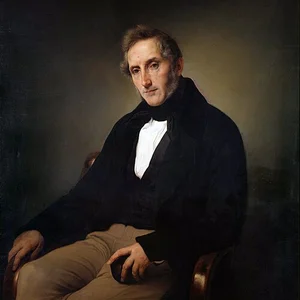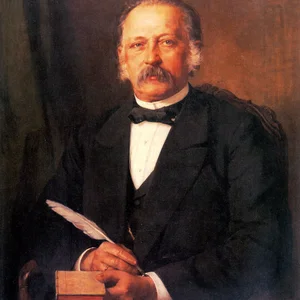

Theodor Fontane was a German writer and a major figure of poetic realism. A pharmacist who became a journalist and then a novelist, he is the author of *Effi Briest*, one of the great novels of nineteenth-century German literature.
Theodor Fontane(1819 — 1898)
Theodor Fontane
royaume de Prusse
6 min read
Frequently asked questions
Key Facts
- Born on **30 December 1819** in **Neuruppin**, in **Brandenburg**, into a family of émigré French Huguenots
- Worked first as a pharmacist before devoting himself to journalism and literature
- Published his *Rambles Through the March of Brandenburg* (*Wanderungen durch die Mark Brandenburg*) starting in **1862**
- Brought out his masterpiece *Effi Briest* in **1894–1895**, a novel of German realism about adultery and Prussian society
- Died on **20 September 1898** in **Berlin**
Works & Achievements
A sweeping multi-volume portrait describing the history, landscapes, and castles of his native province. A foundational work of his writing.
Autobiographical account of his arrest and detention in France during the war of 1870.
Fontane's first novel, a historical fresco about the Prussian uprising against Napoleon. He wrote it at nearly sixty years old.
A novel of impossible love between a seamstress and a young nobleman, painting the social barriers of Berlin society.
A satire of the Wilhelmine bourgeoisie and its social climbing, through the ironic portrait of a wealthy middle-class woman.
His masterpiece: the tragic fate of a young woman crushed by the code of honor. One of the greatest German realist novels.
His last novel, a meditation on the passage from the old aristocratic world to the modern one, published the year of his death.
Anecdotes
Theodor Fontane was first a pharmacist, like his father. For years he prepared remedies behind a counter, in Berlin and then in Leipzig and Dresden, before daring to live by his pen. He was nearly sixty when he published his first real novel: a literary reinvention of rare boldness for the time.
In 1870, during the Franco-Prussian War, Fontane set off as a correspondent to follow the armies in France. Near Domrémy, the village of Joan of Arc, he was arrested by the French, who took him for a Prussian spy. Imprisoned for several weeks, he owed his release only to a diplomatic intervention, and he recounted the episode in a book.
Before becoming a novelist, Fontane traveled on foot and by carriage through Brandenburg, his native region, to describe its castles, villages, and landscapes. His “Walks through the March of Brandenburg” took up years of his life and made him a kind of affectionate chronicler of his province.
Fontane worked for a long time as a theater critic for a major Berlin newspaper. He attended hundreds of performances and was one of the first in Germany to praise the naturalist theater of Ibsen and the young Gerhart Hauptmann, at a time when many found it scandalous.
His masterpiece, “Effi Briest,” tells the tragic fate of a very young woman married to a much older man. The novel is inspired by a real news story, the Ardenne affair, and in it Fontane subtly denounced the hypocrisy of society and the rigidity of the code of honor.
Primary Sources
"That is too wide a field," says old Briest when asked whether the right thing has been done — a line that became proverbial in German for saying a subject is too complex to settle.
In it Fontane describes his project: to reveal the quiet beauty and history of his native province, castle after castle, village after village.
An autobiographical account of his arrest by the French and his detention during the Franco-Prussian War.
Fontane's last great novel, in which the old aristocrat Dubslav von Stechlin embodies the passage from an old world to a new one.
Key Places
Town in Brandenburg where Fontane was born in 1819 in the family pharmacy. It remains associated with his childhood and his attachment to the March of Brandenburg.
Prussian and later imperial capital where Fontane spent most of his adult life, worked as a journalist, and died in 1898.
Fontane stayed here in the 1850s as a press correspondent, discovering life in a great industrial metropolis.
A region of plains, lakes, and castles that he travelled through extensively and described in his “Rambles”.
Region of France where Fontane, a war correspondent, was arrested and imprisoned as a suspected spy during the Franco-Prussian War.
Typical Objects

A vessel and pestle used to grind and mix substances for preparing remedies. Fontane handled one for years in the pharmacies where he worked.

The writing instrument of the novelist and journalist. Fontane filled thousands of pages with novels, theatre reviews, and correspondence.

The notebook in which Fontane jotted down observations, landscapes, and stories gathered during his rambles across Brandenburg.

The Berlin daily for which Fontane wrote theatre reviews and reportage. The press was then the great medium of public opinion.

In “Effi Briest”, the garden swing symbolizes the lost carefree innocence of the young heroine. A fictional object that became an emblem of the novel.

The 19th-century means of transport that set the pace for the travels of Fontane's characters and enabled his own journeys as a writer and reporter.
School Curriculum
Vocabulary & Tags
Key Vocabulary
Daily Life
Morning
In his years as a pharmacist, Fontane opened the shop early, weighed powders and prepared remedies according to prescriptions. Once he became a writer, he often devoted his mornings to writing, in quiet, before the demands of the day began.
Afternoon
Afternoons could be given over to walks and research: visits to castles, conversations with local people, note-taking for his books. At other times, he worked through newspapers and his abundant correspondence.
Evening
As a theatre critic, he spent many evenings in Berlin's theatres assessing plays and actors. Back home, he wrote up his reviews, often late into the night, by lamplight.
Food
The middle-class diet of 19th-century Prussia was based on rye bread, potatoes, pork, cabbage and herring. Coffee and beer readily accompanied meals in Berlin households.
Clothing
Fontane dressed like the educated bourgeois of his time: a dark frock coat, waistcoat, a high-collared shirt and a knotted necktie. For his long walks in the provinces, he wore simpler clothes and a travelling hat.
Housing
He lived in middle-class apartments in Berlin, their rooms furnished with books, writing desks and armchairs. His home was that of a modest but respected man of letters, far from the luxury of the aristocracy.
Historical Timeline
Period Vocabulary
Liens externes & ressources
Références
Œuvres
Wanderungen durch die Mark Brandenburg (Promenades à travers la Marche de Brandebourg)
1862-1889
Kriegsgefangen (Prisonnier de guerre)
1871
Vor dem Sturm (Avant la tempête)
1878
Irrungen, Wirrungen (Errements, confusions)
1888
Frau Jenny Treibel
1892
Effi Briest
1895
Der Stechlin
1898