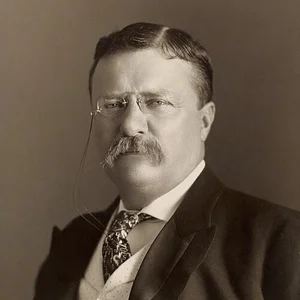

American statesman, 26th President of the United States (1901-1909). A leading figure of progressivism, he championed the regulation of the great industrial trusts and was a pioneer of nature conservation in the United States.
Theodore Roosevelt(1858 — 1919)
Theodore Roosevelt
États-Unis
7 min read
Frequently asked questions
Famous Quotes
« Speak softly and carry a big stick.»
Key Facts
- Became the 26th President of the United States in 1901 after the assassination of William McKinley, at the age of 42 (the youngest president in American history).
- Pursued a policy of fighting the trusts (“trust-busting”) and of social and economic reforms known as the “Square Deal.”
- Launched the construction of the Panama Canal (beginning in 1904), linking the Atlantic and Pacific Oceans.
- Received the Nobel Peace Prize in 1906 for mediating the Russo-Japanese War.
- Created numerous national parks, forests, and nature reserves, making him a pioneer of nature conservation.
Works & Achievements
A program of reforms guaranteeing fair treatment among employers, workers, and consumers. It marked the state's role as arbiter in social and economic conflicts.
The first major federal consumer protection laws, imposing sanitary inspection of food and drugs. They responded to the scandals of the food-processing industry.
The creation of five national parks and dozens of reserves and natural monuments, protecting nearly 93 million hectares. Roosevelt is regarded as a father of American conservation.
The launching of prosecutions against the great industrial monopolies, including the Northern Securities Company. Roosevelt asserted the power of the state against economic concentration.
The launch of construction on the canal linking the Atlantic to the Pacific, a colossal undertaking completed in 1914. It symbolizes the global ambition of the United States.
The negotiation of peace between Russia and Japan, which earned him the Nobel Peace Prize in 1906. The first major role of the United States as an international arbiter.
A work of naval history written in Roosevelt's youth, praised for its rigor. It reveals his erudition and his early interest in maritime power.
The dispatch of a fleet of white battleships on a tour around the world to demonstrate American naval power. A striking diplomatic assertion by the country.
Anecdotes
As a child, Theodore Roosevelt was so frail and asthmatic that his father set up a home gymnasium for him. Young « Teedie » then built himself a sturdy body through exercise, transforming shaky health into the boundless energy that would stay with him all his life.
In 1902, during a hunting trip in Mississippi, Roosevelt refused to shoot a black bear cub tied to a tree, deeming it unsportsmanlike. The press seized on the story and a New York toymaker created a stuffed animal called « Teddy's bear »: this is the origin of the teddy bear.
On October 14, 1912, in the middle of an election campaign in Milwaukee, Roosevelt was the victim of an assassination attempt. The bullet passed through the folded text of his speech and his glasses case before lodging in his chest. Noting that he was not coughing up blood, he delivered his speech anyway for nearly an hour before going to the hospital.
Roosevelt had a veritable living zoo set up at the White House for his six children: ponies, snakes, raccoons, parrots, and even a badger all lived there together. One day, his son Archie, who was sick, was visited in his bedroom by his pony Algonquin, brought up discreetly in the elevator.
In 1906, Roosevelt became the first American to receive the Nobel Peace Prize, for negotiating the end of the Russo-Japanese War through the Treaty of Portsmouth. He donated the entire prize amount to charity.
Primary Sources
There are, in the body politic, economic and social, many and grave evils, and there is urgent necessity for the sternest war upon them by all decent men.
The conservation of our natural resources and their proper use constitute the fundamental problem which underlies almost every other problem of our national life.
The welfare of the people is the supreme law; every man must have an equal chance to show what is in him.
Speak softly and carry a big stick; you will go far. If a man speaks softly and carries a big stick, he will succeed.
Key Places
Roosevelt's birthplace, where he was born in 1858 into a wealthy family of Dutch descent. It was here that he began his political career in the State Assembly.
Roosevelt's family home on Long Island, nicknamed the “Summer White House.” He died there in January 1919.
The presidential residence he occupied from 1901 to 1909 and which he officially renamed the “White House.” His six children turned the place into a playground.
The region where Roosevelt settled as a cattle rancher in the 1880s after the death of his first wife. These landscapes fueled his commitment to nature.
Site of the famous charge of the “Rough Riders” in 1898 during the Spanish-American War. This military feat made Roosevelt a national hero.
A national monument where Roosevelt's face is carved into the rock alongside Washington, Jefferson, and Lincoln. There he embodies the expansion and development of the United States.
Typical Objects

Small glasses without temples that pinch the nose, which became Roosevelt's emblematic visual attribute. A glasses case deflected the bullet during the 1912 assassination attempt.

A large-caliber rifle used by Roosevelt, a passionate hunter and naturalist. He made use of it during his African safari of 1909.

The symbolic stick from his famous phrase “Speak softly and carry a big stick.” It embodies his firm diplomacy backed by military power.

The clothing of the cattle rancher he once was in the Dakotas during the 1880s. He forged his image as a rugged and manly man of the West.

A toy born from the 1902 anecdote in which Roosevelt refused to kill a bear cub. His nickname “Teddy” gave the toy its name and made it popular worldwide.

An award granted in 1906 for his mediation in the Russo-Japanese War. Roosevelt was the first American statesman to receive it.
School Curriculum
Vocabulary & Tags
Key Vocabulary
Tags
Daily Life
Morning
Roosevelt rose early and was bursting with energy from dawn. His mornings were devoted to work at the White House: reading mail, meeting with advisers and drafting speeches, often conducted at a frantic pace.
Afternoon
In the afternoon, he received visitors, journalists and delegations in the Oval Office. A believer in the “strenuous life,” he set aside time for physical exercise almost every day: horseback riding, boxing, wrestling or jiu-jitsu.
Evening
In the evening, Roosevelt dined with his family or with political and intellectual guests, enlivening the conversation with a thousand topics. A voracious reader, he could devour an entire book in one evening before going to bed.
Food
Roosevelt had a hearty appetite and enjoyed meat, game from his hunts and copious dishes. He drank enormous quantities of coffee, served in a cup that, his son said, resembled a bathtub.
Clothing
As a public figure, he wore dark three-piece suits with his famous pince-nez and a thick mustache. In private or on expedition, he donned the attire of an explorer, a horseman or a cowboy.
Housing
His beloved residence was Sagamore Hill, a sprawling wood-and-brick home in Oyster Bay, filled with hunting trophies, books and mementos. During his presidency, he lived in the White House, which he had enlarged with the West Wing.
Historical Timeline
Period Vocabulary
Liens externes & ressources
Références
Œuvres
Le « Square Deal »
1901-1909
Lois Pure Food and Drug Act et Meat Inspection Act
1906
Politique de conservation de la nature
1901-1909
Lutte contre les trusts (« trust-busting »)
1902-1904
Le canal de Panama
1904-1914
Médiation du traité de Portsmouth
1905
The Naval War of 1812
1882