
Reformer of the Carmelite Order, mystic, Doctor of the Church
Teresa of Ávila(1515 — 1582)
Teresa of Ávila
couronne de Castille, Empire espagnol
7 min read
Frequently asked questions
Key Facts
Works & Achievements
A spiritual treatise written for the nuns of her convent, guiding Carmelite sisters toward Christian perfection through mental prayer and contemplation. It is a foundational text of reformed Carmelite spirituality.
A masterpiece of Christian mysticism describing the soul's spiritual journey through seven mansions of an inner castle toward union with God. A major work of Western spiritual literature.
A spiritual autobiography recounting her experience of conversion, her visions, and her religious commitment. A precious document on the inner life and mystical experience in the 16th century.
The first convent of the Carmelite Reform, establishing strict rules for contemplative life. The concrete foundation of the Discalced Carmelite reform.
A major religious reform movement aimed at restoring the rigor and poverty of the Carmelite rule. A landmark foundation that transformed religious life in Spain and across the Western world.
A collection of spiritual poems expressing her mystical experience, including 'The Transverberation' and 'Vivo sin vivir en mí'. Lyrical texts of great spiritual depth.
Canonized posthumously in 1622 and proclaimed a Doctor of the Church in 1970 by Pope Paul VI — the first woman to receive this title for her theological and spiritual contributions.
Anecdotes
In 1560, Teresa of Ávila had a famous mystical vision: an angel pierced her heart with a golden arrow, a symbol of divine love. This experience, which she described in her writings, became one of the greatest mystical visions in religious history. She portrayed it as a union of the soul with God, and the vision even inspired artists such as Bernini, who created a celebrated sculpture depicting it.
At the age of 20, Teresa entered the Convent of the Incarnation in Ávila, Castile, where she suffered a serious illness that left her paralyzed for three years. Her prayers and determination allowed her to gradually regain her health, which deepened her conviction that she had received divine grace. This traumatic experience became the starting point of her spiritual commitment.
In 1562, Teresa founded the first reformed Carmelite convent in Ávila with just four nuns, with the aim of returning to the simple, contemplative life of the early Carmelites. This small convent, called Saint Joseph's, became the model for her reform. She served as its prioress for five years, establishing strict rules of poverty and silence.
Teresa wrote major works such as 'The Interior Castle' and 'The Book of Her Life' — mystical texts of remarkable psychological depth that circulated widely across Europe. Written with unusual clarity, these works explain the different stages of spiritual life and influenced religious thought for centuries.
In 1582, at the age of 67, Teresa died in Ávila after spending 20 years travelling across Spain to found convents and reform the Carmelite order. Forty years after her death, she was recognized as a Doctor of the Church by Pope Paul VI in 1970 — a very rare honor reserved for the greatest Christian thinkers.
Primary Sources
This castle has seven dwelling places; in the innermost and most secret dwells the King of glory... The path to reach this dwelling is mental prayer.
Since I began to speak of this supernatural prayer, I desire with all my heart to be understood; for it has often cost me much effort, because the prayer of quiet and that of union are difficult to explain.
I beg you, my daughters, to understand clearly that the true way to perfection is to love the Lord our God and to love one another.
Prayer is my refuge... I entrust myself entirely to God, and it is there that I find the strength to endure my trials.
We recognize in Teresa of Jesus a Doctor of the Church, whose mystical wisdom and spiritual writings illuminate all the faithful.
Key Places
Teresa's birthplace in Castile, where she was born in 1515. This walled city in central Spain had a profound influence on her identity and spirituality.
The Carmelite convent where Teresa spent 27 years of her religious life before founding her own reformed communities. It was here that she underwent her most significant mystical experiences.
The city where Teresa established one of her first reformed convents, the Convento de San José de los Descalzos, in 1574, marking the beginning of her work reforming the Carmelite order.
An important center of the Carmelite reform, where Teresa founded several communities and continued her work as a spiritual director and writer.
The town where Teresa withdrew in the final years of her life and where she died on October 4, 1582. She founded a convent there and now rests in peace.
The spiritual capital where Teresa sought papal approval for her reforms. Her mystical writings were recognized there, and she was canonized in 1622 by the Vatican.
Typical Objects

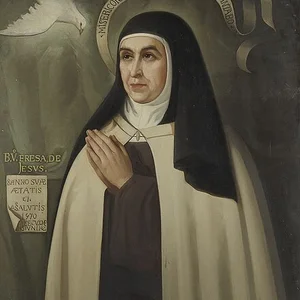
A long brown robe with a white veil and rope belt, symbol of the Carmelite reform Teresa led. This habit represents the rigor and simplicity of monastic life that she championed.

A major spiritual work written by Teresa describing the stages of the mystical life. This foundational text has been recognized as a masterpiece of Christian spirituality, and she was named a Doctor of the Church.

Renaissance writing tools representing Teresa's intense literary activity — she left behind an extensive correspondence and important spiritual treatises.

The central symbol of Christian faith and of Teresa's contemplative spirituality. She held that the cross was at the heart of her mystical experience and her teaching.

The small, austere and bare space typical of Teresa's reformed monasteries. This cell represents the cloistered life of contemplative prayer she restored to the Carmelite order.

A liturgical furnishing from which Teresa taught and instructed the nuns under her direction. It symbolizes her role as a spiritual teacher and reformer.

A personal devotional book containing prayers and meditations, a typical everyday object of 16th-century religious life that Teresa practiced with great intensity.

A symbol of Teresa's mystical union with the divine, which she referred to in her accounts of extraordinary spiritual experiences and ecstasies.
School Curriculum
Daily Life
Morning
Teresa rises before dawn to attend Matins and the community's Carmelite offices. She devotes several hours to contemplative prayer and meditation, which are central practices of her mystical spirituality. After a light meal, she turns to her convent duties and the writing of her spiritual works.
Afternoon
The afternoon is divided between the convent's manual tasks (cooking, laundry, upkeep) and spiritual correspondence with other religious figures and her disciples. She takes part in the offices of None and Vespers, important communal moments of convent life that give structure to the day.
Evening
Teresa takes a simple communal meal in the refectory, where religious texts are typically read aloud. She spends the early evening writing her spiritual treatises and providing spiritual direction to her novices. She retires before Compline for a short night, interrupted by the nocturnal liturgy of Matins.
Food
Her diet follows the reformed Carmelite rule, which is very austere: bread, vegetables, fruit, herbs, and occasionally fish. She regularly observes strict fasts, reducing her portions even further, in keeping with the austerity of contemplative life. Water and herbal teas are her main beverages.
Clothing
Teresa wears the reformed Carmelite habit: a simple white wool tunic, a brown scapular, and the distinctive white veil of the Discalced Carmelites. Her garments are deliberately coarse and unadorned, reflecting her rejection of vanity and her commitment to spiritual poverty.
Housing
She lives at the Convent of Saint Joseph in Ávila, a monastery she herself founded. Her cell is spartan: a simple bed, a small writing table, a few spiritual books. The convent, a modest stone building, includes the conventual church, the cloister, a common refectory, and the individual cells of the nuns.
Historical Timeline
Period Vocabulary
Visual Style
Un style aliant la spiritualité mystique de la Renaissance espagnole à une atmosphère contemplatrice et lumineuse, où la divine illumination domine par des jeux de lumière dorée et des teintes chaudes. L'influence de la peinture religieuse du XVIe siècle se mêle à une délicatesse graphique pour représenter les expériences spirituelles intenses de la réformatrice.
Sound Ambience
Une ambiance contemplative et spirituelle évoquant les cloîtres carmélites de l'Espagne du XVIe siècle, mêlant chants grégoriens, silence monacal et sons intimes de l'écriture mystique.
Liens externes & ressources
Références
Œuvres
Le Chemin de la Perfection
1566-1567
Le Château Intérieur (Les Demeures)
1577-1579
La Vie de Sainte Thérèse
1565
Fondation du Couvent Saint-Joseph d'Ávila
1562
Réforme du Carmel (Carmel Déchaussé)
1562-1582
Poésies mystiques
1570-1580
Reconnaissement comme Docteur de l'Église
1970