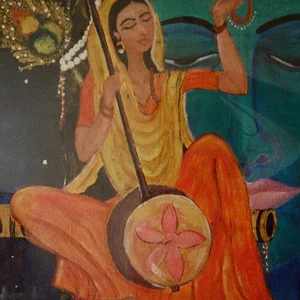

Mirabai was a 16th-century Rajput princess, mystic, and devotional poet dedicated to Krishna. Rejecting the conventions of her caste, she devoted her life to worship and composed hundreds of bhajans (devotional hymns) that have endured through the centuries. A major figure of the Bhakti movement, she embodies the spiritual quest freed from social hierarchies.
Mirabai(1498 — 1546)
Mirabaï
Inde
7 min read
Frequently asked questions
Famous Quotes
« Mero to Giridhar Gopal, doosro na koi. (My only refuge is Giridhar Gopal, there is none other.)»
Key Facts
- Born around 1498 in Kudki (Rajasthan), into a royal Rajput family
- Married to Prince Bhoj Raj of Chittorgarh, she nonetheless refused to submit to her in-laws' rituals at the expense of her devotion to Krishna
- Persecuted by her brothers-in-law for a devotion deemed scandalous, she eventually left the palace to live as a pilgrim
- Composed several hundred bhajans in Rajasthani and Brajbhasha, still sung across the Indian subcontinent today
- Died around 1546 in Dwarka (Gujarat), according to tradition by mystically merging with the image of Krishna
Works & Achievements
A corpus of several hundred poem-songs in Braj Bhasha and Rajasthani languages, addressed to Krishna. They constitute Mirabai's main body of work and are still sung throughout India.
A celebrated narrative poem recounting the devotion of Narsi Mehta, a saint from Gujarat. Mirabai praises bhakti as the supreme path to salvation.
A collection of bhajans composed on specific musical modes (ragas), combining poetry with classical Indian music.
Songs associated with the garba tradition of Gujarat, integrating devotion to Krishna into a popular musical form still practised during the Navratri festival.
Anecdotes
From childhood, Mirabai is said to have asked her mother who owned the statue of Krishna displayed during a wedding procession. Her mother reportedly replied as a joke: "He is your husband." Mirabai took these words literally and devoted herself absolutely to Krishna until the end of her life, considering him her true spiritual husband.
After the death of her earthly husband, Mirabai's in-laws sent her poison several times under the pretense of offering her prasad (sacred food), hoping to put an end to her activities deemed dishonoring to the royal family. According to tradition, Mirabai drank the poison while praying to Krishna and did not die, this miracle strengthening her reputation as a saint.
The queen permanently left the palace of Chittorgarh to live as a wandering pilgrim, singing her bhajans in the streets, temples, and ghats. She traveled to Vrindavan, the sacred place associated with Krishna's youth, where she was initially refused by an ascetic who did not accept women. She replied to him that there was only one man in the universe, Krishna, and that all others were his servants.
It is said that the Mughal emperor Akbar, fascinated by Mirabai's renown, disguised himself as a beggar to hear her sing. After listening to her bhajans, he reportedly placed a precious necklace at her feet as a tribute. When her brother-in-law, the Rana of Mewar, learned that a Muslim had entered the devotee's circle, he threatened Mirabai, prompting her to leave for Dwarka.
Primary Sources
Mero to Giridhar Gopal, dusaro na koi — "My only support is Giridhar Gopal (Krishna), there is no other."
Priya Das describes Mirabai as an exemplary bhakta whose devotion to Krishna transcended social and familial obligations.
Nabhadas mentions Mirabai among the great bhakti saints, emphasizing her renunciation of royal wealth in favor of divine companionship alone.
Mirabai is said to have written to Tulsidas seeking advice on how to reconcile devotion with family duties. His response reflects the tension between social dharma and personal bhakti.
Key Places
Mirabai's birthplace in present-day Rajasthan, India. It is here that she had her first vision of the child Krishna and received her education as a Rajput princess.
Capital of the kingdom of Mewar where Mirabai lived after her marriage. The fortress was the setting for her conflicts with her in-laws, who disapproved of her public devotion.
Sacred city associated with Krishna's childhood and a major pilgrimage site of the Vaishnava tradition. Mirabai stayed there and sang her bhajans in the company of recognized saints.
Krishna's birthplace according to Hindu tradition, a few kilometers from Vrindavan. Mirabai made several devotional stays there during her pilgrimage.
Holy city of Gujarat associated with Krishna's legendary reign. Mirabai spent her final years there and, according to tradition, died around 1546.
Typical Objects

A single-stringed instrument used by wandering saints to accompany their devotional songs. Mirabai played it to perform her bhajans in honor of Krishna.

A representation of Krishna in the form of Giridhar ("the one who lifts the mountain"). Mirabai owned a small statue she venerated as her divine husband and took with her into exile.

A necklace of beads made from tulsi wood (sacred basil) used for Vaishnava prayers. Mirabai used it to count her recitations of Krishna's name.

A metal or clay bowl that wandering saints used to receive alms of food. After leaving the palace, Mirabai lived by begging like any ascetic.

A saffron or blood-red fabric worn by devout women. The saffron color symbolizes renunciation and devotion in the Hindu tradition.

A handwritten collection of devotional poems and songs. Mirabai's bhajans were passed down orally and later recorded by her disciples.
School Curriculum
Vocabulary & Tags
Key Vocabulary
Daily Life
Morning
Mirabai rose before dawn to perform puja (devotional ritual) before the statue of Krishna, offering lotus flowers, incense, and diya light. She recited the divine names while counting the beads of her tulsi rosary, then mentally composed the verses of her bhajans for the day.
Afternoon
She sang and danced in a state of ecstasy before the temple or in the streets, accompanied by the ektara. She welcomed pilgrims and sadhus, engaged in discussions on bhakti, and distributed the alms she received. After her exile, she begged for food and taught her songs to devotees.
Evening
The evening was devoted to collective kirtans — sessions of devotional singing and music with a group of the faithful. Mirabai composed new bhajans by the light of oil lamps, immersed in meditation on Krishna. She slept little, on a simple mat, in a corner of a temple or beneath a tree.
Food
Strictly vegetarian in accordance with the Vaishnava tradition, Mirabai subsisted mainly on chapati (flatbread), dal (spiced lentils), and boiled vegetables. After leaving the palace, she lived on prasad (food offerings) received at temples and food given by devotees.
Clothing
Mirabai wore silk saris in saffron or deep red tones — colors of devotion and renunciation — adorned with embroidered mirrors in the Rajasthani tradition. She kept her traditional jewelry — a tulsi necklace, bracelets, and ankle bells (ghungroo) — but paired them with increasingly austere dress as her pilgrimage progressed.
Housing
In the palace of Chittorgarh, Mirabai occupied richly decorated royal apartments. She transformed one room into a personal temple for Krishna. After her departure, she lived in dharamsalas (pilgrim rest houses), under temple porticos, or in the open air, sleeping on the ground like other wandering saints.
Historical Timeline
Period Vocabulary
Visual Style
Style de la miniature rajpoute du XVIe siècle, couleurs saffran, bleu paon et or, représentant une princesse dévote dans un cadre entre palais royal et sanctuaire krishnaïte.
Sound Ambience
Ambiance sonore d'un temple vaishnava du Rajasthan du XVIe siècle : drones de l'ektara, chants dévotionnels féminins, cloches et cymbales, vent sur les remparts de Chittorgarh.
Liens externes & ressources
Références
Œuvres
Bhajans (chants dévotionnels)
vers 1515-1546
Narsi Ji Ra Mayra
vers 1530
Raag Govind
vers 1525-1540
Garba Geet (Chants de danse circulaire)
vers 1520-1545