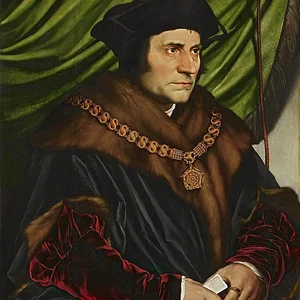

An English humanist and statesman, Thomas More served as Lord Chancellor to Henry VIII before opposing the Anglican schism. Author of Utopia (1516), he was executed for refusing to acknowledge the king as Supreme Head of the Church of England.
Thomas More(1478 — 1535)
Thomas More
royaume d'Angleterre
8 min read
Frequently asked questions
Famous Quotes
« I die the king's good servant, but God's first.»
« Custom makes the greatest hardships bearable.»
Key Facts
- 1478: Born in London
- 1516: Publication of Utopia, a founding work of humanist political thought
- 1529: Appointed Lord Chancellor of England by Henry VIII
- 1532: Resigned the chancellorship in disagreement over the king's divorce
- 1535: Executed for treason after refusing to swear the Oath of Supremacy recognizing royal authority over the Church
Works & Achievements
A masterpiece of humanist literature, this Latin text describes an imaginary island governed by reason, without private property or war, serving as a critical mirror of European society. It gave its name to the literary and philosophical genre of utopia.
The first example of critical political biography in English, this text portrays Richard III as a tyrannical usurper and had a lasting influence on the king's image — most notably the portrayal Shakespeare would later give in his eponymous play.
Written during his imprisonment in the Tower of London, this English-language work is a spiritual meditation on suffering, faith, and courage in the face of death. It bears witness to the depth of his inner life as his execution drew near.
More wrote this fierce refutation of Luther's theses on behalf of Henry VIII, defending papal authority and the Catholic sacraments. This polemical work reveals his deep engagement in the religious controversies of the Reformation.
These letters to his beloved daughter, written during his imprisonment, are deeply moving documents of both human and spiritual intensity. They reveal a loving father and a man at peace with his conscience as he faced the ultimate sacrifice.
Anecdotes
Thomas More was renowned for his sharp wit, even in the face of death. Climbing the scaffold on 6 July 1535, he reportedly said to the executioner: 'Help me up; as for coming down, I can manage that myself.' This quip illustrates the composure and spirit he maintained to the very end.
More shared a deep and enduring epistolary friendship with Erasmus of Rotterdam, whom he had welcomed into his home in Chelsea. It was in More's house that Erasmus wrote part of his famous work The Praise of Folly (1509), whose Latin title Moriae Encomium is a pun on his friend's name.
Thomas More was a remarkably forward-thinking father: he had his daughters educated to the same level as his sons, something extraordinarily rare in the sixteenth century. His daughter Margaret Roper was celebrated for her command of Latin and Greek, and corresponded with the leading humanists of Europe.
Imprisoned in the Tower of London for more than a year before his execution, More refused to sign the Oath of Supremacy recognising Henry VIII as head of the Church. He maintained a strategic silence, reasoning that silence could not lawfully be construed as refusal — an argument his judges circumvented by convicting him of treason regardless.
Thomas More secretly wore a hair shirt against his skin as an act of penance, a practice discovered only after his death. This hidden asceticism stood in sharp contrast to his reputation as a polished and refined courtier, revealing the depth of his inner faith.
Primary Sources
There is no private ownership in Utopia. Everyone works, but no one is compelled to excessive labor... They devote their free hours not to idleness, but to improving their minds.
I cannot help telling you, my dear Meg, that I feel as calm and content in this place as anywhere in the world. It seems to me that God is showing me a particular grace.
Richard, Duke of Gloucester, was small in stature and misshapen, his left shoulder higher than his right... His mind was cunning and devious, quick to dissemble, disposed to conceal.
Tribulation is for the virtuous man an occasion for merit and glory; for the wicked, a means of correcting himself and avoiding a greater evil... Neither, therefore, should despair in adversity.
Key Places
More had a large and comfortable house built in Chelsea, on the banks of the Thames, where he welcomed Erasmus, Holbein, and the greatest minds of his time. This home also served as a school for his children and an intellectual hub of English humanism.
More was imprisoned there from 1534 until his execution in 1535, after refusing to swear the Oath of Supremacy. It was within this fortress that he wrote his final letters to his daughter Margaret and his Dialogue of Comfort against Tribulation.
As Lord Chancellor, More presided over the Court of Chancery at the Palace of Westminster, dispensing justice in the king's name. This place symbolised the height of his political career before his break with Henry VIII.
Utopia was first published in Leuven in December 1516, by the printer Thierry Martens, thanks to the support of Erasmus and Peter Giles. This city in the Spanish Netherlands was a leading humanist intellectual centre.
More trained in law at Lincoln's Inn, one of the four London Inns of Court, an elite institution for legal education. This training established him as a respected jurist and opened the doors to Parliament and the royal court.
Typical Objects

As Lord Chancellor, More held the Great Seal of England, symbol of royal authority in judicial and legislative affairs. It was this seal that he surrendered in 1532 upon his resignation — a solemn act marking his break with Henry VIII's policies.

A deeply devout man, More meditated and prayed daily from the text of the Vulgate. During his imprisonment in the Tower of London, pious books and the Bible were his main consolations and sources of comfort.

A prolific humanist and jurist, More composed all of his works — correspondence, theological treatises, political writings — with a quill pen. Even while imprisoned, he obtained writing materials to draft the Dialogue of Comfort and his letters to his daughter Margaret.

More secretly wore a hair shirt beneath his court clothes — a rough garment made of coarse animal hair used as bodily mortification. This penitential practice, revealed after his death, attests to his inner asceticism and deep Catholic devotion.

The office of Lord Chancellor came with richly furred ceremonial robes, symbols of dignity and power. Hans Holbein the Younger immortalized More in this official dress in his famous 1527 portrait, now held at the Frick Collection in New York.

Like every educated Catholic of his era, More owned a Book of Hours — a collection of prayers and liturgical offices marking the hours of the day according to the church calendar. Daily prayer structured his existence, even during the busiest periods of his political life.
School Curriculum
Vocabulary & Tags
Key Vocabulary
Tags
Daily Life
Morning
Thomas More rose early, around five o'clock, to attend private Mass in the chapel of his Chelsea home with his entire family. He then devoted an hour to personal prayer and reading the Scriptures before dressing with the help of his servants.
Afternoon
Afternoons were given over to judicial hearings or the king's business at Westminster, where More traveled by boat along the Thames from Chelsea. As Lord Chancellor, he received litigants, counselors, and foreign ambassadors, and was renowned for the speed and fairness of his judgments.
Evening
Evenings at Chelsea were both studious and convivial: More read in Latin or Greek, wrote his humanist correspondence, and discussed philosophy with his children, whom he educated himself. He would sometimes play music or receive scholars and artists such as Erasmus or Hans Holbein.
Food
More's table was that of a prosperous English gentleman: roasted meats, fish (on Fridays and days of fasting), white bread, and fruit and vegetables from the Chelsea garden. More himself was modest in his eating habits, preferring vegetables and milk out of personal taste and ascetic discipline.
Clothing
As Lord Chancellor, More wore luxurious robes of burgundy or black velvet trimmed with fox or marten fur, along with the great gold chain of his office. In private, he dressed more simply in English wool doublets, while concealing beneath his clothes the hair shirt he wore as a penitential practice.
Housing
The Chelsea house was a spacious Renaissance residence on the banks of the Thames, with gardens, an orchard, a private chapel, a library, and a farmyard. It housed not only his immediate family but also sons-in-law, daughters-in-law, and grandchildren, forming the kind of extended, cultivated household that More fondly called his 'school'.
Historical Timeline
Period Vocabulary
Visual Style
Style portrait holbeinien de la cour Tudor : intérieurs sombres et chaleureux, velours et fourrures, lumière à la bougie sur des livres et des documents, sobriété humaniste teintée de gravité.
Sound Ambience
Atmosphère sonore de l'Angleterre Tudor : cloches de Westminster, bruits de la Tamise, plume sur parchemin dans une bibliothèque humaniste et prières en latin dans une chapelle privée.
Liens externes & ressources
Références
Œuvres
Utopia (L'Utopie)
1516
Histoire du roi Richard III
vers 1513-1518
Dialogue of Comfort against Tribulation
1534
Réponse à Luther (Responsio ad Lutherum)
1523
Lettres à Margaret Roper depuis la Tour
1534-1535