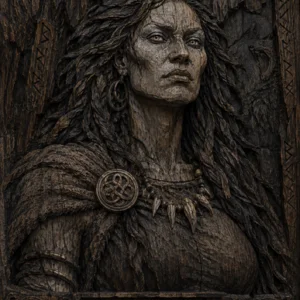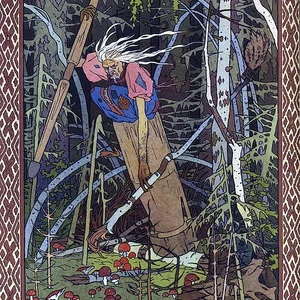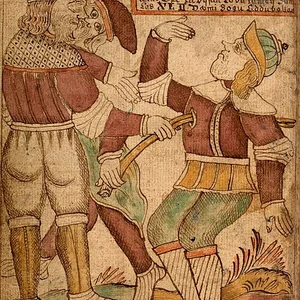

Þökk is a giantess (jötunn) from Norse mythology. She is the only creature to refuse to weep for the god Baldr, thereby preventing his return from the realm of the dead. She is suspected of being Loki in disguise.
Thökk
Þökk
6 min read
Frequently asked questions
Key Facts
- Appears in the Gylfaginning of the Prose Edda, compiled by Snorri Sturluson around 1220.
- Refuses to weep for Baldr while all of creation does so, condemning the god to remain with Hel.
- Utters the formula by which “Þökk will weep dry tears,” sealing Baldr's fate.
- Is traditionally interpreted as a metamorphosis of Loki, who was responsible for Baldr's death.
- Her name means “gratitude” or “thanks” in Old Norse, by way of irony.
Works & Achievements
Þökk's central act: as the only creature in the universe to refuse to weep for Baldr, she seals his confinement in the realm of the dead.
The stanza spoken by Þökk in which she declares that she will shed only dry tears, one of the most chilling passages in the Edda.
By her refusal alone, Þökk prevents the return to life of the most beloved god, an irreversible consequence for the Æsir.
According to the suspicion of the Æsir, Þökk is Loki in disguise: the episode illustrates the trickster god's mastery of the art of disguise.
The character is recorded in the Prose Edda, the principal source that has transmitted her story down to us.
Anecdotes
When the god Baldr dies, the goddess Frigg secures a promise from the underworld: her son will return to life if everything in the universe weeps for him. The Æsir then send messengers all over the world to ask beings and objects to shed tears.
Everything weeps for Baldr — humans, animals, the earth, the stones, and even the trees, just as metal weeps when it is taken from the cold to be warmed. Only one creature refuses: the giantess Þökk, sitting in a cave.
Þökk answers with a chilling verse: she will shed only dry tears on Baldr's pyre, for Odin's son never brought her any good. Because of this single refusal, Baldr must remain with Hel, the goddess of the dead.
Snorri Sturluson's text ends with a suspicion that became famous: “It is thought that this was Loki, son of Laufey, who had done the Æsir the greatest harm.” The mischievous god is said to have disguised himself as a giantess to ruin Baldr's return.
Her very name, Þökk, means “thanks” or “gratitude” in Old Norse — a biting irony for a character who refuses everything, and one more clue to the deceptive nature of Loki hidden behind this mask.
Primary Sources
Þökk will weep dry tears for Baldr's funeral. Neither in life nor in death has the old man's son brought me any good; let Hel keep what she holds.
It is thought that the one who was there was Loki, son of Laufey, who had done the greatest harm to the Æsir.
I see the fate of Baldr, the bleeding god, Odin's son, doomed to die; standing taller than the plain, slender and very fair, grew the mistletoe.
Odin rides down to the realm of Hel to question a dead seeress about the ominous dreams that torment his son Baldr.
Key Places
Lair where the giantess is found sitting, refusing to weep for Baldr. Located in the world of the giants, beyond the reach of the Æsir.
Underworld of the dead governed by the goddess Hel, where Baldr is held after his death. There he must remain for want of Þökk's tears.
Celestial citadel of the Æsir gods, plunged into mourning after Baldr's death. From here set out the messengers who will meet Þökk.
Baldr's radiant dwelling in Asgard, reputed the purest place where no evil may enter. It remains empty after his death.
Land where the Norse myths were set down in writing in the 13th century, notably the episode of Þökk in Snorri's Edda.
Typical Objects

A seemingly harmless plant, the only thing that had not sworn an oath never to harm **Baldr**; cut into a dart, it brings about his death. It is the spark that sets off the whole quest for tears in which **Þökk** appears.

To bring **Baldr** back, every being had to weep; the tears become a true ransom-currency in the face of death. **Þökk**'s refusal to weep makes the bargain fail.

Raised upon the ship *Hringhorni*, it receives **Baldr**'s body during a magnificent funeral. **Þökk** declares that she will mourn him with dry tears alone.

**Odin**'s golden ring that multiplies on its own, laid upon his son's pyre. It embodies the wealth and power of the Æsir, powerless to ransom **Baldr**.

The guise of a reclusive giantess that **Loki** takes on, according to the Æsir's suspicion, to sabotage **Baldr**'s return. A symbol of the metamorphosis and cunning of the deceiver god.

A rocky lair where the Æsir's messengers find **Þökk** seated, apart from the world. A secluded place that underscores her refusal to join the universal mourning.
School Curriculum
Vocabulary & Tags
Key Vocabulary
Daily Life
Morning
A mythological figure, Þökk has no daily routine like a mortal. The story simply shows her sitting at the back of a cave, far from the world of gods and men, when the messengers of the Æsir discover her.
Afternoon
The giants (jötnar) of Norse mythology are imagined living in the mountains, the rocks, and the frozen lands of Jötunheim, far from Asgard. There Þökk dwells in isolation, indifferent to the universal mourning that afflicts the gods.
Evening
The myth grants her only one decisive moment: her reply to the emissaries who come to beg for her tears. In a few words, she seals the fate of Baldr, then vanishes from the story as swiftly as she had appeared in it.
Food
The Norse sagas imagine the giants feeding like oversized humans: meat, fish, mead. But Þökk, perhaps a guise of Loki, escapes any such concrete description.
Clothing
She can be imagined dressed in the manner of the giantesses of the sagas, in rough garments suited to the cold of the wild lands. Her very appearance is a disguise, perhaps concealing the features of the god Loki.
Housing
The cave where she is found evokes the typical dwelling attributed to giants: caves, cliffs, and the mountains of Jötunheim. It is a secluded place, the opposite of the golden palaces of Asgard.
Historical Timeline
Period Vocabulary
Liens externes & ressources
Références
Œuvres
Le refus des larmes
récit mythique
Le poème des larmes sèches
vers 1220 (texte)
L'échec de la résurrection de Baldr
récit mythique
La métamorphose de Loki en géante
récit mythique
Apparition dans la Gylfaginning de Snorri Sturluson
vers 1220