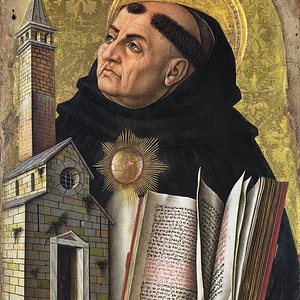

A Dominican theologian and philosopher of the 13th century, Thomas Aquinas is one of the greatest figures of medieval scholasticism. Author of the Summa Theologica, he sought to reconcile Aristotelian reason with Christian faith, and was declared a Doctor of the Church.
Frequently asked questions
Famous Quotes
« Reason is the way of faith, in a certain sense.»
« Being is the first thing that falls under the apprehension of the intellect.»
Key Facts
- 1225: Born in Aquino, in southern Italy
- 1244: Joins the Dominicans and begins his theological studies
- 1256: Becomes Master of Theology in Paris
- 1265–1274: Writes the Summa Theologica, his major work
- 1274: Dies at the Abbey of Fossanova on March 7
Works & Achievements
His major masterpiece, a systematic synthesis of Christian theology in three parts. This monumental work reconciles Aristotelian philosophy with Christian doctrine and remains foundational in Catholic theology.
An apologetic treatise aimed at defending the Christian faith against the objections of non-Christians. Thomas rationally demonstrates the existence of God and the fundamental truths of Christianity.
A major theological commentary on this foundational text of the Middle Ages. This early work established Thomas Aquinas as an orthodox and original thinker within the Scholastic tradition.
A collection of in-depth theological debates in which Thomas examines complex questions using the dialectical method. These texts reflect the university discussions of his era.
A masterful interpretation of Aristotelian moral philosophy adapted to a Christian perspective. Thomas brings together Greek virtue and theological grace.
A detailed commentary applying Aristotelian metaphysics to the Christian understanding of the human soul and its relationship to the body.
Five philosophical arguments for proving the existence of God, presented in the Summa Theologiae. These rational proofs became the foundation of Thomistic natural theology.
Anecdotes
Thomas Aquinas was so absorbed in his studies and reflections that he often forgot to eat. His fellow Dominicans regularly had to call him to the table for meals. This extreme focus on intellectual work became legendary at his convents in Naples and Paris.
During his studies at the University of Paris, Thomas Aquinas was so quiet and reserved that his classmates nicknamed him 'the dumb ox.' His teacher Albert the Great reportedly declared: 'This ox will bellow so loudly that his bellowing will fill the whole world' — a prophecy of the immense influence Aquinas would come to have.
Thomas Aquinas wrote the Summa Theologica, a monumental work of over 3,000 pages, in just a few years. He would dictate his thoughts to several secretaries simultaneously, working with remarkable productivity despite the challenging conditions of 13th-century life.
In 1274, while traveling to the Council of Lyon convened by the pope, Thomas Aquinas stopped at the monastery of Fossanova, where he died on March 7 at only 49 years old. His final words are said to have been about the Eucharist — the heart of his theological reflection.
Thomas Aquinas built his philosophical synthesis by drawing heavily on Aristotle, whose works had only recently been rediscovered in the West during the 13th century. This groundbreaking approach drew criticism from some Church circles, who viewed Aristotle as a pagan author incompatible with the Christian faith.
Primary Sources
Utrum Deus sit? Videtur quod Deus non sit... Sed contra est quod dicitur in Exodo nomine Domini: Ego sum qui sum. Respondeo dicendum quod Deus est.
Cum sit nostrum principale intentio veritatem quam fides profitetur, manifestare... oportet ut ostendamus quod ea quae fidei sunt contraria, falsa esse omnino.
Magister in sententiis dicit quod virtus est dispositio animae, per quam homo bene vivitur.
Omnis homo naturaliter desiderat scire... Et ideo Philosophus in principio Metaphysicae dicit quod omnes homines naturaliter scire desiderant.
Utrum virtus sit una vel plures? Et videtur quod sit una tantum, quia omnis virtus consistit in medio rationis.
Key Places
A hilltop fortress near Aquino in southern Italy, birthplace of Thomas Aquinas in 1225. This small feudal stronghold is the cradle of the future great Dominican theologian.
Founded in 1224, this institution is where Thomas Aquinas studied before joining the Dominican order. This southern Italian university shaped his earliest years of intellectual formation.
The leading medieval university where Thomas Aquinas taught theology from 1252. The Parisian Sorbonne was the central stage of his academic career and the crucible of his scholastic thought.
The great English university where Thomas Aquinas likely taught and spread his Aristotelian thinking. This major intellectual hub of the medieval world contributed to the dissemination of his theology.
The headquarters of the Dominican order, where Thomas Aquinas lived and worked. This Roman monastery was an important site of his commitment to the Order of Preachers.
A place of canonization and veneration of Thomas Aquinas following his death in 1274. Declared a saint in 1323, he was named a Doctor of the Church and became one of the most important figures in Christian theology.
Typical Objects

A large illuminated codex containing Thomas Aquinas's masterwork, written in medieval Latin. This monumental treatise synthesizes Christian theology and represents the pinnacle of 13th-century Scholasticism.

The distinctive religious garb of the Dominican Order, to which Thomas Aquinas belonged. This vestment — a white scapular worn over a black tunic — symbolizes his commitment to the order and is the hallmark of the Friars Preachers.

A work desk used for writing and studying in the scriptoriums of monasteries and universities. Thomas Aquinas composed his treatises and commentaries at such a desk, an essential tool of medieval intellectual life.

A quill cut from a reed and an inkwell holding the ink used for medieval calligraphy. These were the indispensable tools of the theologian for composing his philosophical and theological works.

A copy of the works of the Greek philosopher Aristotle, translated into Latin in the 13th century. Thomas Aquinas devoted years to studying and commenting on Aristotle in order to reconcile his rational thought with Christian faith.

The raised seat from which Thomas taught at the University of Paris and the University of Naples. This lectern represents his role as a recognized master and one of the foremost intellectual authorities of the Middle Ages.

A string of prayer beads used for meditation and prayer within the Dominican Order. A daily devotional object that speaks to the intense spiritual life of this theologian-monk.

A symbol of the doctrinal and canonical authority of Thomas Aquinas, recognized as a Doctor of the Church. It represents his legitimacy and influence within the religious institutions of the late Middle Ages.
School Curriculum
Vocabulary & Tags
Key Vocabulary
Daily Life
Morning
Thomas Aquinas begins his day before dawn with the morning religious offices in his Dominican convent's scriptorium. He then devotes time to prayer and solitary meditation in his monastic cell, before heading to his teaching duties and intellectual work.
Afternoon
The afternoon is dedicated to teaching theology at the University of Paris or other academic institutions where he lectures. He also takes part in theological debates (quodlibeta) and continues drafting or revising his major works, most notably the Summa Theologica.
Evening
Evenings are spent in the convent refectory with his fellow Dominican friars, sharing a frugal meal while listening to edifying readings. After dinner, Thomas returns to his cell for evening prayer and rests briefly before sleep, adhering to the strict schedule of communal religious life.
Food
In keeping with the Dominican rule, Thomas eats simply and relies mainly on plant-based foods: bread, legumes, soups, and cheese. Wine is consumed in moderation at communal meals, and meat is served only occasionally — for the sick or on major religious feast days.
Clothing
He wears the black-and-white habit of the Dominicans (Order of Preachers): a white tunic, black scapular, and hood. This plain, unadorned habit reflects the monastic commitment to voluntary poverty and the simplicity characteristic of the Order of Preachers.
Housing
Thomas lives in a Dominican convent, sharing a communal monastic space. His personal cell is very sparse: a simple straw or wooden bed, a writing desk for his manuscripts and notes, and a few devotional objects. The convent also has a library, a scriptorium, and teaching rooms.
Historical Timeline
Period Vocabulary
Visual Style
Un style inspiré de l'art religieux médiéval des XIIIe-XIVe siècles, combinant l'enluminure de manuscrits avec la peinture à l'huile flamande. L'ambiance est contemplative et savante, dominée par les teintes chaudes de la lumière aux chandelles dans un environnement gothique chargé de symboles théologiques.
Sound Ambience
Une atmosphère sonore médiévale immersive évoquant le scriptorium et la chapelle d'un monastère dominicain du XIIIe siècle, mêlant le calme studieux de la réflexion théologique aux sons sacrés du quotidien monacal.
Liens externes & ressources
Références
Œuvres
Somme théologique (Summa Theologiae)
1265-1274
Somme contre les Gentils (Summa Contra Gentiles)
1259-1265
Commentaire des Sentences de Pierre Lombard
1254-1256
Questions disputées (Quaestiones Disputatae)
1256-1272
Commentaires sur l'Éthique à Nicomaque d'Aristote
1267-1272
Traité sur l'Ame (Commentaire du traité De l'Âme d'Aristote)
1267-1268
Les Cinq Voies (Quinque Viae)
1265-1274