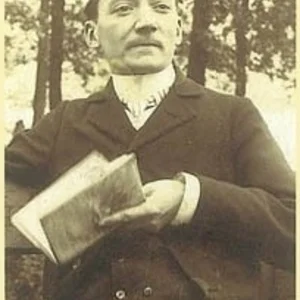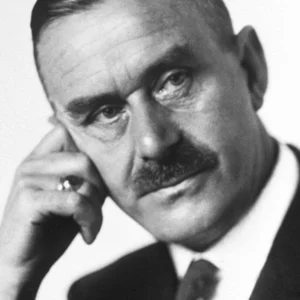

Thomas Mann (1875-1955) was a German novelist and essayist, a major figure of twentieth-century European literature. Winner of the Nobel Prize in Literature in 1929, he was forced into exile after the Nazis came to power and became a great voice of humanism in the face of totalitarianism.
Thomas Mann(1875 — 1955)
Thomas Mann
États-Unis, Tchécoslovaquie, Reich allemand
6 min read
Frequently asked questions
Famous Quotes
« A writer is somebody for whom writing is more difficult than it is for other people.»
Key Facts
- 1875: born in Lübeck into a family of the wealthy merchant bourgeoisie
- 1901: publication of Buddenbrooks, a saga depicting the decline of a bourgeois family
- 1924: publication of The Magic Mountain, a novel emblematic of the crisis of European civilization
- 1929: Nobel Prize in Literature
- 1933: departure into exile in the face of the Nazi regime, first in Switzerland and then in the United States; died in 1955 in Zurich
Works & Achievements
A sweeping family novel tracing the decline of a dynasty of Lübeck merchants; it made Mann's name and was praised by the Nobel committee.
A novella about an aging writer mesmerized by beauty and swept into decadence, one of his most famous texts.
A world-encompassing novel set in an Alpine sanatorium, a vast fresco of European ideas on the eve of 1914.
A long, conservative and nationalist wartime essay, from which Mann would later distance himself as he rallied to democracy.
A four-part novel cycle inspired by the Bible, a vast meditation written partly during his exile.
A novel featuring Goethe, written in exile and read as a defense of true German culture.
The story of a composer who makes a pact with the devil, an allegory of the tragic fate of Nazi Germany.
An unfinished, deeply ironic picaresque novel about a charming swindler, the last great work published in his lifetime.
Anecdotes
Thomas Mann published his first major novel
Buddenbrooks
in 1901 when he was only 26 years old. This tale of the decline of a wealthy merchant family from Lübeck draws heavily on his own family
which irritated some of his relatives who recognized themselves in the characters.
In 1929, Thomas Mann received the Nobel Prize in Literature. Surprisingly, the Swedish committee officially honored him above all for "Buddenbrooks
written nearly thirty years earlier
rather than for his more recent masterpiece
The Magic Mountain".
From 1940 onward, while in exile, Mann recorded monthly messages for the British BBC radio titled "Deutsche Hörer!
(
German listeners!
) intended for his people. At great risk to those who listened in secret
he used them to denounce the Nazi regime and call on Germans to resist.
His entire family was a true dynasty of writers: his elder brother Heinrich Mann was also a famous novelist (author of "Professor Unrat
adapted for film under the title
The Blue Angel
)
and several of his six children
including Klaus and Erika Mann
became writers and figures of the anti-fascist movement.
In 1936, the Nazi regime stripped Thomas Mann of his German citizenship. The University of Bonn also revoked his honorary doctorate; he responded with a famous open letter, asserting that the true German tradition he defended had nothing to do with Hitler's barbarism.
Primary Sources
“What does this mean. — What does this mean...” It is with this child's question that the chronicle of the decline of a family of the Hanseatic upper bourgeoisie begins.
During the First World War, Mann defends German “culture,” which he sets against Western “civilization” — a conservative stance he would later disavow.
In this speech, Mann surprises his audience by publicly rallying to the young Weimar Republic and calls on German youth to support democracy.
“German Listeners!”: a series of radio addresses broadcast by the BBC to Germany, denouncing the crimes of Nazism and urging Germans not to make themselves complicit.
In it, Mann reflects on the honor bestowed upon German literature and the writer's moral responsibility in a troubled Europe.
Key Places
Hanseatic city in northern Germany where Mann was born in 1875; it directly inspired the setting of *Buddenbrooks*.
City in Bavaria where Mann lived much of his adult life, wrote his first major works and started his family.
Spa town in the Swiss Alps whose sanatorium, where his wife Katia stayed, served as the setting for *The Magic Mountain*.
Neighborhood in California where Mann had his house of exile built and wrote, among other works, *Doctor Faustus*.
Region by Lake Zurich, in Switzerland, where Mann settled at the end of his life and where he died in 1955.
Italian city that provided the melancholy setting for his famous novella *Death in Venice*.
Typical Objects

The central tool of a 20th-century writer's daily work, on which Mann produced clean copies of his long novels after regular mornings of writing.

The gold medal awarded with the Nobel Prize in Literature given to Mann in 1929, a symbol of international recognition.

The microphone before which Mann recorded his “Deutsche Hörer!” addresses for the BBC, turning his voice into an instrument of resistance against Nazism.

The handwriting instrument with which Mann drafted his manuscripts, his letters, and his voluminous private diary.

Mann was a great lover of cigars and cigarettes; tobacco set the rhythm of his working days and even appears as a motif in “The Magic Mountain”.

A travel document that became vital after he was stripped of his nationality; Mann obtained Czechoslovak and then American citizenship in order to travel.
School Curriculum
Vocabulary & Tags
Key Vocabulary
Tags
Daily Life
Morning
Mann observed an almost sacred work discipline: every morning, after breakfast, he would shut himself in his study to write, undisturbed. This morning slot, devoted to creation, allowed him to make steady progress, page after page, on his long novels.
Afternoon
The afternoon was reserved for reading, his abundant correspondence, proofreading, and long walks, often in the company of his dog. It was also the time when he received visitors or prepared his lectures.
Evening
Evenings were spent with the family, gathered around reading aloud, music, and conversation. Mann also kept a very regular diary, in which he recorded his thoughts, his reading, and the events of the day.
Food
Coming from the upper middle class, Mann enjoyed refined German bourgeois cooking and a well-set table. A great lover of tobacco, he smoked cigars and cigarettes throughout the day, a habit inseparable from his work.
Clothing
Mann took care over his appearance and embodied the bourgeois elegance of his time: dark three-piece suits, stiff-collared shirts, a tie, and sometimes a bow tie. This strict attire reflected his sense of dignity and respectability.
Housing
Mann lived in comfortable bourgeois houses, notably a large villa in Munich, then in his places of exile in France, the United States (Princeton, then Pacific Palisades), and finally near Zurich. His interiors were tastefully furnished, equipped with vast libraries and a central study.
Historical Timeline
Period Vocabulary
Liens externes & ressources
Références
Œuvres
Les Buddenbrook (Buddenbrooks)
1901
La Mort à Venise (Der Tod in Venedig)
1912
La Montagne magique (Der Zauberberg)
1924
Considérations d'un apolitique
1918
Joseph et ses frères (Joseph und seine Brüder)
1933-1943
Lotte à Weimar (Lotte in Weimar)
1939
Docteur Faustus (Doktor Faustus)
1947