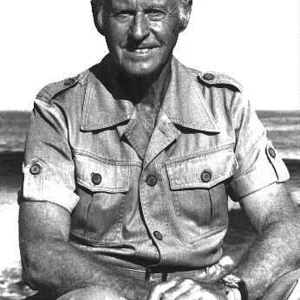

Norwegian anthropologist and navigator, Thor Heyerdahl crossed the Pacific in 1947 on the raft Kon-Tiki to demonstrate that prehistoric migrations from South America to Polynesia were possible. His expeditions combined adventure with archaeological research.
Thor Heyerdahl(1914 — 2002)
Thor Heyerdahl
Norvège
9 min read
Frequently asked questions
Famous Quotes
« Borders? I have never seen one. But I have heard they exist in the minds of some people.»
Key Facts
- 1947: crossed the Pacific on the raft Kon-Tiki (8,000 km in 101 days)
- 1950: publication of the book Kon-Tiki, translated into 70 languages
- 1969–1970: Ra I and Ra II expeditions on papyrus boats to cross the Atlantic
- 1977–1978: Tigris expedition on a reed boat across the Indian Ocean
- Archaeological excavations on Easter Island (1955–1956)
Works & Achievements
Account of the 1947 expedition, translated into more than 70 languages and sold in millions of copies worldwide. The book made Heyerdahl famous and sparked a global debate about the pre-Columbian peopling of the Pacific.
A documentary made from footage filmed directly during the expedition, awarded the Academy Award for Best Documentary Feature in 1952. It helped bring Heyerdahl's theories to a wide international audience.
Account of the archaeological expedition to Easter Island, blending scientific rigor with adventurous storytelling. Heyerdahl describes how the moaï could have been erected and records the oral traditions shared by the island's inhabitants.
Account of the Ra I and Ra II expeditions, exploring the possibility of transatlantic contact between ancient Egypt and pre-Columbian American civilizations through navigation on papyrus boats.
Account of the voyage from Mesopotamia aboard a reed boat; Heyerdahl documents ancient trade routes and voices his protest against the contemporary armed conflicts in the region.
The result of archaeological research in the Maldive Islands, where Heyerdahl uncovered remains of pre-Islamic civilizations showing stylistic similarities to cultures in Southeast Asia and the Americas.
Anecdotes
In 1947, Thor Heyerdahl built a balsa wood raft he named Kon-Tiki, after an Inca sun deity. Accompanied by five companions, he left the port of Callao in Peru and drifted for 101 days on the Humboldt Current before reaching Raroia Atoll in French Polynesia, covering nearly 6,900 kilometers. His goal was to prove that ancient Peruvians could have populated the Pacific long before the arrival of Europeans.
Before attempting the Pacific crossing, Heyerdahl had lived with his wife Liv in the Marquesas Islands as early as 1937, studying Polynesian populations firsthand. It was there that he noticed striking similarities between Polynesian and South American cultures — in their statues, cultivated plants such as the sweet potato, and local legends. This formative experience convinced him that prehistoric migrations had taken place long before Christopher Columbus.
In 1969, Heyerdahl built the Ra, a papyrus boat inspired by ancient Egyptian frescoes, in an attempt to cross the Atlantic from Morocco. The Ra I took on water and had to be abandoned a few hundred kilometers from the Caribbean. Far from being discouraged, he built the Ra II the following year with Bolivian craftsmen from Lake Titicaca, and crossed the Atlantic in 57 days, reaching Barbados — proving that ancient sailors could have connected the two continents by sea.
The documentary film about the Kon-Tiki expedition, made from footage shot on board the raft itself, won the Academy Award for Best Documentary Feature in 1952. Heyerdahl's book recounting the adventure became a worldwide bestseller, translated into more than 70 languages. The work's popularity generated as much admiration among the general public as it did controversy in academic circles, where many linguists and archaeologists challenged his theory of Pacific settlement.
During the Tigris expedition in 1977, Heyerdahl built a reed boat to travel from Mesopotamia (Iraq) to the Red Sea, demonstrating the navigational possibilities of ancient trade routes between these great civilizations. Outraged by the armed conflicts that prevented him from landing on the shores of the Horn of Africa, he chose to deliberately burn his vessel on April 3, 1978, as a protest against war, sending an open letter to the Secretary-General of the United Nations.
Primary Sources
We were six men on a raft of balsa wood, drifting across the greatest ocean in the world. The stars above us and the currents below us were the same ones that had guided prehistoric navigators from the coasts of Peru.
The statues of Easter Island did not rise from the earth by magic. They were carved, transported, and erected by men whose descendants we found, and these men entrusted us with some of their ancestral secrets.
Egyptian sailors could have crossed the Atlantic on papyrus boats long before Christopher Columbus. Our expedition aimed to prove this was technically possible, not to assert with certainty that it had actually happened.
We are burning the Tigris in protest against the wars raging on the shores of the Arabian Peninsula and in the Horn of Africa. We do so in peace, in the hope that the world's leaders will come to their senses before it is too late.
An analysis of cultivated plants common to both regions, notably Ipomoea batatas (the sweet potato), whose Polynesian name kumara corresponds to the Quechua term kumar used in South America, suggests pre-Columbian contact between these two cultural areas.
Key Places
Thor Heyerdahl's birthplace, where he was born in 1914. Larvik is home to a memorial dedicated to the explorer, and the Kon-Tiki Museum in Oslo continues to preserve his scientific legacy.
The port from which Heyerdahl and his five companions set sail on April 28, 1947, aboard the raft Kon-Tiki, embarking on their legendary crossing of the Pacific Ocean.
The landing point of the Kon-Tiki expedition on August 7, 1947, after 101 days drifting from Peru across the Pacific Ocean, confirming the feasibility of the prehistoric crossing Heyerdahl had envisioned.
Heyerdahl led archaeological excavations here in 1955–1956, studying the famous moai statues and searching for evidence of a South American origin for the island's earliest inhabitants.
The departure port for the Ra II expedition in 1970; Heyerdahl and his international crew set off aboard the papyrus boat on their successful crossing of the Atlantic to the Caribbean.
A village in Liguria where Heyerdahl established his main European residence from the 1950s onward, and where he passed away peacefully on April 18, 2002.
Typical Objects

Built using the ancestral techniques of the Tiwanaku Indians of Peru, the raft measured 13.7 meters and was assembled without nails or screws. It is now on display at the Kon-Tiki Museum in Oslo, Norway.

Built by Bolivian craftsmen from Lake Titicaca using methods depicted in ancient Egyptian frescoes, the Ra II allowed Heyerdahl to demonstrate the feasibility of crossing the Atlantic using ancient natural materials.

Heyerdahl carried modern navigation instruments but also observed the stars, currents, and winds, just as the ancient navigators he sought to imitate and understand had done.

Heyerdahl systematically documented every expedition through photographs and films. The footage shot aboard the Kon-Tiki was used to produce the Oscar-winning documentary.

Heyerdahl recorded the scientific, meteorological, and human observations from his expeditions every day. These notebooks formed the basis of his bestselling books and articles published in scientific journals.

The sole link with civilization during weeks at sea, the radio allowed Heyerdahl to send daily reports to the world's press and receive weather bulletins essential for navigation.

During his land expeditions to Easter Island, the Maldives, and the Canary Islands, Heyerdahl used the classic tools of the archaeologist — brushes, trowels, measuring tapes — to carefully excavate remains and collect samples.
School Curriculum
Vocabulary & Tags
Key Vocabulary
Daily Life
Morning
During his sea voyages, Heyerdahl rose at first light to check wind direction and current conditions. He logged coordinates in the ship's journal, measured drift speed, and assigned watch shifts among the crew.
Afternoon
In the afternoons, aboard the raft or the papyrus boat, the team fished to supplement their supplies, carried out repairs to the vessel's structure, and observed the surrounding marine life. Heyerdahl wrote up his scientific notes and filmed notable natural phenomena and events of the day.
Evening
In the evenings, the crew gathered for a shared meal and lively discussions about anthropological theories, Polynesian myths, or tales of exploration. Heyerdahl transmitted a radio report to the newspapers and institutions following the expedition, then studied the night sky for celestial navigation.
Food
At sea, the team lived on fresh fish caught daily (tuna, bonito), dried provisions loaded at departure, and plankton scooped up in nets dragged behind the raft. Heyerdahl noted in his journal that plankton, rich in protein, could prove a valuable food resource for the future of humanity.
Clothing
On board, Heyerdahl wore light clothing suited to the tropical heat: shorts, a short-sleeved shirt, and a wide-brimmed hat to shield against the intense sun. On his land-based archaeological expeditions, he adopted the standard explorer-researcher outfit of the era: sturdy canvas trousers, a long-sleeved shirt, and walking boots.
Housing
During sea crossings, Heyerdahl and his companions slept in a small cabin of bamboo and banana leaves built on the raft and sheltered by waterproof canvas. On land — whether in Polynesia, Easter Island, or the Maldives — he often stayed with local inhabitants or lived under canvas, seeking to immerse himself in the way of life of the communities he was studying.
Historical Timeline
Period Vocabulary
Liens externes & ressources
Références
Œuvres
Kon-Tiki : à travers le Pacifique sur un radeau
1948
Aku-Aku : le secret de l'île de Pâques
1957
L'Expédition Ra
1970
L'Expédition Tigris
1979
Les Maldives : un mystère
1986