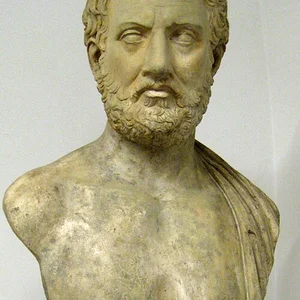

An Athenian historian and general of the 5th century BC, Thucydides is the author of the History of the Peloponnesian War, an account of the conflict between Athens and Sparta. Regarded as the founder of scientific historiography, he sought to establish facts with rigor and impartiality.
Thucydides(460 av. J.-C. — 394 av. J.-C.)
Thucydides
Athènes
8 min read
Frequently asked questions
Famous Quotes
« The Peloponnesian War was the greatest upheaval that had ever shaken the Greeks.»
« The strong do what they can, and the weak suffer what they must.»
Key Facts
- Born around 460 BC in Athens, died around 394 BC
- Elected general in 424 BC, he was exiled after the fall of Amphipolis to Brasidas
- During his exile, he wrote the History of the Peloponnesian War, an unfinished account covering 431–411 BC
- Firsthand witness to the Plague of Athens (430 BC) and the epidemic that decimated the population
- Introduced critical method into history: verification of sources, rejection of the supernatural
Works & Achievements
Thucydides' singular masterwork, in eight books, chronicling the war between Athens and Sparta from 431 to 411 BC. Left unfinished, it laid the foundations of Western historiography through its factual rigor and analysis of the political causes of conflict.
A reconstruction of Pericles' speech honoring the Athenian soldiers who fell in 431 BC. Regarded as the founding text of the Athenian democratic ideal, it remains one of the most quoted passages from Antiquity.
A passage of exceptional clinical precision describing the epidemic of 430 BC. Thucydides, himself a survivor of the disease, provides a symptomatic account that continues to be studied by modern epidemiologists.
A reconstruction of the dialogue between Athenian envoys and the inhabitants of the island of Melos in 416 BC. This passage illustrates the ruthless logic of political power: 'the strong do what they can, and the weak suffer what they must.'
A reconstruction of the opposing speeches by Cleon and Diodotus on the punishment to be imposed on the rebellious Mytilenians. This debate exemplifies the Thucydidean method: setting antithetical speeches against each other to reveal the underlying logic of political decisions.
Anecdotes
Thucydides was himself an Athenian general during the Peloponnesian War. In 424 BC, he failed to defend the city of Amphipolis against the Spartan general Brasidas, arriving too late with his fleet. Sentenced to exile for this failure, he spent twenty years away from Athens — which, paradoxically, allowed him to observe both sides of the conflict.
Unlike his predecessor Herodotus, Thucydides refused to include myths or accounts of miracles in his work. He claimed to want to write a history useful for the future, convinced that human conflicts repeat themselves according to unchanging patterns. This rigorous approach has earned him recognition as the father of scientific historiography.
Thucydides contracted the great Plague of Athens in 430 BC and survived. He left behind a remarkably precise medical description of the disease, recording symptoms day by day — a document that remains a valuable source for historians and modern physicians attempting to identify the illness.
His work, the History of the Peloponnesian War, breaks off abruptly in 411 BC, mid-sentence, with no explanation. It is assumed that Thucydides died before he could finish it. The subsequent events were recorded by Xenophon in his Hellenica, as a kind of unsolicited continuation.
In his account of the Mytilenean Debate (427 BC), Thucydides presents two opposing speeches on the fate to be dealt to a rebellious population. This mirror-image rhetorical structure illustrates his method: he reconstructs speeches to draw out their political logic, openly warning the reader that he does not reproduce them word for word, but according to the spirit they were intended to convey.
Primary Sources
Thucydides, an Athenian, wrote the history of the war between the Peloponnesians and the Athenians, beginning at the moment that it broke out, and believing that it would be a great war and more worthy of relation than any that had preceded it.
The doctors were unable to treat the disease at first, since they did not know what it was and treated it without knowledge; they died themselves in the greatest numbers, having the most contact with the sick. No human art could avail.
Our constitution does not copy the laws of neighbouring states; we are rather a pattern to others than imitators ourselves. Its administration favours the many instead of the few; this is why it is called a democracy.
The strong do what they can and the weak suffer what they must.
As to the facts of the occurrences of the war, I have not allowed myself to rely on information from the first source that came to hand, nor on my own impressions; I have recorded only events at which I was present or which I investigated from other eyewitnesses, checking them with as much accuracy as possible.
Key Places
Thucydides' birthplace and the heart of his historical narrative. He lived there, served as a general, contracted the plague, and returned at the end of his life after his exile.
A strategically vital city in Thrace that Thucydides failed to defend against Brasidas in 424 BC. This failure led to his condemnation and a twenty-year exile.
An island off the Thracian coast where Thucydides owned gold mines, an inheritance from his mother's family. These resources gave him considerable political influence in the region.
Athens' great rival and the dominant land power of the Peloponnesian League. Thucydides' exile allowed him to move in circles close to Sparta, deepening his analysis of the conflict.
The site of the disastrous Athenian expedition of 415–413 BC. Thucydides devotes two entire books to this episode, which he regards as the fatal turning point of the war.
Typical Objects

The primary writing tool of Greek scholars, the wax tablet allowed observations to be jotted down quickly before being transcribed onto papyrus. Thucydides certainly used these tablets to record the events of the war as they unfolded.

The medium on which Thucydides' work was written and copied. The eight books of the History of the Peloponnesian War filled several scrolls, preserved and recopied by Greek and later Hellenistic scribes.

As a strategos, Thucydides commanded triremes — warships powered by three banks of oarsmen that formed the backbone of Athenian naval power. He describes naval maneuvers with great precision throughout his work.

A metal or bone instrument used to inscribe characters onto the wax tablet. The stylus was the everyday tool of the Athenian historian and intellectual.

The standard equipment of the Greek citizen-soldier: helmet, breastplate, round shield (aspis), and spear. As a member of the aristocracy, Thucydides would have worn such armor during his military campaigns.

Used to estimate distances, troop numbers, and timelines, these tools supported Thucydides in his rigorous approach to verifying numerical facts.
School Curriculum
Vocabulary & Tags
Key Vocabulary
Daily Life
Morning
Thucydides rose at dawn, beginning his day with ritual ablutions and a prayer to the gods. He would then make his way to the Agora to gather information from merchants, travelers, and soldiers returning from campaign, building up his network of oral sources.
Afternoon
The afternoon was devoted to writing and reflection in the quiet of his home. During his exile, Thucydides interviewed witnesses from both sides — Athenians and Peloponnesians alike — carefully recording facts on his wax tablets before transcribing them onto papyrus.
Evening
In the evenings, Thucydides likely attended symposia, the intellectual dinner gatherings where citizens debated politics, philosophy, and military strategy. These exchanges fed his thinking about the mechanics of power and the deeper causes of war.
Food
As an Athenian aristocrat, Thucydides' diet consisted of barley or wheat bread, olives, goat's cheese, figs, legumes, and dried fish. Meat was reserved for religious occasions and sacrificial feasts. Wine diluted with water was the everyday drink.
Clothing
Thucydides wore the chiton, a white linen tunic, with an himation — a large draped woolen cloak — worn over it. When on military duty, he donned a bronze breastplate, a Corinthian helmet, and greaves (leg armor). As an aristocrat, his clothing was of fine quality.
Housing
Thucydides likely lived in a stone and mud-brick house in Athens, built around a central peristyle courtyard with a well. The main rooms opened onto this inner courtyard. In Thrace, he owned a property connected to his gold mines — larger and more secluded.
Historical Timeline
Period Vocabulary
Visual Style
Esthétique de la Grèce classique du Ve siècle av. J.-C. : architecture en marbre blanc, céramique à figures rouges, lumière méditerranéenne dorée et bleu profond de la mer Égée.
Sound Ambience
L'ambiance sonore d'Athènes au Ve siècle av. J.-C. : le brouhaha de l'Agora, les discours de l'Assemblée, le bruit des chantiers de construction et le rythme des rameurs sur les trières en mer Égée.
Liens externes & ressources
Références
Œuvres
La Guerre du Péloponnèse (Historia tou Peloponnesiakou Polemou)
vers 431–400 av. J.-C.
Le Discours funèbre de Périclès (Livre II)
430 av. J.-C. (discours) / vers 400 av. J.-C. (rédaction)
Description de la peste d'Athènes (Livre II, 47-55)
vers 400 av. J.-C.
Le Dialogue des Méliens (Livre V, 84-116)
vers 400 av. J.-C.
Le Débat de Mytilène (Livre III, 36-50)
vers 400 av. J.-C.