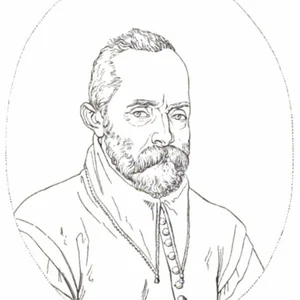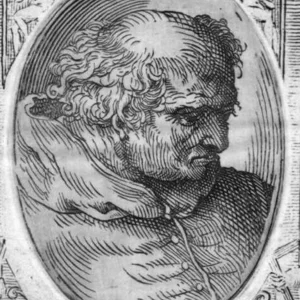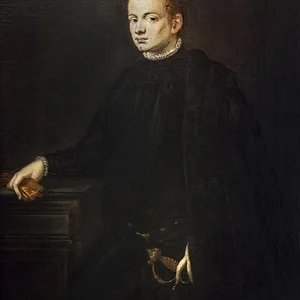

A 16th-century Venetian painter and a major figure of late Mannerism. Nicknamed *il Tintoretto* (the little dyer) after his father's trade, he left his mark on Venetian painting through his dramatic compositions, bold foreshortening, and striking lighting effects.
Tintoretto
Jacopo Robusti, known as Tintoretto
6 min read
Frequently asked questions
Famous Quotes
« The beautiful coloring of Titian and the drawing of Michelangelo»
Key Facts
- Born around 1518 in Venice and died in 1594 in the same city
- Created a vast cycle of paintings for the Scuola Grande di San Rocco (1564–1588)
- Painted “The Miracle of the Slave” (1548), the work that established his reputation
- Executed “Paradise” (around 1588) for the Doge's Palace, one of the largest canvases in the world
- Nicknamed “Il Furioso” for the speed and energy of his execution
Works & Achievements
The first major commission to reveal his genius: a saint plunging in dizzying foreshortening from the sky to save a slave. It established Tintoretto in Venice.
A biblical scene with a luminous nude and a boldly diagonal composition. A masterpiece of Venetian art held in Vienna.
A monumental ensemble of more than sixty canvases covering walls and ceilings. The great work of his career, blending scenes from the Old and New Testaments.
An immense panoramic canvas teeming with figures around Christ on the cross. The dramatic peak of his religious painting.
A theatrical night scene where a vanishing perspective and a flash of lightning create gripping tension. Emblematic of his sense of staging.
His final great Last Supper, seen at an angle, bathed in supernatural light and peopled with angels. A work from the end of his life.
One of the largest paintings on canvas in the world, in the Hall of the Great Council of the Doge's Palace. Hundreds of figures rise toward the heavens.
Anecdotes
According to legend, the young Jacopo was briefly placed in the workshop of the great Titian, but the master — perhaps jealous of his precocious talent — supposedly sent him away after only a few days. True or not, this story fed a lifelong rivalry with the Venetian master.
Tintoretto had written his motto on the wall of his studio: “The drawing of Michelangelo and the colour of Titian.” In this way he sought to unite the powerful forms of the Florentine school with the brilliant colours of the Venetians.
To prepare his complex compositions, he made small models of wax and clay that he arranged in boxes lit by candles. This allowed him to study the shadows, the foreshortenings and the spectacular viewing angles of his paintings.
In 1564, to win the competition to decorate the Scuola Grande di San Rocco, he did not submit a simple sketch like his rivals: he had already secretly painted and installed the central panel on the ceiling. Caught off guard, the members had to accept his gift and entrusted the project to him.
His speed of execution was so famous that he was nicknamed “Il Furioso” (the furious one). His detractors accused him of painting too fast, but this energy gives his works their dramatic tension.
Primary Sources
He painted in a manner entirely his own, with a swiftness of judgment and a boldness never seen before, and at times leaving as finished sketches that were still rough.
On the wall of his workshop he had written these words as a rule: “The drawing of Michelangelo and the colouring of Titian.”
Jacopo Tintoretto undertakes to provide, every year for the rest of his life, three paintings for the decoration of the Scuola in exchange for an annual pension.
Key Places
Tintoretto's native city and the stage for his entire career. A merchant and artistic capital, it offered him his greatest commissions.
A confraternity for which he produced a monumental cycle of more than sixty paintings over more than twenty years. A true life's work, nicknamed Tintoretto's “Sistine Chapel.”
Seat of the Venetian government, which he decorated after the fire of 1577. There he painted the immense Paradise in the Hall of the Great Council.
The church in his neighborhood where he was baptized, worked, and was buried. It holds several of his great canvases.
A confraternity for which he painted The Miracle of the Slave in 1548, the work that established his reputation.
Typical Objects

Tools made of bristles mounted on a handle, used to apply oil paint. Tintoretto varied their sizes for his quick, energetic brushstrokes.

Small modeled figurines arranged in boxes lit by candles. They were used to study the light and the foreshortening of compositions.

A textile support stretched over a frame and coated with primer, which became common in Venice because of the dampness that damaged frescoes. Tintoretto used it to unfold his immense scenes.

Colored powders (azurite, lapis lazuli, earth pigments) ground with oil on a stone slab to make paint. The richness of its colors made Venice's reputation.

A large drawing on paper used as a model before transferring it onto the canvas. Tintoretto used it to refine his figures and their daring poses.

Light sources used in the studio to work late and to study the contrasts of shadow and light. Chiaroscuro lies at the heart of his art.
School Curriculum
Vocabulary & Tags
Key Vocabulary
Daily Life
Morning
Tintoretto rose early and headed to his workshop at the Madonna dell'Orto, where his assistants and apprentices awaited him. He often began by studying his small wax models to fix the lighting of the day's compositions.
Afternoon
The afternoon was devoted to painting itself, which he carried out with legendary speed. He moved from one large canvas to another, directing his helpers and sometimes negotiating with the confraternities who commissioned him.
Evening
In the evening, by candlelight, he studied the contrasts of shadow and light that give his works their power. Known as a sober, stay-at-home man, he liked to spend time with his family and, it is said, play a little music.
Food
Venetian fare was based on fish and seafood from the lagoon, bread, millet polenta, vegetables, and wine. Spices imported from the East, such as pepper and cinnamon, recalled the city's merchant wealth.
Clothing
Famed for his simplicity, Tintoretto wore the plain clothes of a city dweller: tunic, dark doublet, and cloak. Far from the splendor of some artists, he preferred the modest appearance of a tireless worker.
Housing
He lived in the Cannaregio district, near the church of the Madonna dell'Orto, in a Venetian house overlooking a canal. The dwelling housed both his large family and his workshop, which buzzed with activity.
Historical Timeline
Period Vocabulary
Liens externes & ressources
Références
Œuvres
Le Miracle de l'esclave (ou de saint Marc)
1548
Suzanne et les vieillards
vers 1555
Cycle de la Scuola Grande di San Rocco
1564-1587
L'Enlèvement du corps de saint Marc
vers 1562-1566
La Cène (San Giorgio Maggiore)
1592-1594