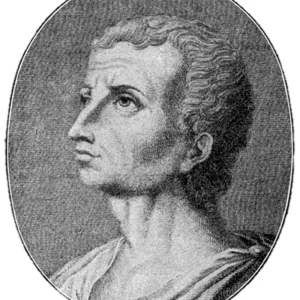

Livy was a Latin historian born in Patavium (Padua) around 58 BC. He is the author of a monumental History of Rome in 142 books, of which 35 have survived. His work traces the history of Rome from its legendary founding to his own time.
Livy(58 av. J.-C. — 17)
Livy (Titus Livius)
Rome antique
7 min read
Frequently asked questions
Famous Quotes
« Vae victis! (Woe to the vanquished!)»
« There is no true peace: it is only peace postponed.»
Key Facts
- Born around 58 BC in Patavium (modern-day Padua, in northern Italy)
- Wrote the Ab Urbe Condita ('From the Founding of the City'), a historical work in 142 books
- A contemporary of Augustus, whose circle he frequented without being a mere courtier
- His work covers more than 700 years of history, from the legendary founding of Rome (753 BC) to the death of Drusus (9 BC)
- Died around AD 17 in Patavium
Works & Achievements
A monumental work in 142 books tracing the history of Rome from its legendary founding (753 BC) to the age of Augustus. Only 35 books have survived intact, making this one of the most significant losses in Latin literature.
The earliest surviving books, covering the founding of Rome, the monarchy, and the early Republic. They contain the great founding myths such as Romulus and Remus, and the sacrifice of Mucius Scaevola.
An account of the war against Hannibal (219–201 BC), widely regarded as the literary high point of the work. Hannibal's crossing of the Alps and the Battle of Cannae are described with remarkable dramatic power.
The last surviving books, dealing with Roman expansion into Greece and the East (200–167 BC). They bear witness to the encounter between Roman civilization and Hellenistic culture.
Late summaries of the lost books, written by anonymous scribes. Without these Periochae, almost nothing would be known about the contents of the 107 lost books of Ab Urbe Condita.
Anecdotes
Livy never left Italy to conduct on-the-ground research, unlike his predecessor Polybius. He wrote his monumental history relying solely on written sources preserved in Rome, which has earned him criticism for certain geographical inaccuracies — particularly in his accounts of Hannibal's campaigns.
Emperor Augustus himself so admired Livy's work that he reportedly forgave the historian his openly republican sympathies, affectionately nicknaming him 'the Pompeian.' This nickname reflects Livy's nostalgia for the Roman Republic, even as he lived at the court of the first princeps.
Of the 142 books of his Roman History (Ab Urbe Condita), only 35 have survived complete. The rest are known only through late summaries called 'Periochae.' It is one of the greatest losses in Latin literature: roughly 75% of the work has been lost over the centuries.
Livy began writing his history around 27 BC, at the very moment Augustus was establishing the Principate. He worked on it until his death — for more than forty years. He is one of the rare ancient authors of whom we know with certainty that he returned to die in his hometown of Patavium.
Primary Sources
"I do not know whether the subject is worth the effort I am devoting to it... But if anything has drawn me to it, it is this: I shall escape from the sight of the evils our age has witnessed for so long."
"Hannibal, barely nine years old, was begging his father Hamilcar, who was preparing to depart for Spain, to take him along... Hamilcar, moved by the boy's plea, made him swear at the altar that he would be Rome's eternal enemy."
"Romulus, having taken the auspices, founded the city and gave it his name."
"Livy possesses a wonderful charm and transparency of narrative, and his speeches are so admirably suited to their characters and situations that one might think one was dealing not with a historian but with true orators."
Key Places
Livy's birthplace, a prosperous city in Cisalpine Gaul known for its strict morality and strong traditions. Livy was born there around 58 BC and died there in AD 17.
Capital of the Empire and intellectual center where Livy spent most of his adult life. He moved in the circle of Augustus and consulted the city's archives and libraries while writing his history.
One of Rome's great public libraries, founded by Augustus, where Livy was able to consult numerous sources for his Ab Urbe Condita. Public libraries were an essential resource for Latin historians.
The political and symbolic heart of Rome, described at length by Livy in his history. It was here that Senate debates unfolded and the great decisions that shaped the Roman Republic were made.
Typical Objects

The main writing medium of Roman antiquity. Livy drafted and consulted his sources in this form; a single book of his history could span one or more scrolls.

The calamus, a reed cut to a point, was the writing instrument of Roman scholars. Livy used it to set down his narratives on papyrus, with an ink made from soot and gum.

Used for drafts and preparatory notes. Livy likely jotted down his notes on these tablets before transcribing them neatly onto papyrus.

Official records kept by the pontifex maximus, one of Livy's primary sources for the early periods of Roman history. Consulting them was essential for tracing ancient events.

In great Roman families, the imagines — wax masks of ancestors — kept the memory of distinguished men alive. Livy's history is dedicated precisely to celebrating these heroic figures from Rome's past.

Artificial lighting allowed scholars to work in the early morning or late at night. Livy, who spent decades writing his great work, must have relied on one every day.
School Curriculum
Vocabulary & Tags
Key Vocabulary
Daily Life
Morning
Livy rose early, at sunrise, like any Roman who respected tradition. After a brief wash, he had a light meal (ientaculum) of bread, cheese, and olives. He would then head to the library or work in his tablinum (study) writing his books.
Afternoon
The afternoon was devoted to consulting sources in public archives or the libraries on the Palatine Hill. Livy likely also received students and young scholars: it is known that he guided the future emperor Claudius in his historical research. The main meal (cena) was taken in the late afternoon.
Evening
The evening allowed for literary and philosophical conversation with friends or members of Augustus's circle. Livy, known for his republican sympathies, had to choose his words carefully at the imperial court. He likely spent the evening rereading and correcting his work by the light of oil lamps.
Food
The diet of Rome's upper classes consisted of vegetables, legumes, bread, cheese, fish, eggs, and various meats. Wine, diluted with water, was the everyday drink. Meals were often eaten reclining on dining couches (triclinium) at formal dinner gatherings.
Clothing
Livy wore the white toga (toga virilis), as did every freeborn Roman citizen of good standing. For work, he likely wore a more practical tunic. Leather Roman shoes (calcei) completed his attire in public.
Housing
In Rome, Livy probably lived in a domus (a private townhouse) with an atrium and a colonnaded garden (peristyle), reflecting his comfortable social standing. A well-to-do Roman home included a tablinum serving as both study and reception room, lit by oil lamps and decorated with frescoes.
Historical Timeline
Period Vocabulary
Visual Style
Style inspiré des fresques et reliefs de l'époque augustéenne : tons chauds en ocre et marbre blanc, architecture classique romaine, atmosphère studieuse et solennelle.
Sound Ambience
L'atmosphère sonore de l'historien romain : le calme studieux d'une bibliothèque du Palatin, ponctué par le bruit de la ville éternelle qui s'éveille au loin.
Liens externes & ressources
Références
Œuvres
Ab Urbe Condita (Histoire romaine)
vers 27 av. J.-C. — 17 ap. J.-C.
Livres I-X (Des origines à 293 av. J.-C.)
vers 27-20 av. J.-C.
Livres XXI-XXX (Deuxième guerre punique)
vers 20-15 av. J.-C.
Livres XXXI-XLV (Guerres macédoniennes)
vers 15-5 av. J.-C.
Periochae (résumés des livres perdus)
IVe siècle ap. J.-C.