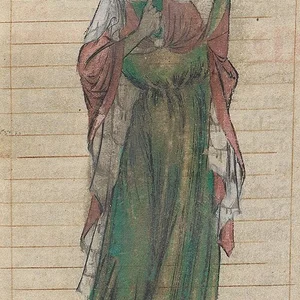

Female physician of the 11th century associated with the School of Medicine of Salerno, Europe's first organized medical institution. She is linked to foundational treatises on gynecology and obstetrics, though her exact biography remains a matter of debate.
Trotula of Salerno(1110 — 1197)
Trotula of Salerno
7 min read
Frequently asked questions
Key Facts
- Associated with the School of Medicine of Salerno (11th–12th century), considered the first organized medical institution in Europe
- Her name is linked to the 'Trotula' corpus, a collection of treatises on women's medicine widely circulated throughout the Middle Ages
- The 'De passionibus mulierum' (a treatise on women's diseases) is traditionally attributed to her
- Her historical existence is debated: some historians view her as a symbolic figure rather than a single individual
- The Trotula corpus influenced European medicine through to the Renaissance
Works & Achievements
A foundational treatise on women's diseases, menstruation, pregnancy, and childbirth. Considered the first European medical text focused on women's health, it was used in medical faculties until the 17th century.
A collection of practical remedies for gynecological and obstetric conditions, attributed to the practitioner Trota of Salerno. This text reflects an unprecedented empirical and clinical approach to women's medicine.
A treatise devoted to cosmetic care and women's hygiene, blending medical prescriptions with beauty recipes. It illustrates the holistic vision of women's health championed by the Salernitan school.
A compilation of the three Salernitan texts on women's health, circulated under the name Trotula throughout Europe. It stands as the most influential gynecological medical source of the Western Middle Ages.
Anecdotes
Trotula of Salerno is one of the very few women to have practiced and taught medicine at the School of Salerno, considered the first university medical institution in Europe. In a world where women were almost entirely excluded from scholarly knowledge, her presence among the "Magistri" of Salerno was so remarkable that she was cited as far away as England and France.
The medical treatises attributed to Trotula were copied and circulated throughout medieval Europe for more than four centuries. Copies were found in English monasteries, French royal libraries, and Italian universities, attesting to a medical authority recognized well beyond southern Italy.
Trotula was one of the first physicians to take her patients' modesty into account: she argued that many women suffered in silence rather than entrust their intimate ailments to a male doctor. It was to address this that she wrote her treatises, so that women could be treated by practitioners trained in these specific concerns.
The question of Trotula's identity has fascinated modern historians. For a long time, some believed that “Trotula” referred to a book rather than a person. Recent research, notably that of historian Monica H. Green, has shown, however, that a woman named Trota did indeed exist in Salerno in the twelfth century and that she is the source of at least some of the texts attributed to her.
According to a Salernitan tradition, Trotula is said to have developed remedies based on local plants — sage, rue, and chamomile — to relieve the pain of childbirth. These preparations, passed down from generation to generation, illustrate how the medical knowledge of Salerno was rooted in an age-old Mediterranean herbal tradition.
Primary Sources
“Women, by reason of the fragility of their nature, are more easily harmed than men […]. It is therefore fitting that women suffering from feminine ailments be treated by learned women.”
“To facilitate childbirth, apply warm compresses of bay oil to the woman's abdomen; and let the midwife anoint her hands with this same oil before intervening.”
“To whiten the teeth and freshen the breath, grind fine salt with dried mint and rub the teeth with this mixture every morning.”
“As Lady Trota of Salerno has taught us, for pains of the womb, a decoction of chamomile and mallow shall be used with great benefit.”
Key Places
A port city in southern Italy, home to the renowned Schola Medica Salernitana, Europe's first medical university. It is here that Trotula lived, practiced, and taught medicine in the 12th century.
A major monastic center near Salerno where monks such as Constantine the African translated Arabic medical texts into Latin, directly supplying the Salernitan teaching tradition from which Trotula benefited.
An ancient city near Salerno whose fertile lands provided the medicinal plants used by Salernitan physicians in their therapeutic preparations.
Capital of the Norman Kingdom of Sicily and a crossroads of Arab, Greek, and Latin cultures, whose intellectual influence encouraged the circulation of Eastern medical knowledge in Salerno.
Liens externes & ressources
Références
Œuvres
De Passionibus Mulierum Curandarum (Trotula Major)
vers 1140-1160
De Curis Mulierum
vers 1140-1160
De Ornamentis Mulierum (Trotula Minor)
vers 1150-1170
Corpus Trotula (ensemble des trois traités)
XIIe-XIIIe siècles (diffusion)