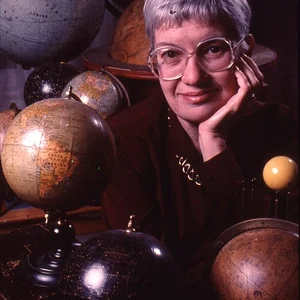

American astronomer (1928–2016), Vera Rubin demonstrated the existence of dark matter through her study of galaxy rotation curves. Her work revolutionized our understanding of the composition of the universe.
Vera Rubin(1928 — 2016)
Vera Rubin
États-Unis
9 min read
Frequently asked questions
Famous Quotes
« In a spiral galaxy, the ratio of dark-to-light matter is about a factor of ten. That's probably a good number for the ratio of our ignorance to knowledge.»
« We have peered into a new world and have seen that it is more mysterious and more complex than we had imagined.»
Key Facts
- 1928: Born in Philadelphia, Pennsylvania
- 1970: Begins her work on galaxy rotation curves with Kent Ford
- 1978: Publication of observational evidence for dark matter in spiral galaxies
- 1993: Elected to the National Academy of Sciences
- 2016: Dies in Princeton, New Jersey
Works & Achievements
A paper co-written with Kent Ford in The Astrophysical Journal, demonstrating that the rotation curve of the Andromeda Galaxy is nearly flat out to its outer edges, contradicting classical predictions and implying the existence of invisible mass surrounding galaxies.
A landmark study published with Ford and Thonnard examining 21 spiral galaxies of various types. It definitively established that flat rotation curves are universal, making the dark matter hypothesis impossible for the astronomical community to ignore.
A collection of lectures and scientific essays in which Rubin traces the history of her discoveries and reflects on the place of women in astronomy. Accessible to general audiences, this book has become a key reference for understanding dark matter.
A review article published in the Publications of the Astronomical Society of the Pacific, in which Rubin surveys a century of research on galactic dynamics and places her own discoveries in their historical and scientific context.
Anecdotes
As a child in Washington D.C., Vera Cooper is so fascinated by the night sky that she spends hours watching the stars from her window. Her father, an electrical engineer, encourages her and helps her build a small homemade telescope so she can track the movement of celestial bodies through the night.
In 1948, Vera Rubin attempts to enroll in Princeton University's doctoral astronomy program — she receives a letter informing her that women are not admitted. Far from being discouraged, she turns to Cornell and then Georgetown, where she earns her doctorate in 1954 under the physicist George Gamow.
In 1965, Vera Rubin officially becomes the first woman allowed to observe at the massive Palomar Mountain telescope in California. Since the restrooms were exclusively for men, she cut out a female silhouette from paper and stuck it on the door — solving the problem with disarming humor.
For years, her findings on galaxy rotation curves were met with skepticism: physicists expected stars at the outer edges to rotate more slowly, like planets far from the Sun. Rubin showed exactly the opposite, proving the existence of an invisible mass — what would come to be called dark matter.
Vera Rubin raised four children with her husband Robert Rubin, a mathematician. Remarkably, all four of her children went on to earn doctorates in science or mathematics. She liked to say that the best thing she could pass on to her family was scientific curiosity.
Primary Sources
The rotation curve is approximately flat from 3 kpc to 30 kpc from the nucleus, indicating that the mass is not concentrated at the center and that considerable matter must exist at large radii.
The rotation curves for the majority of these Sc galaxies are found to be flat or rising to the last measured point. This implies that either the mass distributions in spiral galaxies do not follow the light, or some additional invisible mass is present.
I have always been motivated by a desire to understand the universe as it really is, not as we might wish it to be. The flat rotation curves told us something profound: most of the matter in the universe is dark.
The history of rotation in galaxies spans a century of observations and misunderstandings. It is now clear that the dynamical mass of a spiral galaxy far exceeds its luminous mass, a conclusion that has reshaped our view of the cosmos.
Key Places
It was within this prestigious research institution that Vera Rubin worked from 1965 until the end of her active career. There, alongside Kent Ford, she conducted the systematic observations that led to the observational evidence for dark matter.
Home to the 200-inch Hale Telescope, one of the most powerful in the world at the time. In 1965, Vera Rubin became the first woman officially admitted to observe there, and collected a crucial portion of her data on spiral galaxies.
Vera Rubin completed and defended her doctoral dissertation here in 1954, under the supervision of George Gamow. Her thesis, demonstrating a non-uniform distribution of galaxies, was initially ignored but proved pioneering for observational cosmology.
A landmark of American astronomy where Rubin and her team conducted numerous observing campaigns. The clear skies of the Sonoran Desert provided ideal conditions for spectroscopy of distant spiral galaxies.
A historically women's college where Vera Cooper earned her undergraduate degree in astronomy in 1948. The intellectual atmosphere at Vassar played a foundational role in shaping her scientific vocation.
Typical Objects

A revolutionary instrument developed by her collaborator Kent Ford, it could record the light spectrum of very faint regions of galaxies within reasonable exposure times. Without this tool, the velocity measurements Rubin sought to obtain would have been virtually impossible.

Before the digital era, starlight was captured on glass plates coated with photosensitive emulsion. Rubin spent hours analyzing them under a magnifying glass to measure the spectral shifts that revealed the rotation speed of stars orbiting the galactic center.

The Hale Telescope was, at the time of Rubin's earliest observations, the largest optical telescope in the world. It was there that she gathered some of her most decisive data, having become the first woman officially admitted to use it.

Rotation curves were plotted by hand on graph paper, point by point, from calculated velocities. The slide rule allowed the necessary conversions to be made quickly, before electronic calculators became widespread.

An essential reference of the era, this atlas classified galaxies by morphology based on detailed photographs. Rubin used it to select her observation targets and to compare the distribution of visible light with measured rotation velocities.

Indispensable tools for long nights of high-altitude observing, hot coffee helped keep her awake while the notebook recorded weather conditions, exposure times, and initial spectral readings. Rubin's notebooks are today considered valuable scientific archives.
School Curriculum
Vocabulary & Tags
Key Vocabulary
Tags
Daily Life
Morning
During observation campaigns, Vera Rubin slept during the day in the observatory's spartan accommodations, waking in the late afternoon to prepare equipment before dusk. When she was working at the Carnegie Institution in Washington, mornings were devoted to reading recent papers, scientific correspondence, and meetings with her collaborators.
Afternoon
Afternoons were for analysis: examining photographic plates under a magnifying glass, calculating Doppler shifts, and carefully plotting rotation curves point by point on graph paper. She also supervised her students' work and collaborated with Kent Ford to improve the performance of the spectrograph. She sometimes crossed campus for interdisciplinary discussions with physicist colleagues.
Evening
On observation nights, she arrived at the dome at dusk to align the telescope and check atmospheric conditions. She then spent the entire night guiding the instrument over precise regions of target galaxies, recording spectra hour after hour in the cold and silence. When she was home in Washington, evenings were family time: dinner with her four children and her mathematician husband Robert.
Food
During observation nights, Vera Rubin ate frugally, bringing sandwiches and hot coffee in thermoses. Caffeine was essential to stay awake until dawn. Day-to-day in Washington, the Rubin family shared traditional American meals; she enjoyed cooking and hosting fellow astronomers for dinner.
Clothing
During high-altitude nighttime observations, she wore warm, practical clothing — a thick coat, wool gloves, and a hat — since nights at observatories are freezing even in the height of summer. In her office at Carnegie, she dressed simply and professionally, in keeping with the standards of American academic circles from the 1960s through the 1980s.
Housing
The Rubins lived in a comfortable family home in the suburbs of Washington D.C., where Vera had set up an office to work on her data on weekends. During observation campaigns lasting two to three weeks, she stayed in the functional accommodations provided by national observatories, sometimes sharing common areas with other astronomers in residence.
Historical Timeline
Period Vocabulary
Visual Style
Esthétique des grands observatoires américains des années 1960-1980 : instruments en acier et aluminium, lumière rouge de travail, ciel nocturne profond et courbes de rotation tracées à la main sur papier millimétré.
Sound Ambience
Ambiance nocturne d'un observatoire américain des années 1960-1980 : ronronnement mécanique du télescope en suivi, silence du désert et discrets cliquetis d'instruments de précision sous une voûte étoilée.
Liens externes & ressources
Références
Œuvres
Rotation of the Andromeda Nebula from a Spectroscopic Survey of Emission Regions
1970
Rotational Properties of 21 Sc Galaxies with a Large Range of Luminosities and Radii
1980
Bright Galaxies, Dark Matters
1997
One Hundred Years of Rotating Galaxies
2000