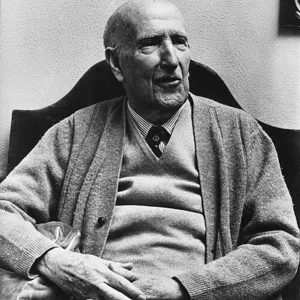

Vicente Aleixandre is a major Spanish poet of the 20th century, a figure of the Generation of '27. His work, marked first by surrealism and then by a poetry of human solidarity, earned him the Nobel Prize in Literature in 1977.
Vicente Aleixandre(1898 — 1984)
Vicente Aleixandre
Espagne
6 min read
Frequently asked questions
Key Facts
- Born on 26 April 1898 in Seville
- Publishes 'La Destrucción o el amor', awarded the National Prize for Literature in 1933
- Remains in Spain after the civil war and becomes a reference point for young poets under Francoism
- Elected to the Royal Spanish Academy in 1949
- Receives the Nobel Prize in Literature in 1977; dies on 13 December 1984 in Madrid
Works & Achievements
First collection of poems, still marked by pure poetry and formal rigor.
A fully surrealist collection, in which the free image and the unconscious take control of language.
A masterpiece crowned with the National Literature Prize: here love is total fusion with nature and the cosmos.
A major postwar work that revitalized Spanish poetry; it evokes a primitive, luminous paradise.
A turn toward a poetry of human solidarity, attentive to the passing of time and to other people.
A collection awarded the Critics' Prize, broadening his gaze to matter and to the human collective.
A great work of old age, meditating on knowledge, lost youth, and death.
Anecdotes
Starting in 1925, Vicente Aleixandre was struck by a serious kidney disease that cost him a kidney in 1932. Often bedridden, he turned his bedroom into a writing studio and composed part of his work lying down, which did not prevent him from becoming one of the greatest Spanish poets of the century.
While most of the poets of the Generation of '27 (Alberti, Cernuda, Guillén…) went into exile after the civil war, Aleixandre chose to remain in Spain under Franco's dictatorship. His Madrid home at no. 3 Velintonia Street became a literary refuge and a bridge between the prewar poets and the younger generations.
In 1977, at the age of 79, Aleixandre received the Nobel Prize in Literature. Too frail to travel to Stockholm, he was unable to attend the ceremony: a representative accepted the award on his behalf, while Spain, only just emerging from the Franco era, celebrated one of its own.
As a child, Aleixandre spent several years in Málaga, on the shores of the Mediterranean. All his life he would remember this luminous city as a lost paradise, which he celebrated in the poem “Ciudad del paraíso” from his collection *Sombra del paraíso*.
Aleixandre became friends with Federico García Lorca and other poets of his generation during the tribute to Góngora in 1927. Lorca's assassination in 1936, at the start of the civil war, would mark him deeply and would loom over his postwar poetry.
Primary Sources
La poesía es comunicación. (“Poetry is communication.”)
For a creative poetic writing which illuminates man's condition in the cosmos and in present-day society, at the same time representing the great renewal of the traditions of Spanish poetry between the wars.
The title itself sums up his vision: love is a total fusion with nature and the cosmos, inseparable from a form of self-destruction.
Key Places
City in Andalusia where Vicente Aleixandre was born in 1898. He spent his earliest years there before the family moved away.
Mediterranean city where Aleixandre spent part of his childhood. He would celebrate it as a “city of paradise,” a luminous and lost memory.
City where Aleixandre lived most of his adult life and died in 1984. His house at no. 3 Velintonia Street was a major literary gathering place.
Madrid institution charged with overseeing the Spanish language, where Aleixandre was elected an academician in 1949.
Site of the December 1927 tribute to Góngora, the founding event of the Generation of '27 to which Aleixandre belonged.
Typical Objects

Writing instrument with which Aleixandre composed his poems. Many writers of his time still worked by hand before dictating or typing up a clean version of the text.

Notebooks where the poet jotted down his verses, drafts and corrections. Today these manuscripts make it possible to study the genesis of his collections.

Collection of books from his house at no. 3 Velintonia Street, in Madrid. This home was a place of gathering and reading for the young poets he welcomed.

Because of his kidney disease, Aleixandre spent long periods bedridden. His bed became a true workstation where he read and wrote.

Award presented to Nobel Prize laureates, struck with the likeness of Alfred Nobel. It symbolizes the international recognition of Aleixandre's work in 1977.

Letters exchanged with the other members of the Generation of '27 and with young authors. They bear witness to his role as a mentor and a bridge between generations.
School Curriculum
Vocabulary & Tags
Key Vocabulary
Daily Life
Morning
Often weakened by his kidney disease, Aleixandre began the day slowly, from his bedroom. Mornings were devoted to reading and writing, when his health allowed, in the quiet of his Madrid home.
Afternoon
In the afternoon, his house at no. 3 Velintonia Street opened its doors to visitors: young poets, friends, and writers came to discuss literature. There, Aleixandre played the role of a mentor and a kindly adviser.
Evening
Evenings were devoted to conversation, correspondence, and reflection. The poet, sparing of his strength, preferred a secluded and studious life to social gatherings.
Food
His serious kidney disease required a careful and moderate diet. He had to watch what he ate throughout his life, within the framework of simple Spanish cuisine.
Clothing
Aleixandre wore the sober, neat attire of the cultured Spanish middle class of the 20th century: a suit, shirt, and tie, with no taste for extravagance.
Housing
He lived in Madrid in a house with a garden, at no. 3 Velintonia Street (now renamed in his honor). This peaceful home was both his residence and a famous literary meeting place.
Historical Timeline
Period Vocabulary
Liens externes & ressources
Références
Œuvres
Espadas como labios
1932
La destrucción o el amor
1935
Sombra del paraíso
1944
Historia del corazón
1954
En un vasto dominio
1962
Poemas de la consumación
1968