 flip
flipBeef Daube à la Mode of Bloomsbury
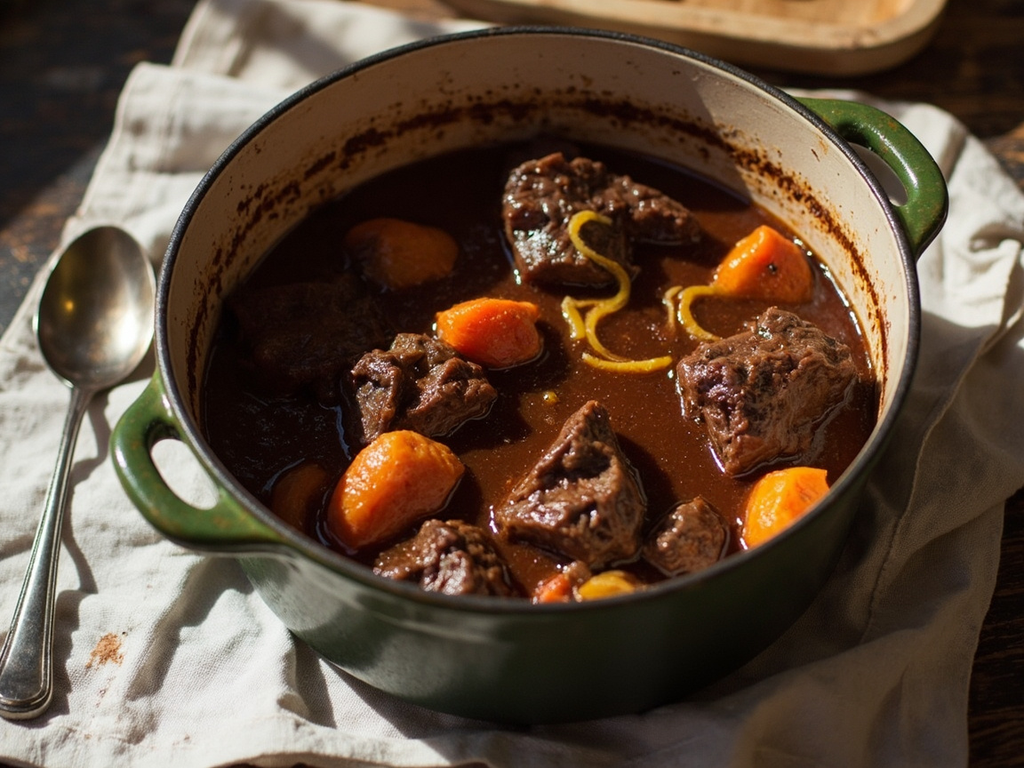
Beef Daube à la Mode of Bloomsbury
Why this dish? Beef daube is THE dish of the grand dinner in 'To the Lighthouse' (1927), the meal where Mrs Ramsay gathers her guests around a casserole simmered for three days. Woolf immortalized this 'continental' dish that the English middle-class served to impress guests: a refined French borrowing, a sign of good taste.
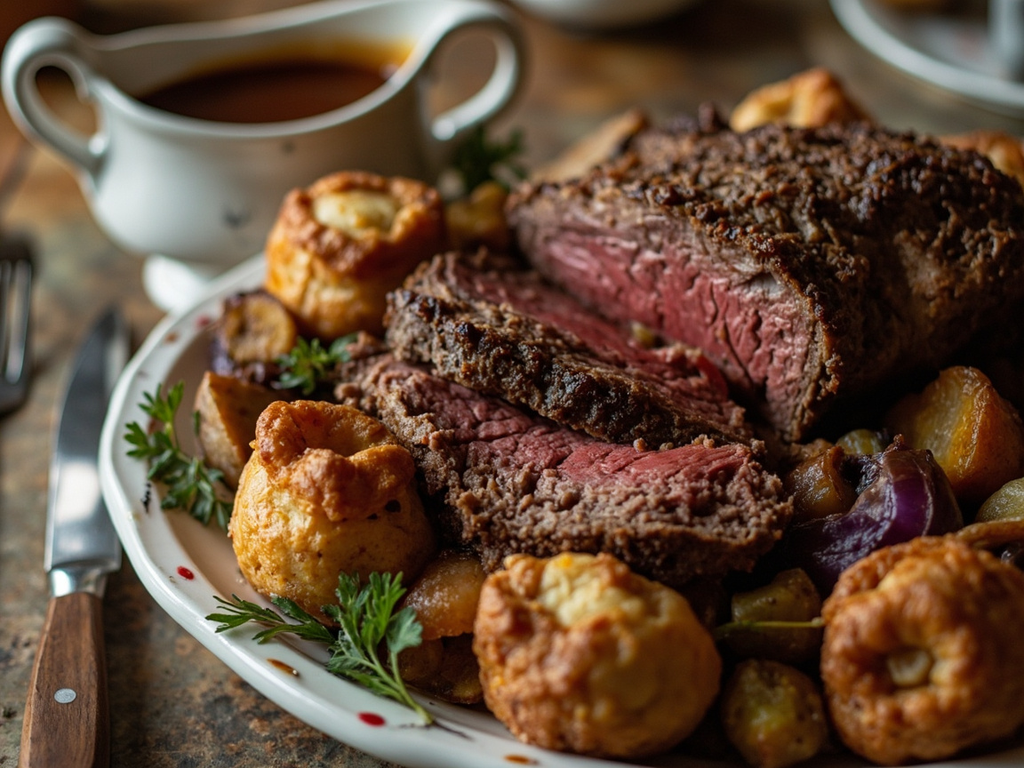
A beef stew braised very slowly in red wine, bacon, oranges, and herbs — of Provençal origin, adopted by cultivated English tables as the epitome of refined hospitality. The meat becomes tender, the sauce deep and glossy.
You see, this dish is not English in the least, and that is precisely its charm — it comes to us from France, and one serves it to signify that one has taste. It simmers for three days, and the cook watches over it as one watches the tide; it cannot be hurried. When at last one lifts the lid of the great casserole, that brown and fragrant steam rises, and the whole table falls silent for a moment, collected. I have always thought that a successful dinner depends less on the food than on that silence, when each person, suddenly, feels united with the others.
- •Beef chuck or shin — a fine piece (braising meat)
- •Full-bodied red wine — one bottle (braising liquid)
- •Smoked bacon — a few thick slices (fat and smoke)
- •Onions studded with cloves — two (aromatic)
- •Dried orange peel — one piece (Provençal perfume)
- •Bouquet of thyme, bay, parsley — one (herbs)
- •Carrots — a few (vegetable)
Beef Daube à la Mode of Bloomsbury
A beef stew braised very slowly in red wine, bacon, oranges, and herbs — of Provençal origin, adopted by cultivated English tables as the epitome of refined hospitality. The meat becomes tender, the sauce deep and glossy.
Why this dish? Beef daube is THE dish of the grand dinner in 'To the Lighthouse' (1927), the meal where Mrs Ramsay gathers her guests around a casserole simmered for three days. Woolf immortalized this 'continental' dish that the English middle-class served to impress guests: a refined French borrowing, a sign of good taste.
You see, this dish is not English in the least, and that is precisely its charm — it comes to us from France, and one serves it to signify that one has taste. It simmers for three days, and the cook watches over it as one watches the tide; it cannot be hurried. When at last one lifts the lid of the great casserole, that brown and fragrant steam rises, and the whole table falls silent for a moment, collected. I have always thought that a successful dinner depends less on the food than on that silence, when each person, suddenly, feels united with the others.
Ingredients (period version)
- Beef chuck or shin — a fine piece (braising meat)
- Full-bodied red wine — one bottle (braising liquid)
- Smoked bacon — a few thick slices (fat and smoke)
- Onions studded with cloves — two (aromatic)
- Dried orange peel — one piece (Provençal perfume)
- Bouquet of thyme, bay, parsley — one (herbs)
- Carrots — a few (vegetable)
Ingredients
- Beef chuck — 1.2 kg in large cubes (meat)
- Red wine (Côtes-du-Rhône) — 75 cl (braise)
- Smoked bacon lardons — 200 g (smoked fat)
- Onions — 2 large + 4 cloves (aromatic)
- Carrots — 4 (vegetable)
- Peel of 1 untreated orange — 1 wide strip (perfume)
- Bouquet garni — 1 (herbs)
- Flour — 2 tbsp (thickener)
- Salt, pepper — to taste (seasoning)
Method
- The day before, marinate the beef cubes in red wine with the orange peel, bouquet garni and one sliced onion.
- The next day, drain the meat (reserve the marinade), pat it dry, lightly dust with flour, and brown it with the bacon lardons in a casserole.
- Add onions, carrots, orange peel and bouquet garni, then pour in the strained marinade. Season with salt and pepper.
- Cover and simmer over very low heat (or in the oven at 150 °C) for 3 to 4 hours, until the meat falls apart.
- Ideally, let cool and reheat the next day: the daube is only better.
How it was made : Before adjustable gas stoves, this type of daube cooked for hours on the edge of a coal range or in a cooling oven after bread baking. The very long cooking was not a refinement but a necessity to tenderize cheap cuts. Served in a cast-iron casserole brought to the table, it was a reception dish that displayed the household's ease and cosmopolitanism.
The contemporary twist : Serve it with mashed potatoes enriched with butter and name the dish 'Ramsay Dinner' as a nod to the novel — each guest receives their ladle in a warm deep plate, as at the Woolfs' table.
Sources : Virginia Woolf, To the Lighthouse (1927) · Mrs Beeton's Book of Household Management (revised early 20th century)
Virginia Woolf · Charactorium