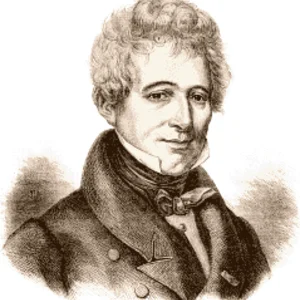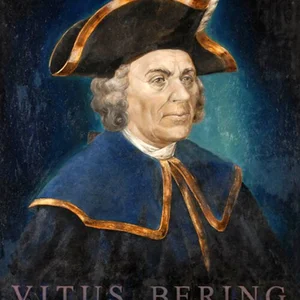

A Danish navigator and explorer in the service of Imperial Russia, Vitus Bering led two major expeditions to the Russian Far East. He explored the coasts of Siberia and Alaska, and gave his name to the strait separating Asia from America.
Vitus Bering(1681 — 1741)
Vitus Bering
Empire russe, Royaume de Danemark
9 min read
Frequently asked questions
Key Facts
- 1681: born in Denmark
- 1725–1730: First Kamchatka Expedition, commissioned by Peter the Great
- 1728: sailed through the strait that would bear his name, separating Asia from America
- 1741: reached the coast of Alaska during the Great Northern Expedition
- 1741: died on the island that bears his name during the return voyage
Works & Achievements
Bering crossed the whole of Siberia overland and by river, built a ship on site, and explored the coasts of Kamchatka before sailing through the strait separating Asia from America. This expedition produced the first accurate maps of the Russian Far East.
Upon his return, Bering submitted to the Admiralty a detailed report accompanied by maps correcting the inaccurate depictions of the Siberian and Kamchatkan coastlines. These documents persuaded the authorities to fund a second, even more ambitious expedition.
Bering founded this strategic port on the eastern coast of Kamchatka as a logistical base for his expedition toward America. The city is today the administrative center of Kamchatka Krai and preserves the memory of the explorer.
A scientific undertaking of unprecedented scale for the 18th century, bringing together scholars, sailors, and military personnel to chart the Arctic coasts of Siberia and explore the North Pacific as far as Alaska. Its geographical and naturalist findings were published over several decades following the expedition.
Bering was the first European navigator to document and map the southern coast of Alaska from the sea. This discovery directly opened the way for Russian colonization of North America and the lucrative fur trade in the North Pacific.
Anecdotes
Born Danish, Vitus Bering joined the Imperial Russian Navy in 1703, drawn by the opportunities offered by Peter the Great, who was actively recruiting experienced naval officers from Western Europe. He rose through the ranks to the grade of captain-commander, a remarkable ascent for a foreigner within an institution as jealously guarded as the Tsarist navy.
During his first expedition to Kamchatka (1725–1730), Bering sailed through the strait separating Asia from America on August 13, 1728, but a thick fog prevented him from catching sight of the Alaskan coast. He returned to Saint Petersburg unable to certify with any certainty whether the two continents were connected or separated, leaving the geographical question partially unresolved in the eyes of the Admiralty.
On July 16, 1741, during his second expedition, Bering finally caught sight of the snow-capped peaks of Alaska — notably Mount Saint Elias — after months of perilous navigation in the North Pacific. His naturalist Georg Wilhelm Steller landed on Kayak Island on July 20, but had only ten hours to observe the local fauna and flora, which left the scientist furious, as the discoveries were so promising.
On the return voyage in 1741, Bering's ship, the St. Peter, was battered by violent storms and ran aground on a deserted island in the North Pacific that his men named Bering Island. Exhausted, ravaged by scurvy and frostbite, Vitus Bering died there on December 8, 1741. His grave was later found and his identity formally confirmed by Danish and Russian archaeologists during excavations carried out in 1991.
The Great Northern Expedition organized by Bering remains one of the most ambitious scientific endeavors of the 18th century: it mobilized several thousand men over ten years (1733–1743), mapped thousands of kilometers of Arctic coastline, and enabled the description of Steller's sea cow, a gigantic marine mammal discovered on Bering Island that was tragically hunted to extinction by 1768.
Primary Sources
1. One or two decked boats must be built in Kamchatka or elsewhere. 2. On these boats, the coast running northward must be followed — a coast that appears, though it is not known for certain, to be the coast of America. 3. One must seek where it meets America and proceed to a city belonging to a European power.
We sailed along the coast stretching to the northeast; from our observations and the bearing of the coast, we concluded that we were indeed facing a strait separating Asia from America, and that the two continents do not meet in that direction.
On the island where we wintered, we discovered a marine mammal of prodigious size, never before described by European scholars, feeding peacefully on seaweed in the coastal waters. These animals, having no fear of men, allowed themselves to be approached and showed a nature wholly untouched by human contact.
Our captain-commander, worn down by scurvy, could no longer leave his cabin or stand on deck. He nonetheless retained full clarity of mind and passed his orders calmly, knowing that his strength was steadily abandoning him on that lonely, frozen island.
This day, 16 July 1741, through a break in the clouds, we made out on the horizon a high snow-covered mountain which we named Mount St. Elias. We thus have certainty that there exists a land to the east which may be taken for northern America.
Key Places
Vitus Bering's birthplace, where he was born in 1681. A museum and monument are now dedicated to him in this port city in central Jutland.
The imperial capital from which Bering organized his two major expeditions and where he reported his voyages to the Russian Admiralty. He lived there between expeditions and received his letters of commission.
A 82-kilometer-wide sea passage between Siberia and Alaska that Bering crossed on August 13, 1728, during his first expedition. The strait bears his name even though Semyon Dezhnyov had crossed it first in 1648.
A port founded by Bering himself in 1740 as the departure base for his second expedition toward Alaska. The city takes its name from his two ships, the Saint Peter and the Saint Paul, in honor of the apostles.
The first Alaskan land on which Bering's crew came ashore on July 20, 1741. Naturalist Georg Wilhelm Steller spent ten hours there producing a pioneering scientific description of the local flora and fauna.
A remote island in the North Pacific where the Saint Peter ran aground in November 1741. Bering died there on December 8, 1741, from scurvy and the harshness of the Arctic winter; his grave was identified during archaeological excavations in 1991.