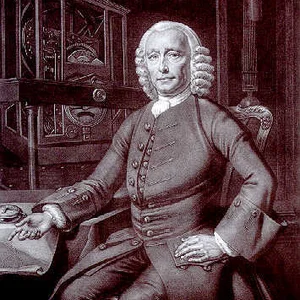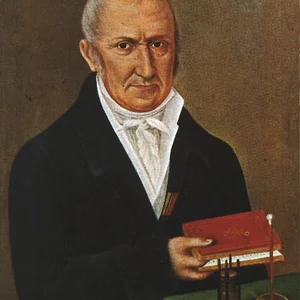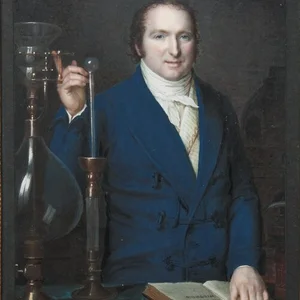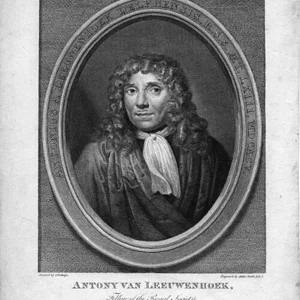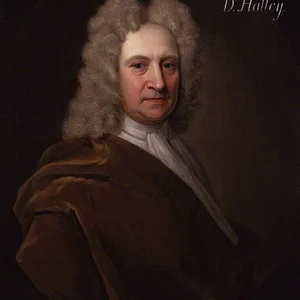

An English astronomer and scientist of the 17th–18th century, he is famous for calculating the orbit of the comet that bears his name and predicting its return. A friend and patron of Newton, he played an essential role in the publication of the Principia Mathematica.
Edmond Halley(1656 — 1742)
Edmond Halley
royaume de Grande-Bretagne, royaume d'Angleterre
9 min read
Frequently asked questions
Key Facts
- 1656: born in Haggerston, England
- 1676: catalogue of 341 stars of the southern hemisphere, observed from the island of Saint Helena
- 1687: funds and oversees the publication of Newton's Principia Mathematica
- 1705: predicts the return of the comet of 1682, which will bear his name (Halley's Comet, period ~76 years)
- 1742: dies in Greenwich; the comet returns in 1758, confirming his prediction
Works & Achievements
The first accurate catalogue of stars in the southern hemisphere, containing 341 stellar positions measured at Saint Helena. This pioneering work earned him the nickname 'the Tycho Brahe of the South' and immediate election to the Royal Society.
Halley persuaded Newton to publish his masterwork, oversaw its editing and layout, and funded the printing out of his own pocket. Without him, this scientific revolution might have remained buried in Newton's desk drawers.
The world's first global map of magnetic declinations, the fruit of his Atlantic expeditions. It allowed 18th-century navigators to correct their compasses and determine their position at sea with unprecedented accuracy.
A comparative study of twenty-four historical comets in which Halley demonstrated that the comets of 1531, 1607, and 1682 were one and the same comet following a periodic orbit, and predicted its return in 1758 — confirmed 16 years after his death.
A memoir in which Halley proposed using the transit of Venus across the Sun to calculate the Earth-Sun distance by parallax. His instructions guided astronomers during the transits of 1761 and 1769, ushering in an era of precise cosmic measurement.
Tables of the Moon's position compiled by Halley during his years at Greenwich, published after his death. They served as an essential reference for astronomical navigation throughout the 18th century.
Anecdotes
In 1687, Isaac Newton was hesitant to publish his work due to lack of funds and fear of controversy. Edmond Halley made the remarkable decision to personally finance, out of his own fortune, the printing of the Principia Mathematica. Without this act, one of the most important works in the history of science might never have seen the light of day.
In 1705, Halley published a study comparing the orbits of several comets observed between 1337 and 1698. He noticed that the comets of 1531, 1607, and 1682 had nearly identical trajectories and concluded that they were the same celestial body returning approximately every 75–76 years. He predicted its return for 1758 — sixteen years after his own death — and this prediction proved correct, brilliantly confirming Newton's law of universal gravitation.
At just 20 years old, Halley left Oxford before completing his degree to sail to the island of Saint Helena in the South Atlantic. He spent nearly two years there observing the southern sky, cataloguing 341 stars invisible from Europe. Upon his return in 1678, he was nicknamed the “Tycho Brahe of the South” and elected to the Royal Society at just 22 years old.
Halley invented one of the first practical diving apparatuses: a reinforced wooden diving bell equipped with barrels of compressed air sent down from the surface. In 1691, he personally descended to a depth of 18 meters in the Thames and remained there for over an hour. This invention paved the way for the first underwater explorations and shipwreck salvage operations.
Halley was one of the first scientists to attempt to measure the Earth-Sun distance. He proposed observing the transit of Venus across the Sun from different points around the globe to calculate this distance by parallax. Knowing he would not live long enough to see the next transit (scheduled for 1761), he wrote detailed instructions for future astronomers — a kind of posthumous scientific message.
Primary Sources
By comparing the orbital elements of twenty-four comets observed between 1337 and 1698, I have reached the conclusion that the comets of 1531, 1607, and 1682 are one and the same celestial body returning periodically. I therefore predict with confidence its return around the year 1758.
This catalogue presents the positions of three hundred and forty-one stars of the southern hemisphere, observed at the island of Saint Helena between 1676 and 1678 by means of a telescopic sextant of five and a half feet radius.
The variations in atmospheric pressure observed at different altitudes appear to follow a regular law which, if better understood, would allow the altitude of a location to be deduced by simply reading the barometer.
Here at last, benevolent reader, is the fruit of the most profound meditations of the celebrated Newton. May the mortals who read these pages recognise the greatness of the human mind and the glory of English genius.
This general chart of magnetic declination, based on my own observations at sea during my voyages from 1698 to 1700, is intended to guide navigators in correcting their instruments and determining their longitude.
Key Places
A district in east London where Edmond Halley was born in 1656, into a prosperous family. This city, in the midst of an intellectual flourishing marked by the founding of the Royal Society in 1660, shaped his scientific vocation.
An isolated volcanic island in the middle of the Atlantic where Halley stayed from 1676 to 1678 to observe the southern sky. It was there that he compiled his catalogue of 341 stars and earned his international reputation as an astronomer.
An institution founded in 1675 of which Halley became the second director (Astronomer Royal) in 1720. He spent the last twenty years of his life there refining the lunar tables essential to navigation.
Halley studied at Queen's College from 1673 before leaving for Saint Helena without completing his degree. He returned as the full professor of the Savilian Chair of Geometry from 1703 to 1742.
Halley commanded the vessel *Paramour* on two scientific expeditions across the Atlantic, collecting magnetic data from the Arctic to the Antarctic. These voyages resulted in the first world map of magnetic declination.
Typical Objects

An optical instrument using mirrors rather than lenses to observe celestial bodies with fewer chromatic aberrations. Halley used it night after night to measure star positions and observe comets.

A precision instrument for measuring angles between two celestial objects. Halley used it on Saint Helena to compile his famous catalogue of southern stars with a level of accuracy unmatched at the time.

A glass tube filled with mercury that measures atmospheric pressure. Halley was one of the first to study barometric variations with altitude and link them to weather conditions.

A wooden and metal chamber supplied with compressed air, designed and improved by Halley to allow men to work underwater. He used it personally in the Thames and proposed deploying it to salvage shipwrecks.

An essential navigation instrument at sea, though prone to variations in magnetic declination depending on one's location on the globe. Halley dedicated several expeditions to measuring these variations in order to produce his famous magnetic charts.

Halley published the world's first isogonic charts (lines connecting points of equal magnetic declination), a true revolution for open-sea navigation in the eighteenth century.

Printed tables listing the future positions of planets and stars at specific dates. Halley used them to plan his observations and compare his measurements against theoretical predictions.
School Curriculum
Vocabulary & Tags
Key Vocabulary
Tags
Daily Life
Morning
Halley rose before dawn to make the most of the final hours of night, best suited for observations. After a night's vigil at the observatory, he meticulously recorded his measurements in his notebooks, corrected the previous day's calculations, and replied to scientific correspondence reaching him from across Europe.
Afternoon
Afternoons were devoted to mathematical calculations, often lengthy ones: reducing observational data, comparing results against the ephemerides, and working on his astronomical tables. He also received visitors — colleagues from the Royal Society, naval officers, or natural philosophers passing through London or Greenwich.
Evening
At dusk, Halley returned to his telescope for the first nocturnal observations, timing the transit of stars across the meridian using his precision clock. At Greenwich, he would dine simply with his family before resuming his observations until clouds or fatigue forced him to stop.
Food
Like most well-off Englishmen of his era, Halley's daily diet included roast beef, puddings, wheaten bread, boiled vegetables, and light ale. During his sea expeditions, he shared the sailors' rations: ship's biscuits, salt meat, dried peas, and collected rainwater.
Clothing
As a gentleman of science and a royal officer, Halley wore a powdered wig, a woollen frock coat, knee breeches, silk stockings, and silver-buckled shoes for official occasions. In his observatory, he exchanged these formal clothes for a long dressing gown and a nightcap during the long nights of observation.
Housing
Halley lived in several London lodgings before taking up residence in the house adjoining the Royal Observatory at Greenwich from 1720 onwards. This official accommodation offered direct access to the observatory's instruments and an unobstructed view of the Thames and the Deptford shipyards — symbols of British maritime power that he served through his charts and tables.
Historical Timeline
Period Vocabulary
Liens externes & ressources
Références
Œuvres
Catalogus Stellarum Australium
1679
Principia Mathematica de Newton (édition et financement)
1687
A New and Correct Chart Shewing the Variations of the Compass
1701
Astronomiae Cometicae Synopsis
1705
Methodus singularis qua Solis Parallaxis... determinari poterit
1716
Tables astronomiques lunaires (Tabulae Astronomicae)
1749 (posthume)