
A Berber slave from Morocco, Estevanico was one of the first Africans to explore North America. A survivor of the wreck of the Narváez expedition (1528), he crossed the present-day American Southwest on foot and opened the route to the legendary Seven Cities of Cíbola.
Estevanico(1500 — 1540)
Estevanico
couronne de Castille
8 min read
Frequently asked questions
Key Facts
- Around 1500: born in Azamor (Morocco), probably of Berber origin
- 1527: embarked as the slave of Andrés Dorantes on the Narváez expedition to Florida
- 1528: shipwrecked off the coast of Texas, one of only four survivors, along with Álvar Núñez Cabeza de Vaca
- 1528–1536: traveled on foot across the present-day American South and northern Mexico, covering approximately 9,000 km
- 1539: sent ahead as a scout toward Cíbola by Viceroy Mendoza, he was killed by the Zuni in New Mexico
Works & Achievements
Alongside Cabeza de Vaca and two other survivors, Estevanico completed one of the first documented crossings of the North American continent, covering roughly 10,000 kilometers on foot through Texas, New Mexico, and Arizona to Mexico.
Commissioned by Viceroy Mendoza and Friar Marcos de Niza, Estevanico scouted the lands north of New Spain as an advance explorer, opening the route into what is now New Mexico and Arizona.
Estevanico developed healing practices recognized by numerous Indigenous nations, blending Native American rituals with African knowledge, earning him a reputation that allowed him to pass through hostile territories.
Estevanico learned several Native American languages and served as interpreter between the Spanish survivors and Indigenous peoples, playing a crucial diplomatic role in the group's survival during the crossing of the continent.
Anecdotes
When the Narváez expedition was shipwrecked off the coast of Texas in November 1528, only four men survived out of six hundred: Álvar Núñez Cabeza de Vaca, Andrés Dorantes, Alonso del Castillo Maldonado, and Estevanico. For several years they lived in captivity among the indigenous peoples of Texas before making their escape westward, setting in motion one of the most extraordinary crossings of the American continent ever undertaken.
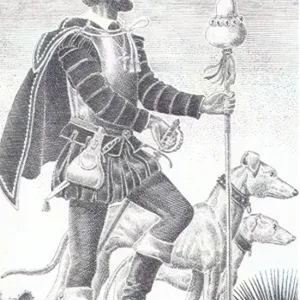
Estevanico quickly earned a reputation as a skilled healer among the Native American nations he passed through. One tribe presented him with a gourd decorated with feathers and bells — the emblem of shamans — which he carried during healing ceremonies. This talisman gave him considerable authority and protection: entire villages would sometimes travel several days on foot to be treated by him.
During the 1539 expedition in search of the Seven Cities of Cíbola, Friar Marcos de Niza sent Estevanico ahead as a scout, several days in advance of the rest of the group. Estevanico dressed in Native American garments and ornaments, traveled with a retinue of guides, and sent increasingly large crosses back to Friar Marcos to signal the significance of his discoveries.
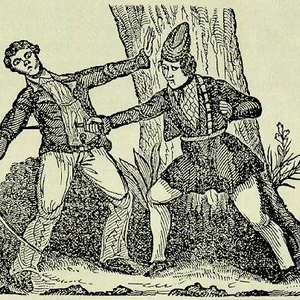
Upon reaching the gates of the Zuni pueblo of Hawikuh, Estevanico presented himself as the envoy of white Christian men arriving in peace. The Zuni leaders refused to believe that a Black man could represent an unknown civilization. He was arrested, interrogated, and put to death in 1539, making him one of the first Africans to die on North American soil.
Estevanico had mastered several Native American languages picked up during his years of wandering — a rare skill his Spanish companions lacked entirely. According to Cabeza de Vaca, he would gather information from Native Americans about routes, villages, and dangers ahead, serving as an indispensable interpreter and diplomat whose efforts were essential to the survival of the whole group.
Primary Sources
The Black Man always spoke to the Indians, inquiring about the roads we were to take and the villages we would find, and other things we wished to know.
I sent Esteban de Dorantes, a Black man, with instructions to march fifty or sixty leagues to the north to see if he could learn news of something important; and that he should send me a white cross the size of a hand if he learned of something of modest importance, and a larger one if he learned of something great.
The said Esteban, slave of Captain Andrés Dorantes, was a Black Arab, a native of Azemmour, on the Barbary Coast, opposite Gibraltar.
Fray Marcos returned and reported to me that he had seen, from a height, the city that was being sought, and informed me of the death of Esteban, who was killed by the inhabitants of that province.
Key Places
A Berber coastal town on the Atlantic where Estevanico was born around 1500. Captured by the Portuguese in 1513, many of its inhabitants were enslaved, including Estevanico, who was sold to a Spanish nobleman.
The landing point of the Narváez expedition in 1528. It was from here that the disastrous adventure began that would lead Estevanico across the North American continent.
The site of the expedition's shipwreck in November 1528. Estevanico and the other survivors were taken in by the Karankawas, a coastal Indigenous nation, and then held in slavery by them for several years.
Capital of New Spain, where Estevanico and the three other survivors arrived in 1536 after eight years of wandering. Their accounts of unknown lands to the north immediately captured the interest of Viceroy Mendoza.
A Zuni pueblo where Estevanico was captured and killed in 1539. He believed he had found one of the legendary Seven Cities of Cíbola, but the inhabitants refused to accept him and put him to death.
Typical Objects

Adorned with colorful feathers and bells, this gourd rattle was given to Estevanico by a Texan tribe as a healer's emblem. He carried it during his encounters with Indigenous peoples to signal his status as a shaman and ensure a welcome and safe passage.

Estevanico sent crosses of varying sizes to Friar Marcos de Niza to indicate the significance of his discoveries: a small cross meant little news, while a large one announced a major find. This long-distance communication system had been agreed upon before he set out as a scout.

Acquired through exchanges with the Indigenous nations of the Southwest, these ornaments marked Estevanico's status as a respected emissary. During his 1539 expedition, he adorned himself with turquoise, feathers, and belts gifted by allied tribes to make a strong impression on the peoples he encountered.

Acquired and mastered during his years of living among Indigenous nations, the bow and arrows were essential tools for hunting and self-defense across the vast deserts he traversed.

Travel provisions supplied by Indigenous nations, these compact foods allowed Estevanico to cover long distances between villages, sometimes with no certainty of finding food along the way.

Indispensable during the long marches through the deserts of Texas and New Mexico, the staff served as support on difficult crossings and as a symbol of authority during negotiations with Indigenous communities.
School Curriculum
Vocabulary & Tags
Key Vocabulary
Daily Life
Morning
Estevanico rose at dawn in the Indigenous camps where the group sought refuge. He took part in morning rituals, learned local languages and customs, and welcomed the sick who came to consult him in ever-growing numbers as a healer.
Afternoon
Afternoons were devoted to walking — sometimes more than twenty kilometers a day — across deserts, steppes, and arid plateaus. Estevanico often served as a scout ahead of the group, negotiating welcome in villages and assessing the dangers of unknown trails.
Evening
In the evenings, Estevanico led the healing ceremonies that Native Americans asked of him. He would breathe over the sick, sing prayers, and use his shamanic gourd — practices that earned him respect and protection among every nation they passed through.
Food
His food depended entirely on the generosity of Indigenous peoples: corn, beans, squash, dried bison meat, roasted agave, and wild plants that varied by region. During periods of famine in the desert, the group could go several days without eating.
Clothing
In the Americas, his Spanish clothes were gradually replaced by tanned hides, cotton weaves, and Indigenous ornaments — turquoise, feathers, and colorful belts — adopted through exchanges with the nations they traversed, giving him the appearance of a local shaman.
Housing
Lodging varied depending on the nation and the season: bison-hide tipis on the plains of Texas, semi-subterranean houses among the sedentary farmers of the Southwest, makeshift shelters in the desert during solitary scouting legs.
Historical Timeline
Period Vocabulary
Liens externes & ressources
Références
Œuvres
Traversée pédestre de l'Amérique du Nord
1528-1536
Mission de reconnaissance vers les Sept Cités de Cíbola
1539
Pratique de la médecine chamanique
1528-1539
Médiation linguistique et diplomatique
1528-1539