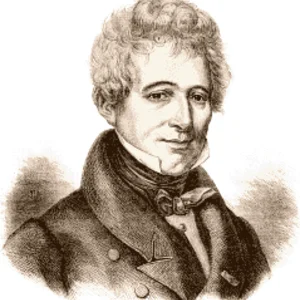

French diplomat and explorer (1766–1834), he participated in the La Pérouse expedition as an interpreter and was the only member to return to Europe before the shipwreck. He crossed Siberia to bring the expedition's logbooks back to Paris.
Barthélemy de Lesseps(1766 — 1834)
Barthélemy de Lesseps
France
8 min read
Frequently asked questions
Key Facts
- 1766: born in Saint Petersburg, son of a French consul in Russia
- 1785–1788: takes part in the La Pérouse expedition as vice-consul and interpreter
- 1788: landed at Kamchatka, crosses Siberia to bring the expedition's journals back to Paris
- 1790: publishes his account 'Voyage de Lesseps' describing his journey across Siberia
- The only member of the La Pérouse expedition to have survived, the others having perished in the 1788 shipwreck
Works & Achievements
Lesseps's principal work, this two-volume account describes his overland journey across Siberia from Petropavlovsk to Saint Petersburg and then Paris. It is both a scientific and a literary document — a unique testimony to the peoples and landscapes of eastern Siberia at the close of the eighteenth century.
In his capacity as French consul at Kronstadt, Lesseps wrote numerous diplomatic reports on the commercial and political situation of the Russian Empire, forming a valuable source for the history of Franco-Russian relations.
Lesseps contributed notes and corrections to the posthumous 1797 publication of the Voyage de La Pérouse, providing first-hand testimony about the events in which he had taken part and authenticating the expedition's documents.
Anecdotes
In September 1787, La Pérouse decided to have Barthélemy de Lesseps disembark at Petropavlovsk-Kamchatsky to carry the expedition's precious logbooks back to France. This decision was driven by Lesseps's command of Russian, acquired during his childhood in Saint Petersburg, where his father had served as consul. He thus became the only crew member to leave the expedition before the shipwreck.
Lesseps's return journey across Siberia was an achievement in its own right: he covered nearly 10,000 kilometers by sled, on horseback, and on foot, crossing frozen and nearly uninhabited territories. He arrived in Paris in October 1788, after fourteen months of travel, carrying the scientific documents that would reveal La Pérouse's discoveries to the world.
Lesseps handed the logbooks and charts directly to Louis XVI at Versailles, just a few months before the French Revolution overturned the monarchical order. The king, who was passionate about geography and navigation, had himself helped plan La Pérouse's expedition, and according to tradition, inquired about the explorer's fate until the very end.
When La Pérouse's ships were wrecked near the island of Vanikoro (Pacific) in 1788, Lesseps was already safely back in France. He thus became the last eyewitness able to tell the story of the expedition from the inside. His account, published in 1790, was one of the main sources historians used to reconstruct La Pérouse's final months before the disaster.
Barthélemy de Lesseps was the uncle of Ferdinand de Lesseps, the future builder of the Suez Canal. A taste for adventure and grand endeavors seemed to run in the family. Barthélemy went on to pursue a diplomatic career after his return from Siberia, serving as French consul in Kronstadt and Lisbon.
Primary Sources
On October 6, 1787, I landed at Petropavlovsk, entrusted with the most precious mission M. de La Pérouse could have placed in my hands: to carry back to France the journals, charts, and scientific observations of our expedition, crossing for that purpose the vast lands of Siberia.
M. de Lesseps, interpreter to the expedition, was tasked with carrying the papers and journals of our voyage back to Europe. His knowledge of the Russian language made him the natural choice for this mission of the highest importance.
I am sending M. de Lesseps with all our journals and charts. Should some misfortune befall our expedition, these documents would at least be preserved for science and for the glory of France.
M. de Lesseps accomplished with remarkable courage and perseverance the mission with which M. de La Pérouse had entrusted him. He arrived in Paris after a journey of more than fourteen months through the most inhospitable regions of the Russian Empire.
Key Places
Military port from which the Boussole and Astrolabe set sail on **August 1, 1785**. It was from this Breton harbor that Lesseps embarked on the adventure that would change his life.
Russian port on the Kamchatka Peninsula where La Pérouse stopped in **September 1787**, and from which Lesseps began his overland crossing of Siberia to bring the expedition's logbooks back to France.
Capital of the Russian Empire where Lesseps had grown up, his father having served there as French consul. He reconnected with acquaintances in the city after crossing Siberia before continuing on to Paris.
Royal residence where Lesseps personally delivered the expedition's logbooks to **Louis XVI** in **1788**. This ceremonial handover marked the fulfillment of his extraordinary mission.
Principal city of eastern Siberia that Lesseps passed through during his epic journey. This stop represented one of the major waypoints of his trek across territories that were virtually unexplored.
Typical Objects

Lesseps was tasked with preserving and transporting the precious logbooks of the La Pérouse expedition across Siberia. These documents, written daily by the officers, formed the scientific and geographical record of the voyage.

During his winter crossing of Siberia, Lesseps used sleds pulled by dogs or horses to traverse the immense frozen expanses. This mode of transport, typical of Siberian peoples, allowed him to survive the extreme temperatures.

An essential navigation instrument aboard La Pérouse's frigates, the sextant was used to measure the altitude of celestial bodies in order to determine latitude. Lesseps, familiar with its use, understood its scientific importance for cartographic surveys.

A warm garment made of bear or fox fur, indispensable for enduring Siberian winters. Lesseps had to adopt local dress during his crossing, trading his officer's uniform for clothing provided by the Siberian peoples he encountered along the way.

The expedition's maps and cartographic surveys represented a scientific treasure that Lesseps was absolutely determined to preserve. These documents embodied years of observations and made it possible to chart coastlines still unknown to Europeans.

As a bearer of official documents, Lesseps carried letters of credence issued by the Russian authorities, which allowed him to cross the Russian Empire and receive assistance from local governors throughout his Siberian journey.
School Curriculum
Vocabulary & Tags
Key Vocabulary
Daily Life
Morning
During his crossing of Siberia, Lesseps rose before dawn to make the most of the short winter daylight hours. He spent his mornings checking the sledge harnesses, consulting his local guides, and taking notes on the landscapes and peoples he encountered.
Afternoon
Afternoons were devoted to the journey itself, pushing forward as fast as possible along the Siberian tracks. In the relay towns, Lesseps met Russian governors and military commanders, relying on his letters of credential to obtain assistance and lodging.
Evening
At day's end, Lesseps settled into the inns or isbas that dotted the route. He used these stops to update his travel journal and tend to his precious documents, keeping them safe from the cold and damp.
Food
In Siberia, Lesseps adopted local food: smoked fish, dried meats, black bread, and hot tea formed the staples of his daily diet. In larger cities such as Irkutsk or Yakutsk, he could enjoy more elaborate cuisine at the homes of the Russian dignitaries who received him.
Clothing
To withstand the rigors of the Siberian climate, Lesseps had traded his officer's uniform for traditional local garments: a fur pelisse, reindeer-skin boots, and a chapka (fur hat). These garments, provided by the populations he encountered, were essential to his survival in temperatures that could drop below -40°C.
Housing
During his crossing, Lesseps lodged in very varied conditions: smoky peasant isbas in remote villages, more comfortable wooden houses among Siberian merchants, and governors' residences in the larger cities. In Paris, he lived in a civil servant's apartment, in keeping with his status as a consul.
Historical Timeline
Period Vocabulary
Liens externes & ressources
Références
Œuvres
Journal historique du voyage de M. de Lesseps, consul de France, employé dans l'expédition de M. le comte de La Pérouse
1790
Rapports consulaires sur la Russie
1790-1800
Témoignages et notes pour la publication posthume du Voyage de La Pérouse
1797