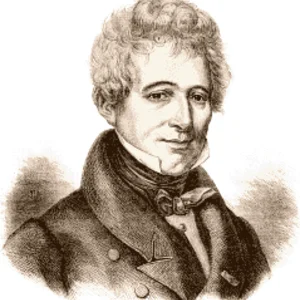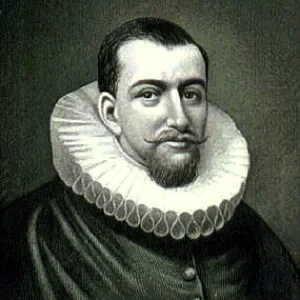

An English navigator and explorer of the early 17th century, Henry Hudson led four expeditions in search of a Northwest Passage to Asia. He gave his name to Hudson Bay in Canada, before disappearing during a mutiny by his crew in 1611.
Henry Hudson(1565 — 1611)
Henry Hudson
royaume d'Angleterre
9 min read
Frequently asked questions
Key Facts
- 1607: first expedition for the Muscovy Company in search of a polar route to Asia
- 1609: explores the river that will bear his name (the Hudson River) on behalf of the Dutch East India Company
- 1610–1611: fourth expedition, discovery and exploration of Hudson Bay
- 1611: crew mutiny; Hudson, his son, and a handful of loyal men are set adrift in a small boat and are never found
- His name is given to Hudson Bay, the Hudson River, and the Hudson Strait
Works & Achievements
Commissioned by the Muscovy Company, Hudson reached 80°23' North near Svalbard. His report on the abundance of whales and walruses triggered intense European hunting activity in these Arctic waters.
Again for the Muscovy Company, Hudson attempted a northeast passage via the Russian archipelago. Blocked by ice, he nonetheless gathered valuable cartographic data on the Arctic coastline.
In service of the Dutch VOC, Hudson explored the eastern coast of North America and sailed up the river that would bear his name as far as present-day Albany. This voyage opened the door to Dutch colonization of the region and the eventual founding of New York.
Funded by English merchants, Hudson entered the strait and then the vast bay that bear his name, mapping this interior region of Canada for the first time and paving the way for the future Hudson's Bay Company.
This journal kept by first mate Robert Juet is the primary written account of Hudson's explorations in North America, describing the landscapes, peoples encountered, and navigation conditions.
Anecdotes
In 1609, Hudson was sailing on behalf of the Dutch East India Company (VOC) with a mission to find a northeast passage to Asia. Blocked by ice off the coast of Norway, he made a bold and unexpected decision: he turned back and crossed the Atlantic to explore the coasts of North America, disobeying the orders of his employers. In this way, he sailed up the river that now bears his name as far as the present-day city of Albany.
During his fourth and final voyage in 1610–1611, Hudson and his crew spent the winter trapped in Hudson Bay under extreme conditions of cold and food scarcity. In the spring of 1611, a mutiny broke out: the rebellious sailors abandoned Hudson, his son John, and seven ailing companions on a small boat in the icy bay. They were never seen again.
On his first voyage in 1607, Hudson reached a latitude of 80°23' North near the Svalbard archipelago, a record for the time. He brought back valuable observations on the whales and walruses in these waters, which immediately sparked intense whaling activity by Europeans in those Arctic regions.
During his ascent of the Hudson River in 1609, he established trade contacts with several Native American nations, notably the Lenapes and the Mohicans. His men exchanged European manufactured goods (glass beads, knives) for precious furs, thereby laying the foundations for Dutch trade in the region that would eventually lead to the founding of New Amsterdam, the future New York.
Primary Sources
The fourth, in the morning, as soon as the day was light, we saw that it was good riding farther up. So we sent our boat to sound, and found that it was a very good harbour; and four or five fathoms, two cables' length from the shore.
Henry Hudson came out of his cabin and called some of the company to him ; and when Henry Greene and Wilson came to him, he told them that he marvelled that this action was begun without his knowledge, and that he was resolved to go through or end his days.
Hudson came within sight of the American coast at approximately 44 degrees north latitude, and followed the coast southward before turning north to explore a great inland river for a considerable distance.
We had the wind at south-southeast, a good gale; we lay north-northeast, and saw many whales and seals, and much ice; and so we fell with the land of Newland.
Key Places
Henry Hudson's likely birthplace and the port of departure for his expeditions. It was here that he was commissioned by the Muscovy Company and later by English merchants, and where he lived with his family between voyages.
During his first voyage in 1607, Hudson reached these Arctic islands at 80°23' North, one of the highest latitudes ever achieved by a European. He observed large concentrations of whales and walruses there, triggering a rush of European hunters to the region.
In 1609, Hudson sailed up this river from present-day New York to Albany — roughly 150 miles — believing he might find a passage to Asia. The river bears his name today in recognition of this exploration, which opened the way for Dutch colonization of the region.
Hudson entered this vast inland sea in 1610, convinced he had found the passage to the Pacific. His crew endured a brutal winter there, and it was here that a mutiny broke out in the spring of 1611, leading to his permanent disappearance.
On his second voyage in 1608, Hudson attempted to sail around this Arctic archipelago in search of a Northeast Passage to China. Blocked by ice, he was forced to turn back — an experience that deepened his conviction that the route to Asia lay to the west.
Typical Objects

An indispensable navigation instrument in the 17th century, it allowed Hudson to measure the altitude of the sun or stars to determine the ship's latitude. Without it, navigating in the unknown Arctic waters would have been impossible.

The compass guided Hudson by indicating magnetic north, essential for holding a course through fog and polar waters where visual landmarks vanish. Hudson carefully recorded magnetic variations in his logbook.

Every day, Hudson recorded weather conditions, depths sounded, encounters with local populations, and calculated positions. These logs were the primary source of knowledge about the regions he explored.

A rope fitted with a lead weight used to measure water depth in unknown bays and rivers. Hudson used it constantly to navigate safely through estuaries and avoid running aground.

These nautical charts depicted coastlines, ports, and known maritime hazards. Hudson updated and annotated them as he made new discoveries, passing them on to his backers and expanding the geographical knowledge of the era.

During his explorations in North America, Hudson carried European manufactured goods to trade with Native American peoples. These exchanges allowed him to obtain food, geographical information, and valuable furs.

Turned regularly by the watch crew to measure time, the hourglass allowed sailors to calculate the ship's speed and estimate the distance traveled. Aboard the *Half Moon*, it set the rhythm of the watches and the crew's maneuvers.
School Curriculum
Vocabulary & Tags
Key Vocabulary
Tags
Daily Life
Morning
Hudson rose at the first light of dawn to observe the sun with his astrolabe and determine the ship's latitude. He recorded his observations in the logbook before holding council with his officers on the day's course.
Afternoon
The afternoon was devoted to active navigation: Hudson supervised the ship's maneuvers, organized depth soundings in unknown waters, and had the coastlines charted to build his maps. In North America, he also arranged meetings and trade exchanges with the Native American peoples they encountered.
Evening
In the evening, Hudson compiled the day's observations into his log report: distances covered, heading held, nature of the coastlines, fauna and resources sighted. In Arctic waters, night watches were maintained continuously to keep lookout for icebergs and drifting ice.
Food
On board, the diet relied on long-lasting provisions: ship's biscuit (hard, dry crackers), salted or smoked meat and fish, dried legumes (peas, lentils), and weak beer substituting for water that was often unfit to drink. In Arctic regions, the crew hunted and fished to supplement their rations and try to ward off scurvy.
Clothing
Hudson wore the dress of a sea captain of the early seventeenth century: a thick wool jacket, baggy breeches, a linen shirt, woolen stockings, and waterproofed leather boots. In Arctic regions, additional fur-lined overcoats and thick hide gloves were essential for surviving the extreme temperatures.
Housing
At sea, Hudson occupied the captain's cabin at the ship's stern — the most private space on board, fitted with a bunk, a navigation table, and his measuring instruments. On land, between voyages, he lived in London with his wife Katherine and their sons, including John, who accompanied him on his last and fatal voyage.
Historical Timeline
Period Vocabulary
Liens externes & ressources
Références
Œuvres
Premier voyage arctique : exploration du Spitzberg et record de latitude
1607
Deuxième voyage : exploration des côtes de la Nouvelle-Zemble
1608
Troisième voyage : exploration du fleuve Hudson à bord du Half Moon
1609
Quatrième voyage : exploration du détroit et de la baie d'Hudson
1610-1611
Journal du voyage du Half Moon (via Robert Juet)
1609