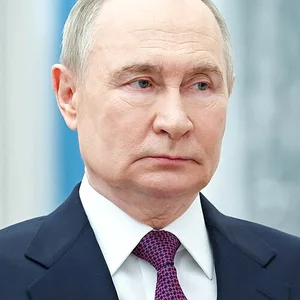

Russian statesman, President of the Russian Federation since 2000 (with an interlude as Prime Minister from 2008 to 2012). A former KGB officer, he concentrated power, pursued authoritarian policies, and launched the invasion of Ukraine in 2022.
Vladimir Putin(1952 — ?)
Vladimir Putin
Russie
6 min read
Frequently asked questions
Key Facts
- Came to power as acting president in late 1999, elected president in 2000
- Waged the Second Chechen War in the early 2000s
- Prime Minister from 2008 to 2012, then president again from 2012
- Annexation of Crimea in 2014
- Launched the full-scale invasion of Ukraine on 24 February 2022
Works & Achievements
Centralized reorganization of the Russian state, concentrating authority around the presidency at the expense of the regions and checks and balances.
Taking advantage of rising oil and gas prices, Russia experienced strong growth that boosted Putin's popularity.
A military campaign that cemented Putin's authority by suppressing Chechen separatism, at the cost of heavy destruction.
The incorporation of the Ukrainian peninsula into Russia, marking a turning point in relations with the West.
Military support for Bashar al-Assad's regime that restored Russian influence in the Middle East.
An amendment to the Constitution that reset his term-limit count, allowing him to remain in power beyond 2024.
A full-scale military offensive, the largest conflict in Europe since 1945, leading to Russia's international isolation.
Anecdotes
Before becoming a political leader, Vladimir Putin was a spy: he served as an officer in the KGB, the Soviet secret services, and was stationed in Dresden, in East Germany, during the 1980s. There he witnessed the fall of the Berlin Wall in 1989, an event that deeply shaped his worldview.
Putin is a black belt in judo and even co-wrote a book about the sport in 2000. He long cultivated his strongman image, being photographed bare-chested on horseback or practicing martial arts, to embody Russia's renewed power.
In 2008, barred by the Russian Constitution from serving a third consecutive presidential term, Putin became Prime Minister while his ally Dmitri Medvedev took over the presidency. In 2012, he returned to the Kremlin: this game of musical chairs allowed him to retain power without any real interruption.
Almost unknown to the general public, Putin was appointed Prime Minister by Boris Yeltsin in August 1999, then named acting president on 31 December 1999 when Yeltsin resigned by surprise on the last day of the millennium. His rise was therefore swift and unexpected.
In 2014, Putin's Russia annexed the Crimean Peninsula, which belonged to Ukraine, triggering heavy Western sanctions. Eight years later, in February 2022, he launched a full-scale invasion of Ukraine, the largest armed conflict in Europe since 1945.
Primary Sources
The collapse of the Soviet Union was the greatest geopolitical catastrophe of the century.
A unipolar world is a world in which there is one master, one sovereign. It is harmful not only for all those who live within this system, but also for the sovereign itself.
I have taken the decision to carry out a special military operation.
In the hearts and minds of the people, Crimea has always been an inseparable part of Russia.
Key Places
Putin's native city, then called Leningrad, where he grew up and began his political career in the 1990s. He worked for the city hall there after his career in the KGB.
Seat of Russian power and the president's official residence since 2000. It is the decision-making center of the Russian Federation.
City in East Germany where Putin was posted as a KGB officer in the 1980s. There he experienced the fall of the Berlin Wall in 1989.
Putin studied law here and graduated in 1975, before being recruited by the KGB. This is where he received his higher education.
Strategic port of the Russian Black Sea Fleet, at the heart of the annexation of Crimea in 2014. A symbolic site of Russia's expansionist policy.
Typical Objects

The “nuclear briefcase” (Cheget) accompanies the Russian president and symbolizes his control over the country's atomic arsenal. It embodies deterrence and the ultimate power of the head of state.

Putin, a black belt and judo enthusiast, has often linked his image to this martial art. The kimono symbolizes the discipline and strength he claims to embody.

The emblem of the Russian Federation, the two-headed eagle inherited from the tsars adorns official buildings and state documents. It symbolizes the historical continuity of Russian power.

Putin is often seen wearing expensive Swiss watches, which have become a much-discussed detail of his public image. They illustrate the lifestyle of Russia's ruling elite.

With its white, blue, and red stripes, the Russian flag restored in 1991 accompanies all of Putin's official speeches. It serves as a backdrop for his patriotic messaging.

From this lectern bearing the coat of arms, the president addresses the nation during his televised speeches. It is a stage for the display of Russian power.
School Curriculum
Vocabulary & Tags
Key Vocabulary
Daily Life
Morning
Known for sleeping in, Putin often begins his day with a sport session — swimming or weight training — followed by breakfast. His unusual working hours are well known to those around him.
Afternoon
His afternoons are filled with meetings with his ministers, official audiences, and security councils. He receives foreign heads of state and advisers in the salons of the Kremlin.
Evening
The evening often stretches late into the night with files and phone calls. Putin is known for keeping his counterparts waiting, even foreign leaders.
Food
He is said to favour a healthy diet: fish, meat, dairy products, and honey. He has a reputation for avoiding excess alcohol, unlike some of his predecessors.
Clothing
In public, he wears plain, well-cut dark suits, sometimes luxury watches. To cultivate his strongman image, he has also posed in sportswear, hunting gear, or diving outfits.
Housing
He has official residences, including the Kremlin and the Novo-Ogaryovo residence near Moscow. The press also mentions luxurious private properties, such as a vast “palace” on the shores of the Black Sea.
Historical Timeline
Period Vocabulary
Liens externes & ressources
Références
Œuvres
Verticale du pouvoir
années 2000
Redressement économique post-1998
2000-2008
Deuxième guerre de Tchétchénie
1999-2009
Annexion de la Crimée
2014
Intervention militaire en Syrie
2015
Réforme constitutionnelle de 2020
2020
Invasion de l'Ukraine
2022