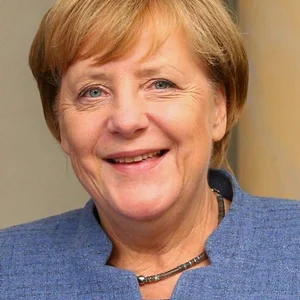

A physicist turned German politician, Angela Merkel led Germany as Chancellor from 2005 to 2021. The first woman to hold this position, she is one of the most influential political figures in contemporary European history.
Angela Merkel(1954 — ?)
Angela Merkel
Allemagne
9 min read
Frequently asked questions
Famous Quotes
« Wir schaffen das. (We can do this.)»
« Freedom does not defend itself; it must be won anew each day.»
Key Facts
- Born on July 17, 1954, in Hamburg, she grew up in East Germany
- PhD in quantum physics (1986)
- First woman elected Chancellor of Germany in 2005
- Re-elected three times, she led Germany until December 2021
- Played a central role in managing the eurozone crisis (2010–2015) and the refugee crisis (2015)
Works & Achievements
Following the Fukushima disaster, Merkel decided on Germany's definitive exit from nuclear energy and launched a massive renewable energy program. This bold policy turned Germany into a global laboratory for the ecological transition.
Faced with the looming bankruptcy of Greece, Spain, and Portugal, Merkel led European negotiations by imposing fiscal austerity while maintaining eurozone solidarity, saving the euro at the cost of major political tensions.
In the midst of the migration crisis, Merkel opened Germany's borders to more than one million refugees, proclaiming “Wir schaffen das.” This humanitarian decision, deeply controversial, remains the most symbolic and debated act of her sixteen years in office.
Together with President Hollande, Merkel led negotiations between Ukraine and Russia following the annexation of Crimea, resulting in the Minsk Agreements. She served as the principal Western mediator in dealings with Vladimir Putin.
Drawing on her scientific background, Merkel steered Germany's public health response with an unprecedented ability to communicate epidemiological data clearly, while coordinating the joint European procurement of Covid-19 vaccines.
Across Merkel's four terms, Germany maintained historically low unemployment and budget surpluses through the “Schwarze Null” (zero deficit) policy, making the country Europe's largest economy and a model of governance.
Anecdotes
Angela Merkel grew up in the German Democratic Republic (GDR), behind the Iron Curtain. The daughter of a Protestant pastor, she studied physics in Leipzig — a precise, rigorous discipline that shaped her taste for facts and figures. Nothing at the time suggested she would one day become the most powerful leader in Europe.
In November 1989, when the Berlin Wall fell, Angela Merkel was 35 years old. That historic evening, she first went to the public baths with a friend — as she did every Thursday — before joining the crowd crossing the checkpoints. This detail reveals her character: unflappable, methodical, never giving in to panic even in the most extraordinary moments.
Vladimir Putin, seeking to intimidate Merkel during negotiations in 2007, had his black Labrador Koni brought into the meeting room. He knew the Chancellor had been afraid of dogs since she was bitten as a child. Her discomfort is clearly visible in the footage, but she continued the discussions without flinching. She later confided: “I understood that he wanted to show me he is a courageous man.”
Angela Merkel is famous worldwide for her diamond-shaped hand gesture, nicknamed the “Merkel-Raute.” This natural gesture, which she makes while speaking, has become so iconic that it appeared on campaign posters and inspired emojis. Psychologists have analyzed it as an expression of calm, control, and focus.
In 2013, Edward Snowden’s revelations exposed that the American NSA had been tapping Angela Merkel’s personal mobile phone for years. Merkel, who had grown up under Stasi surveillance (East Germany’s secret police), reacted with rare indignation: “Spying among friends — that is simply not acceptable.” The affair permanently cooled German-American relations.
Primary Sources
Wir schaffen das. Germany is a strong country. The spirit with which we approach these things is the one that must guide our collective action as a nation.
The fall of the Berlin Wall showed that dreams can come true. Nothing should be taken for granted. Freedom is not given once and for all — it must be won and defended every single day.
This is serious. Please take it seriously. Since German reunification — no, since World War II — there has been no challenge to our nation that has demanded such a collective show of solidarity.
Europe is our shared future. We will only overcome the euro crisis together, and we will only preserve the European social model by remaining united around our core values.
I have always tried to do my best for our country. I wish you everything you need to carry out your important mission in the service of peace.
Key Places
The town where Angela Merkel grew up, in communist Germany. Her father, a pastor, settled there, and she spent her childhood and teenage years under the East German regime — an experience that profoundly shaped her views on freedom and democracy.
Merkel studied physics at Karl Marx University (now the University of Leipzig) and completed her doctorate in quantum chemistry there in 1986. The city represents the rigorous scientific training that remained central to her political method throughout her career.
The iconic crossing point of the Berlin Wall, which Merkel passed through on the evening of **9 November 1989**. This site symbolises her life lived between two Germanys and the political destiny born from reunification.
The seat of the German federal government where Merkel held power from **2005** to **2021**. Built after reunification, this building stands as a symbol of modern democratic Germany.
Merkel attended hundreds of European summits in Brussels, playing a decisive role in major crises — the Greek debt crisis, the refugee crisis, Brexit, and Covid. She is widely regarded as one of the most influential figures in the history of the European Union.
Typical Objects

Following the NSA wiretapping scandal revealed in 2013, Merkel used a highly secure phone provided by German intelligence services. This symbol illustrates the tensions between allies and the stakes of cybersecurity in the 21st century.

Merkel is recognizable by her brightly colored blazers (red, green, blue, orange) worn over a black base. This simple, repetitive style became her visual signature — a statement that she preferred to be defined by her ideas rather than by fashion.

Merkel was known for her meticulous preparation: she took extensive notes by hand and read through entire briefing files herself rather than relying on summaries from others. Her scientist's rigor carried directly into her political working method.

Merkel's modest retreat in the wooded Uckermark region of Brandenburg symbolizes her carefully guarded private life. There she hikes with her husband and cooks for herself, far from the protocol of the chancellery.

The glass-and-steel chancellery building in Berlin — nicknamed "the washing machine" by Berliners — was the symbol of Merkel's power for 16 years. This ultra-modern structure embodies reunified Germany.

During the 2020 health crisis, Merkel presented infection curves and mathematical models on television to explain the pandemic to the general public — drawing on her skills as a physicist in a display of scientific communication unprecedented for a head of government.
School Curriculum
Vocabulary & Tags
Key Vocabulary
Daily Life
Morning
Merkel rises early and begins her day with a thorough press review that she reads herself. She has a simple breakfast, often dark bread with quark — typical of East German habits. Her staff note that she is particularly focused and decisive in the mornings.
Afternoon
Her afternoons as Chancellor are devoted to cabinet meetings, ministerial briefings, and meetings with foreign heads of state. Merkel is known for her active listening and her ability to never raise her voice, even in the most tense negotiations. She reads technical files herself rather than delegating their analysis entirely.
Evening
During crisis EU summits, Merkel can work until three or four in the morning, often outlasting her counterparts through sheer endurance. When not traveling, she returns to the Berlin apartment she shares with her husband Klaus Bodenbauer, a chemistry professor, and cooks traditional German dishes such as goulash or potato soup.
Food
Merkel has simple, typically German tastes: dark bread (*Schwarzbrot*), pickled herring, potatoes, sauerkraut. She avoids the lavish formal dinners of official summits and prefers to eat quickly. She has admitted to enjoying German beer and is a willing regular at the Oktoberfest in Munich.
Clothing
Merkel wears almost exclusively coloured blazers paired with black trousers. This deliberate uniformity allows her, she says, to avoid wasting time choosing outfits. Unlike many female political figures, she has refused to be judged on her appearance rather than her ideas.
Housing
Throughout her chancellorship, Merkel lived in a relatively modest apartment in the Mitte district of Berlin, located above a restaurant — declining the official residence. That choice symbolises her desire to remain close to ordinary life. She also owns a holiday home in the Uckermark, a forested region north of Berlin, where she recharges on weekends.
Historical Timeline
Period Vocabulary
Liens externes & ressources
Références
Œuvres
Energiewende (Transition énergétique allemande)
2011
Gestion de la crise de la zone euro
2010-2015
Politique d'accueil des réfugiés syriens ('Willkommenskultur')
2015
Accords de Minsk (médiation dans le conflit ukrainien)
2014-2015
Gestion de la pandémie de Covid-19 et coordination européenne des vaccins
2020-2021
Seize ans de stabilité économique allemande
2005-2021