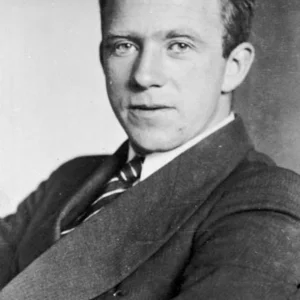

German physicist (1901–1976), one of the founders of quantum mechanics. He formulated the uncertainty principle in 1927, which bears his name, revolutionizing the conception of physical reality. Winner of the Nobel Prize in Physics in 1932.
Werner Heisenberg(1901 — 1976)
Werner Heisenberg
Troisième Reich, république de Weimar, Empire allemand, Allemagne de l'Ouest
9 min read
Frequently asked questions
Famous Quotes
« Natural science does not simply describe and explain nature; it is part of the interplay between nature and ourselves.»
« The first sign that we are dealing with an important result is that it overturns the entire structure of our thinking.»
Key Facts
- 1925: formulates matrix mechanics, the first coherent formulation of quantum mechanics
- 1927: states the uncertainty principle (Heisenberg relations)
- 1932: receives the Nobel Prize in Physics for the creation of quantum mechanics
- 1939–1945: leads the German nuclear research program (Uranverein)
- 1958: publishes his philosophical reflections on physics in 'Physics and Philosophy'
Works & Achievements
The founding paper of quantum mechanics, published in Zeitschrift für Physik. Heisenberg replaces classical quantities with arrays of numbers (matrices) to describe the properties of atoms, inaugurating a physics based solely on observable quantities.
In collaboration with Max Born and Pascual Jordan, Heisenberg developed the complete formulation of matrix mechanics. Together with the Schrödinger equation, this coherent formalism constitutes one of the two equivalent mathematical pillars of quantum mechanics.
Heisenberg demonstrated that it is fundamentally impossible to simultaneously measure, with arbitrary precision, both the position and the momentum of a particle. This result revolutionized the conception of physical reality and stands as one of the philosophical cornerstones of quantum mechanics.
A collection of his lectures at the University of Chicago, this book synthesizes the principles of quantum mechanics in an accessible way. It remains a classic reference, reflecting Heisenberg's ability to articulate the philosophical implications of the new physics.
A work for general audiences in which Heisenberg examines the philosophical implications of quantum mechanics for our understanding of reality, causality, and knowledge. Translated into numerous languages, this book helped bring the philosophical questions raised by modern physics to a wider public.
Anecdotes
In June 1925, suffering from hay fever, Heisenberg retreated to the remote island of Helgoland, in the North Sea. Working feverishly through the night, he developed the mathematical equations that would lay the foundations of quantum mechanics. At dawn, too agitated to sleep, he climbed a rock to watch the sunrise, aware that he had accomplished something fundamental.
At his doctoral defense in Munich in 1923, his examiner Wilhelm Wien asked him practical questions about the resolving power of a microscope and how a storage battery works. Heisenberg was unable to answer correctly. Wien wanted to fail him, but his supervisor Sommerfeld intervened on his behalf: he was awarded the bare minimum passing grade, which deeply humiliated the brilliant young man.
In August 1945, Heisenberg and nine other German physicists were interned at Farm Hall, in England. When the BBC announced the atomic bombing of Hiroshima, Heisenberg initially refused to believe it, convinced that the Allies could not have built a real atomic bomb. Their conversations, secretly recorded by the British, reveal his doubts and his after-the-fact rationalizations.
Heisenberg was a pianist of near-professional standard, and in his youth had hesitated between music and physics. Throughout his life he continued to play Beethoven and Schubert. During his stays at Bohr's Institute in Copenhagen, musical evenings were as frequent as scientific debates, with Bohr himself joining in the passionate discussions on physics and philosophy.
On the night of 7–8 June 1925, on Helgoland, Heisenberg realized that his calculations were finally coming together. He later wrote: “I had the feeling that, through the surface of atomic phenomena, I was looking at a strangely beautiful interior.” He made so few errors in his calculations that the results seemed almost too beautiful to be true, which made him suspicious of them himself.
Primary Sources
In this work an attempt will be made to obtain foundations for a quantum-theoretical mechanics based exclusively on relations between quantities that are in principle observable.
One cannot simultaneously determine the position and velocity of a particle with arbitrary precision. The uncertainties are connected by the relation q₁ p₁ ≥ h.
Quantum theory no longer describes physical reality as it is in itself, but only what can be known of it through experience. The observer forms an integral part of the observed system.
It seemed at first that the new quantum mechanics, which dealt with unvisualizable atomic processes, had broken completely with the ordinary ideas of space and time.
The probability function combines objective and subjective elements. It contains statements about possibilities or better tendencies, and these tendencies are completely objective, they do not depend on any observer.
Key Places
Birthplace of Werner Heisenberg, born on December 5, 1901. He later grew up in Munich, where his father, a professor of medieval Greek, was appointed to the university.
Heisenberg worked here under Max Born from 1922 onward. It was in the intellectual ferment of Göttingen — one of the world's great centers of mathematics — that the decisive collaboration between Born, Heisenberg, and Jordan on matrix mechanics took shape.
Heisenberg spent extended periods in Copenhagen under the mentorship of Niels Bohr, his most important intellectual guide. It was here that the Copenhagen interpretation of quantum mechanics was developed, and where Heisenberg formulated his uncertainty principle in 1927.
In June 1925, Heisenberg retreated to this rocky island to escape his pollen allergy. It was there, over a few days of intense work, that he worked out the mathematical foundations of quantum mechanics — one of the most important discoveries of the twentieth century.
Heisenberg held a full professorship in theoretical physics here from 1927 to 1941, appointed at just 25 years of age. His Leipzig laboratory became an international center for quantum physics, drawing students from across Europe.
After Germany's surrender in May 1945, Heisenberg was detained along with nine other German physicists at this English country house for six months. Their secretly recorded conversations were published in 1992 and shed controversial light on the true progress of the German nuclear program.
Typical Objects

Heisenberg worked through his demonstrations on large blackboards in lecture halls and laboratories. His developments in matrix mechanics filled entire pages with abstract mathematical symbols, incomprehensible to the uninitiated.

The analysis of hydrogen's spectral lines — those precise colors emitted by heated atoms — was the starting point for Heisenberg's work. Explaining why these lines had exactly those frequencies was the great mystery that quantum mechanics had to solve.

An accomplished musician, Heisenberg played piano at a near-professional level. Throughout his life, he found in the music of Beethoven and Bach a counterpoint to mathematical abstraction, seeing in both disciplines the same search for hidden structures of reality.

Heisenberg and Pauli exchanged hundreds of handwritten letters, dense with calculations and philosophical discussions. These letters constitute one of the most precious archives in the history of modern physics, showing how quantum ideas were built through dialogue.

This German scientific journal was the main publication venue for the foundational works of quantum mechanics in the 1920s. Heisenberg published his major articles there, and their reception in the international scientific community came largely through this journal.

During his isolated stay on Helgoland in 1925, Heisenberg filled notebooks with laborious calculations to develop his matrix mechanics. These working notes illustrate the iterative process — full of crossings-out and fresh starts — that led to a conceptual revolution.
School Curriculum
Vocabulary & Tags
Key Vocabulary
Daily Life
Morning
Heisenberg started his mornings early, often before 7 a.m., with a review of scientific publications and an initial hour of solitary reflection before students arrived. He ate a frugal breakfast — black coffee and dark bread, typical of Bavarian bourgeois austerity — then walked to his office to be in the laboratory by 8 o'clock.
Afternoon
Afternoons were devoted to seminars, discussions with doctoral students, and visits from colleagues. At Leipzig and later Munich, his office door was always open: physicists from around the world came to debate quantum problems in informal exchanges that were sometimes more fruitful than any publication. Correspondence with Bohr, Pauli, and Einstein also took up a significant portion of his time.
Evening
In the evenings, Heisenberg turned to the piano, playing Beethoven, Bach, or Schubert for up to two hours at a time. He frequently attended the intellectual and musical gatherings that were a fixture of German university life. An avid hiker, he enjoyed walking in the Bavarian mountains on weekends — a practice he kept up throughout his life.
Food
Heisenberg's eating habits reflected the Bavarian bourgeois customs of his era: hot meals at midday and in the evening, meat and seasonal vegetables, nothing extravagant. During periods of intense work — particularly on Helgoland — he ate very simply, eager to return to his calculations. The austerity at the table stood in sharp contrast to the richness of his intellectual exchanges.
Clothing
Heisenberg favored the understated dress of the German university professor of the 1920s–1950s: dark suit, tie, white shirt. In official photographs he typically wears a three-piece suit, reflecting the academic seriousness of the period. In mountain huts or on Helgoland, he wore practical Bavarian hiking clothes.
Housing
Heisenberg lived successively in university rooms in Munich, Göttingen, and Copenhagen, then in professorial apartments in Leipzig and Munich. He owned a holiday home at Urfeld am Walchensee in Upper Bavaria, where he retreated toward the end of the war and continued to spend his vacations, finding renewal in the Bavarian lakes and mountains far from the controversies that surrounded him.
Historical Timeline
Period Vocabulary
Liens externes & ressources
Références
Œuvres
Über quantentheoretische Umdeutung kinematischer und mechanischer Beziehungen
1925
Mécanique matricielle (avec Born et Jordan)
1925-1926
Principe d'incertitude
1927
The Physical Principles of the Quantum Theory
1930
Physics and Philosophy: The Revolution in Modern Science
1958