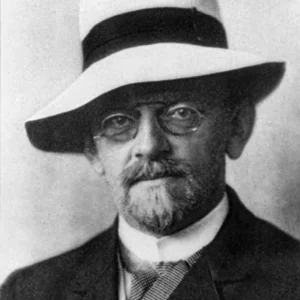

German mathematician (1862–1943), one of the most influential of his era. In 1900, he formulated the 23 problems that would guide mathematical research throughout the 20th century, and sought to establish mathematics on rigorous formal foundations.
David Hilbert(1862 — 1943)
David Hilbert
Troisième Reich, royaume de Prusse, république de Weimar, Empire allemand
8 min read
Frequently asked questions
Famous Quotes
« We must know, we will know.»
« Mathematics is a science that knows no boundaries.»
Key Facts
- 1862: born in Königsberg (Prussia)
- 1900: presentation of the 23 problems at the International Congress of Mathematicians in Paris
- 1899: publication of Foundations of Geometry, refounding Euclidean geometry on rigorous axioms
- 1915: independent formulation of the equations of general relativity
- 1943: death in Göttingen
Works & Achievements
A foundational work in which Hilbert completely reformulates Euclidean geometry from a rigorous axiomatic system. It inaugurates the modern axiomatic method and has had a lasting influence on the philosophy of mathematics.
A lecture delivered at the International Congress of Mathematicians in Paris in which Hilbert sets out 23 open problems. This research program shaped the entire course of twentieth-century mathematics.
A body of work on integral equations that leads to the notion of Hilbert space, a fundamental tool in quantum mechanics and modern functional analysis.
A landmark reference in mathematical physics, synthesizing the mathematical tools required for theoretical physics. Remaining a classic, it was used by several generations of physicists.
The first systematic exposition of first-order logic, notably posing the decision problem. A foundational work of modern mathematical logic.
A two-volume treatise laying out Hilbert's program for the formal foundations of mathematics. Although Gödel had already demonstrated its limitations, the work remains an essential reference in mathematical logic.
Anecdotes
In August 1900, at the International Congress of Mathematicians in Paris, David Hilbert presented a list of 23 unsolved problems he considered essential for the future of mathematics. This address, delivered before the world's mathematical elite, largely shaped research throughout the twentieth century: several of these problems remain open to this day.
On September 8, 1930, at his retirement ceremony in Königsberg, Hilbert delivered a radio-broadcast speech he concluded with these now-famous words: “Wir müssen wissen, wir werden wissen” — “We must know, we will know.” This motto, inscribed on his tombstone, encapsulates his absolute optimism in the progress of human knowledge.
Hilbert devoted many years to his “program,” which aimed to ground all of mathematics in a complete, consistent, and decidable system of axioms. In 1931, the young logician Kurt Gödel proved that this project was impossible: any sufficiently powerful formal system contains truths that cannot be proved within it. Hilbert, already elderly, had to accept that his grand project was doomed.
When a Nazi minister asked Hilbert at a dinner in 1934 whether mathematics at Göttingen had suffered from the departure of the Jewish professors, he replied laconically: “Suffered? It no longer exists, Minister.” Within a matter of months, the racial purges had indeed annihilated what had been the greatest school of mathematics in the world.
Hilbert was known for his long daily walks through the streets of Göttingen, chalk in hand, sometimes stopping to scribble a formula on a wall or a fence. His students and colleagues often joined him, and these walks became informal working sessions where the greatest problems in the discipline were debated.
Primary Sources
Who of us would not be glad to lift the veil behind which the future lies hidden; to cast a glance at the next advances of our science and at the secrets of its development during future centuries!
The present investigation is a new attempt to establish for geometry a complete and as simple as possible system of axioms, and to deduce from them the most important geometrical theorems in such a way that the significance of the different groups of axioms and the scope of the conclusions to be drawn from the individual axioms stand out as clearly as possible.
We must know. We will know. In mathematics there is no ignorabimus.
Mathematics — as we understand it here — is a discipline carried out by purely formal means, i.e., without regard for the meaning of the symbols used.
If one examines the method of axiomatic investigation more closely, one recognizes that this method possesses a general scientific significance far beyond mathematics.
Key Places
Hilbert's birthplace, also the hometown of Immanuel Kant. It was here that he completed his studies and defended his doctoral thesis in 1885 before leaving for Göttingen.
Hilbert taught here from 1895 until his retirement in 1930, transforming it into the world center of mathematics and drawing the greatest minds of the era — Minkowski, Courant, Emmy Noether, Born, Weyl.
It was in the lecture hall of the Sorbonne that Hilbert delivered his famous address on the 23 problems in August 1900, before mathematicians from around the world gathered for the international congress.
Hilbert maintained regular ties with the Prussian Academy of Sciences, where he presented several landmark papers and where the great scientific debates of the era were played out.
Typical Objects

Hilbert was a masterful lecturer, filling blackboards with lengthy proofs. He was renowned for his pedagogical clarity and often carried chalk even on his walks.

This book, which grew out of his lectures, was revised and expanded by Hilbert through its seventh edition. For him it served both as a working tool and as the emblem of his axiomatic method.

Hilbert maintained an extensive correspondence with mathematicians around the world — Einstein, Minkowski, Cantor, Klein — through handwritten letters, which were then the primary medium of scientific exchange.

Hilbert regularly cycled around Göttingen and its surroundings. This mode of transport, characteristic of the German intellectual bourgeoisie of the time, accompanied his habit of thinking outdoors.

Hilbert was long associated with this journal, the flagship publication of German mathematics. Appearing in the *Annalen* was a mark of recognition for any mathematician of the era.

An indispensable analogue calculating instrument before the age of electronic calculators, the slide rule was found on the desks of scientists throughout the Wilhelmine and Weimar periods.
School Curriculum
Vocabulary & Tags
Key Vocabulary
Daily Life
Morning
Hilbert rose early and devoted the first hours of the morning to mathematical reflection, often alone in his study or on a morning walk through the streets of Göttingen. He would then prepare his lectures, renowned for their clarity and pedagogical rigor, and sometimes received his doctoral students before heading to the university.
Afternoon
Afternoons were often dedicated to teaching, seminars, and discussions with colleagues and students. Hilbert led informal working sessions, famous for their stimulating atmosphere, where both open problems and foundational questions were explored. He regularly attended meetings of the Göttingen mathematical school.
Evening
In the evenings, Hilbert enjoyed gathering with friends and colleagues in the cafés and brasseries of Göttingen, particularly at the Ratskeller. These lively dinners blended mathematics, philosophy, and political discussion. He was known for his sharp wit, memorable quips, and a sense of conviviality that was rare in the austere academic circles of the time.
Food
Hilbert followed a typically bourgeois German diet of the late nineteenth and early twentieth century: rye bread, cold cuts, potatoes, seasonal vegetables, and beer on outings. His wife Käthe managed the household; he was little concerned with culinary matters, preferring to get through meals quickly and return to his work.
Clothing
Hilbert dressed in the manner of a Wilhelmine university professor: dark three-piece suit, starched white collar, and tie for formal occasions. Around town or on walks, he often wore an overcoat and hat, and sometimes sported a panama hat in summer. His appearance was neat without being ostentatious, in keeping with the norms of the German academic bourgeoisie.
Housing
Hilbert spent most of his life in a comfortable middle-class house in Göttingen at 29 Wilhelm-Weber-Straße, with his wife Käthe and their son Franz. The spacious, well-kept house included a personal study where he worked, as well as a garden he tended with pleasure. This stable and comfortable setting allowed him to devote himself entirely to his research for more than thirty-five years.
Historical Timeline
Period Vocabulary
Liens externes & ressources
Références
Œuvres
Grundlagen der Geometrie
1899
Mathematische Probleme (Les 23 problèmes)
1900
Théorie des équations intégrales et espaces de Hilbert
1904–1912
Methoden der mathematischen Physik (avec Richard Courant)
1924
Grundzüge der theoretischen Logik (avec Wilhelm Ackermann)
1928
Grundlagen der Mathematik (avec Paul Bernays)
1934–1939