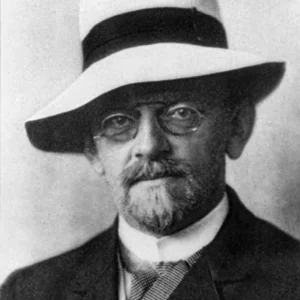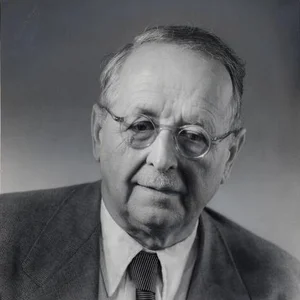

German mathematician and theoretical physicist (1885–1955), Hermann Weyl profoundly transformed geometry, topology, and mathematical physics. He made major contributions to group theory, general relativity, and quantum mechanics.
Hermann Weyl(1885 — 1955)
Hermann Weyl
États-Unis, Suisse, Allemagne, république de Weimar, Empire allemand
8 min read
Frequently asked questions
Famous Quotes
« Logic is the foundation of mathematics, and mathematics is the foundation of all the sciences.»
« My decision to follow Hilbert to Göttingen was the most important decision of my intellectual life.»
Key Facts
- 1885: Born in Elmshorn, Germany
- 1913: Publication of 'The Concept of a Riemann Surface', a foundational work in geometry
- 1918: Attempt to unify gravitation and electromagnetism in 'Space, Time, Matter'
- 1933: Emigration to the United States (Institute for Advanced Study, Princeton) to flee Nazism
- 1955: Death in Zurich
Works & Achievements
Weyl's first major work, it unifies and clarifies the theory of Riemann surfaces by combining complex analysis with nascent topology, paving the way for modern differential geometry and topology.
A mathematically rigorous presentation of Einstein's general relativity, regarded as one of the finest introductions to the theory; the book went through five successive editions and remains a classic reference in mathematical physics.
An essay on the foundations of mathematical analysis in which Weyl questions certain logical underpinnings of actual infinity and proposes a partial reconstruction of calculus on constructivist foundations.
A revolutionary concept introduced in an attempt to unify gravitation and electromagnetism; although its original form required corrections, the idea of local gauge symmetry would become the central principle of all modern particle physics.
A landmark work applying symmetry group theory to quantum mechanics; it would have a lasting influence on theoretical physics, quantum chemistry, and solid-state physics as a whole.
A monumental treatise on the classical groups of linear transformations, which has become an essential reference in algebra, differential geometry, and mathematical physics.
A popular science book exploring the concept of symmetry in mathematics, physics, decorative arts, and the living world, showcasing Weyl's exceptional ability to bridge science and humanistic culture.
Anecdotes
In 1918, Hermann Weyl proposed a revolutionary theory to unify gravitation and electromagnetism by extending Einstein's general relativity. To do so, he invented the concept of “gauge invariance” (Eichtheorie), an idea so fruitful that it would become, decades later, the foundation of all modern particle physics. Einstein himself wrote to Weyl to say it was “a masterpiece,” while raising a major physical objection that forced Weyl to revise his approach.
Weyl was one of the most brilliant students of David Hilbert, the greatest mathematician of his era, at the University of Göttingen. In 1930, when Hilbert retired, it was Weyl who was chosen to succeed him in the most prestigious mathematics chair in Germany — a symbolic succession that reflected the immense esteem the scientific community held for him.
In 1933, as soon as Hitler came to power, Weyl decided to leave Germany and join the Institute for Advanced Study in Princeton, refusing to lend any legitimacy to the Nazi regime. His wife was of Jewish descent, which made the situation additionally dangerous for their family. He thus joined Einstein and other exiled scholars who were turning Princeton into a new world center of mathematics.
Weyl had a rare passion for philosophy and the humanities, unusual among scientists of his caliber. He was deeply influenced by the philosopher Edmund Husserl and devoted his entire life to the foundations of mathematics, particularly Brouwer's intuitionism. His work “Philosophie der Mathematik und Naturwissenschaft” (1927) remains a classic at the boundary of science and philosophy.
Late in his life, Weyl published a small book entitled “Symmetry” (1952), aimed at the general public, in which he explored the notion of symmetry through art, nature, and mathematics. Illustrated with numerous visual examples drawn from Islamic art, crystallography, and biology, the work reflects his deep conviction that mathematical beauty and artistic beauty share a common source.
Primary Sources
Riemannian geometry provides the natural mathematical framework in which Einstein's theory of gravitation takes on its full meaning. Space is not a rigid, pre-existing container, but a dynamic structure shaped by the presence of matter.
Group theory provides the appropriate mathematical language for describing the fundamental symmetries of quantum mechanics and the structural properties of atoms and molecules.
Riemann surfaces constitute the natural mathematical object for studying analytic functions of a complex variable in their full topological generality, reconciling analysis and geometry.
Symmetry, as wide or as narrow as you may define its meaning, is one idea by which man through the ages has tried to comprehend and create order, beauty, and perfection.
The notion of the mathematical continuum can only be rigorously grounded by profoundly revising the logical foundations of analysis, abandoning certain forms of actual infinity that go beyond what intuition can legitimately grasp.
Key Places
Birthplace of Hermann Weyl, born here on November 9, 1885. A small town in northern Germany, it shaped his origins in a middle-class family during the industrial expansion of Wilhelmine Germany.
The world center of mathematics in the early twentieth century, it was here that Weyl studied under Hilbert, defended his doctoral thesis, and returned in 1930 to succeed his mentor — before fleeing the Nazi regime in 1933.
Weyl taught mathematics here from 1913 to 1930; it was in this stimulating intellectual environment — where Einstein himself had studied — that he wrote his major works on relativity and group theory.
Exiled from Germany in 1933, Weyl joined this elite institute founded two years earlier, where he worked alongside Einstein and other eminent European refugees, remaining until his retirement in 1951.
Weyl chose to return to Zurich after his retirement from Princeton; he died there on December 8, 1955, in the city that had sheltered his most creative years and where he felt deeply at home.
Typical Objects

An indispensable daily tool for the mathematician, Weyl used it to present his proofs during lectures and seminars at Göttingen, Zurich, and Princeton, unfolding his geometric reasoning with great pedagogical clarity.

Weyl wrote his research and books by hand, filling pages with formulas, geometric diagrams, and carefully articulated philosophical arguments before sending them to the printer.

These visual representations of multi-sheeted complex surfaces lay at the heart of his early work and reflected his taste for intuitive geometry as a guide to abstract thought.

Weyl exchanged hundreds of letters with Einstein, Hilbert, Schrödinger, and other scholars; this correspondence bears witness to the intensity of the scientific debates of the era and to the international community of mathematicians.

Weyl owned and heavily annotated the writings of Husserl, Brouwer, and Kant, whose ideas continually nourished his thinking on the foundations of mathematics and the nature of space.

Fascinated by symmetry in nature, Weyl collected geometric representations of symmetry groups and ornamental patterns illustrating the seventeen wallpaper groups of the plane, which he drew upon in *Symmetry*.
School Curriculum
Vocabulary & Tags
Key Vocabulary
Tags
Daily Life
Morning
Weyl began his day early, devoting the first hours to solitary mathematical work in his study, which he found most conducive to deep concentration. He wrote his research by hand, slowly filling pages with formulas and carefully chained reasoning, sometimes interspersed with philosophical remarks in the margins.
Afternoon
The afternoon was shaped by teaching: seminars, lectures, and in-depth discussions with advanced students, whether at Göttingen, ETH Zurich, or Princeton. Weyl placed great importance on clarity of exposition and took care to connect technical results to their deeper philosophical significance.
Evening
In the evenings, Weyl devoted himself to reading philosophy — Husserl, Kant, Brouwer — and to corresponding with colleagues across Europe and America. He loved music and the arts, and maintained an active cultural life typical of the educated German-speaking upper middle class of his era.
Food
Weyl led a sober life in keeping with the habits of the cultivated German and Swiss bourgeoisie: structured meals, traditional European cuisine based on meat, vegetables, and bread, with no particular excess. In Princeton, he gradually adopted certain American dietary habits while preserving his European traditions at family meals.
Clothing
Weyl dressed with the elegant restraint of the European university professor of the time: dark suit, carefully knotted tie, and tailored jacket — formal attire that underscored the dignity of the professorial role and matched the strict academic customs of Göttingen and Zurich, a marked contrast to the relative informality he discovered at Princeton.
Housing
In Zurich and Göttingen, Weyl lived in comfortable bourgeois apartments, close to his workplace and the university library. In Princeton, he resided in a well-appointed house in the university neighborhood, as was customary for members of the IAS, in a leafy, tranquil setting conducive to reflection and visits from colleagues.
Historical Timeline
Period Vocabulary
Liens externes & ressources
Références
Œuvres
Die Idee der Riemannschen Fläche
1913
Raum, Zeit, Materie
1918
Das Kontinuum
1918
Théorie de jauge (Eichtheorie)
1918-1929
Gruppentheorie und Quantenmechanik
1928
The Classical Groups: Their Invariants and Representations
1939
Symmetry
1952