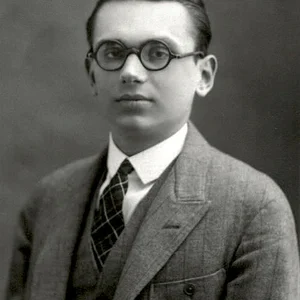

Austrian-American mathematician (1906–1978), Kurt Gödel revolutionized mathematical logic with his incompleteness theorems (1931). He proved that no sufficiently powerful formal system can be both complete and consistent.
Kurt Gödel(1906 — 1978)
Kurt Gödel
États-Unis, Autriche, Tchécoslovaquie, Cisleithanie
9 min read
Frequently asked questions
Famous Quotes
« The truth of a mathematical proposition does not depend on its provability.»
« I am convinced that the existence of the world is easier to prove than the existence of God.»
Key Facts
- 1906: born in Brünn (Brno), then part of Austria-Hungary
- 1931: publication of the incompleteness theorems in *Über formal unentscheidbare Sätze*
- 1938: proves the consistency of the continuum hypothesis with the Zermelo-Fraenkel axioms
- 1940: emigrates to the United States, joins the Institute for Advanced Study in Princeton
- 1978: dies in Princeton, a victim of malnutrition after refusing to eat
Works & Achievements
Gödel proves that every logically valid statement of first-order predicate calculus can be proven from a finite set of axioms. This is his first major contribution, which immediately established his reputation as an exceptional logician.
His masterwork: any consistent formal system expressive enough to describe basic arithmetic contains truths that cannot be proven within it, and cannot prove its own consistency. These results permanently overturned Hilbert's program and the foundations of mathematics.
Gödel proves that the axiom of choice and the continuum hypothesis cannot be refuted from the Zermelo-Fraenkel axioms. Combined with Cohen's result (1963), this establishes that these questions are fundamentally undecidable.
As a tribute to Einstein on his 70th birthday, Gödel proposes solutions to the equations of general relativity that admit closed timelike curves, theoretically implying the possibility of time travel. Einstein himself was struck by this unexpected cosmological result.
A philosophical essay in which Gödel defends mathematical realism (Platonism) and asserts that mathematical objects exist independently of the human mind. He expresses his conviction that the continuum problem has an objective answer, even if our current systems cannot find it.
A rigorous formalization in modal logic of Anselm of Canterbury's ontological argument, developed in secret and never published during his lifetime. Discovered in his posthumous notebooks, it is now studied by logicians and philosophers of religion alike.
Anecdotes
In 1948, during his interview to obtain American citizenship, Gödel warned the judge that he had discovered a logical contradiction in the United States Constitution that would theoretically allow the establishment of a legal dictatorship. Einstein and Oskar Morgenstern, his witnesses, had to interrupt him to avoid a diplomatic incident. The judge, amused, nonetheless granted him citizenship.
Every day at Princeton, Gödel and Albert Einstein would take a long walk together from the Institute for Advanced Study. Einstein once confided that his main reason for continuing to come to the Institute was “the privilege of walking home in Gödel’s company.” These two geniuses formed a legendary intellectual duo, admired by all their colleagues.
Gödel was a hypochondriac and feared being poisoned: he would only accept meals prepared by his wife Adele. When she was hospitalized for six months in 1977–1978, he refused to eat, convinced that no one else could do so safely. He died on January 14, 1978, of severe malnutrition, weighing no more than 30 kilograms.
When Gödel presented his incompleteness theorems in 1930 at the Königsberg congress, only John von Neumann immediately grasped their revolutionary significance. He spoke at length with Gödel after the session and, back in Princeton, developed an alternative proof himself — only to learn that Gödel had already written one.
Gödel was convinced he had established a formal proof of the existence of God, formulated in modal logic. He never dared publish it during his lifetime, fearing it would harm his scientific reputation. Found in his notebooks after his death, this ontological proof is now studied by logicians and philosophers around the world.
Primary Sources
It can be shown that in any sufficiently powerful consistent formal system, there exist propositions that can neither be proved nor disproved within that system.
Every valid statement of first-order predicate logic can be proved from the axioms of the predicate calculus — the logical calculus is therefore complete.
The axiom of choice and the generalized continuum hypothesis are consistent with the axioms of Zermelo-Fraenkel set theory: their negation cannot be proved within that framework.
The continuum problem asks whether there exists an infinite set whose cardinality lies strictly between that of the natural numbers and that of the real numbers. The answer cannot be deduced from the standard axioms of mathematics.
I have discovered in the United States Constitution certain legal provisions that would make it possible to establish a legal tyranny, though no one seems to have noticed this so far.
Key Places
Gödel's birthplace, then a multicultural intellectual and industrial center of the Austro-Hungarian Empire. It was in this city that Gödel spent his childhood and received his early schooling.
The place where Gödel studied and worked from 1924 to 1939. It was here that he participated in the Vienna Circle, defended his doctoral thesis, and developed his famous incompleteness theorems, which would revolutionize mathematics.
The institution where Gödel worked from 1940 until his death in 1978, alongside Einstein and other leading scientists. It was here that he produced his work on set theory, cosmology, and the philosophy of mathematics.
The city where Gödel first publicly mentioned his incompleteness theorems at the 1930 congress on the philosophy of science, in a presentation whose revolutionary significance only von Neumann immediately grasped.
The modest house where Gödel and his wife Adele lived during their American years, a short walk from the IAS. The workrooms were filled with books and notebooks; Gödel rarely received visitors there.
Typical Objects

Gödel filled entire notebooks with logical symbols and formal proofs, written in Gabelsberger German shorthand to conceal his thoughts. His Nachlass, preserved at Princeton, bear witness to the extreme rigor and extraordinary volume of his thinking.

This three-volume work, studied meticulously by Gödel in Vienna, is the formal system that his incompleteness theorems helped to demystify: even this monument of rigor could not prove all arithmetical truths.

Gödel was known at Princeton for the long white coat he wore during his daily walks with Einstein. This characteristic attire made him instantly recognizable on the IAS campus.

A notorious hypochondriac, Gödel took his temperature several times a day and recorded his observations in a meticulous health diary. This obsession with monitoring his body was one of the most visible expressions of his chronic anxiety.

Gödel typed his scientific and administrative correspondence with characteristic precision and rigor. His letters to Einstein, von Neumann, and Morgenstern are now historical documents of the first importance.

At the Institute for Advanced Study, Gödel used the blackboards in seminar rooms to present his proofs during rare public lectures, generally preferring solitary work in his office.
School Curriculum
Vocabulary & Tags
Key Vocabulary
Tags
Daily Life
Morning
Gödel rose late, often after 10 a.m. He ate a light breakfast prepared exclusively by his wife Adele, sometimes scrutinizing its contents with suspicion. He would begin his day by reading scientific correspondence and carefully reviewing his notebooks.
Afternoon
Afternoons were often devoted to long walks with Einstein on the IAS campus, during which the two men debated physics, logic, and philosophy. Back in his office, Gödel worked on his proofs with intense concentration, generally refusing visitors and declining most social invitations.
Evening
Gödel was fond of working very late into the night, finding the nocturnal quiet conducive to mathematical reflection. He recorded his ideas in his notebooks using Gabelsberger shorthand. He would sometimes watch television with Adele while keeping his medications and thermometer close at hand.
Food
His diet was extremely restricted out of fear of poisoning: he would only accept food prepared by Adele. He mostly ate simple foods — cereals, butter, milk — and took numerous medications and dietary supplements. This obsession worsened dramatically over the years, ultimately leading to his death by self-starvation in 1978.
Clothing
In Princeton, Gödel was recognizable by the distinctive long white coat he wore on his walks. In winter, he dressed very warmly in thick overcoats and a hat, constantly fearing drafts and illness. His dress was always neat, in a restrained and understated European style.
Housing
Gödel and Adele lived in a modest house at 129 Linden Lane in Princeton, a few minutes from the IAS. The house was simply furnished and tidy; Gödel's work areas were filled with books, mathematics journals, and notebooks. He generally refused to receive visitors at home, preferring exchanges during walks or in his office at the Institute.
Historical Timeline
Period Vocabulary
Liens externes & ressources
Références
Œuvres
Théorème de complétude de la logique du premier ordre (thèse de doctorat)
1929
Théorèmes d'incomplétude (Über formal unentscheidbare Sätze…)
1931
The Consistency of the Axiom of Choice and of the Generalized Continuum Hypothesis
1940
Rotating Universes in General Relativity Theory
1949
What is Cantor's Continuum Problem?
1947
Preuve ontologique de l'existence de Dieu (logique modale)
1970