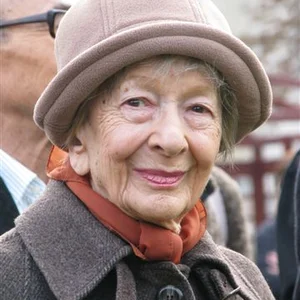

Polish poet (1923–2012), winner of the Nobel Prize in Literature in 1996. Her work, marked by irony and philosophical depth, explores the human condition, memory, and everyday life.
Wisława Szymborska(1923 — 2012)
Wisława Szymborska
Pologne
8 min read
Frequently asked questions
Famous Quotes
« I prefer movies. I prefer cats. I prefer the oaks along the Warta.»
« All knowledge begins with wonder.»
Key Facts
- Born on 2 July 1923 in Prowent, Poland
- Nobel Prize in Literature in 1996, crowning a poetic career spanning several decades
- A member of Poland's cultural movement of the 1950s, she distanced herself from socialist realism
- Author of landmark collections including Calling Out to Yeti (1957) and People on a Bridge (1986)
- Died on 1 February 2012 in Kraków
Works & Achievements
Her first major collection marking a break from the socialist realism of her early work; Szymborska finds her singular voice here, blending philosophical irony with questions about the human condition and freedom.
A collection that confirms her poetic mastery, exploring paradox, wonder at ordinary things, and the imperceptible fragility of everyday existence.
A poetic meditation on chance, contingency, and death; the title poem has become one of the most translated and most quoted in her body of work worldwide.
Inspired in part by a print by Hiroshige, this collection questions time, memory, and the permanence of art in the face of the inevitable disappearance of individuals and civilizations.
One of her most celebrated collections, including the title poem about the aftermath of war and the silent rebuilding carried out by those whom history systematically forgets.
Literary chronicles published in *Życie Literackie*, revealing a playful and endlessly curious Szymborska as a prose writer, with a devastating sense of humor about forgotten or eccentric books.
A foundational text on the poet's vocation, the importance of doubt, and perpetual wonder; it has become a manifesto for freedom of thought and intellectual humility in the face of ideological certainty.
Anecdotes
When the Swedish Academy called her in October 1996 to announce the Nobel Prize in Literature, Wisława Szymborska initially thought it was a joke. Known for her legendary modesty, she declared at her press conference that she had only two answers to offer journalists: “I don’t know.” This disarming humility, rare in a Nobel laureate, became one of her most celebrated trademarks.
Szymborska had a passion for kitsch objects and unusual postcards she would find at Kraków’s flea markets. She hand-crafted small humorous collage books, mixing magazine clippings with personal drawings, which she gave as gifts to her close friends. These handmade works, never intended for publication, bear witness to her private sense of humor and her everyday creativity.
During the German occupation of Poland (1939–1945), the young Wisława worked as an employee of the Polish railways to avoid deportation to forced labor camps in Germany. This experience of war, constant fear, and ever-present death would deeply and lastingly nourish her poetic work and her reflections on the human condition.
Under pressure from the communist regime, Szymborska published two collections of poetry in the socialist realist style in 1952 and 1954, in line with official ideology. She subsequently disavowed these early works entirely, excluding them from her official bibliography. This courageous repudiation illustrates her evolution toward a free, ironic, and deeply personal poetry.
For more than twenty years, Szymborska maintained a literary column in the Kraków journal *Życie Literackie*, entitled *Lektury nadobowiązkowe* (Optional Reading). There she reviewed forgotten, eccentric, or little-known books with wit, revealing an insatiable intellectual curiosity and a talent for prose writing that extends far beyond her poetry alone.
Primary Sources
What is inspiration, if not a renewed invitation to astonishment? Astonishment, I mean. Not the curiosity that is satisfied with an answer, but the astonishment that, with each answer, only grows greater.
Nothing happens twice / nor will it happen. / For this reason we are born / without experience, / and die without routine.
After every war / someone has to tidy up. / Things won't pick themselves up, / after all.
We call it a grain of sand / but it calls itself / neither grain nor sand. / It does just fine without a name— / whether general, particular, permanent, ephemeral, false, or true.
A collective petition signed by Szymborska and thirty-three other Polish intellectuals, protesting the censorship and cultural restrictions imposed by the communist regime — an act of civic resistance taken at the risk of their careers.
Key Places
Birthplace of Wisława Szymborska on July 2, 1923, in the Greater Poland region, before her family settled permanently in Kraków in 1931.
The city where Szymborska spent most of her life, from adolescence until her death in 2012; the heart of her intellectual world, her literary friendships, and the setting of her entire poetic output.
One of Europe's oldest universities (founded in 1364), where Szymborska studied Polish literature and then sociology from 1945 onward, though she never completed her formal degree.
The city where Szymborska received the Nobel Prize in Literature on December 7, 1996, delivering a now-celebrated speech on poetry, doubt, and the human condition.
A historic Kraków café frequented by Polish intellectuals and artists since the early twentieth century, emblematic of the cultural life in which Szymborska was immersed.
Typical Objects

Szymborska composed her poems on a typewriter, an iconic tool of Polish intellectuals of her generation, which also made it possible to produce samizdat (underground texts) to circumvent communist censorship.

She collected kitsch and unusual postcards found at Kraków flea markets, objects of fascination that fed her sense of humor and her taste for the curiosities of everyday life.

She hand-crafted collage books to give to her friends, cutting images from magazines to create unique, humorous works never intended for publication.

A confirmed smoker, Szymborska was rarely photographed without a cigarette; this object accompanied her moments of creation and the lively discussions of the Kraków literary circles she frequented.

The Kraków literary magazine where she worked from 1953 to 1981 and published her column Lektury nadobowiązkowe, a space of intellectual freedom at the heart of her professional life under the communist regime.

A voracious reader with encyclopedic curiosity, she drew on philosophy, biology, physics, and astronomy to infuse her poems with unexpected imagery and questions about the cosmos.
School Curriculum
Vocabulary & Tags
Key Vocabulary
Daily Life
Morning
Szymborska rose late and disliked being disturbed in the morning. She drank her coffee slowly, reading the newspapers and literary magazines that piled up around her apartment — a daily ritual that fed her reading column in *Życie Literackie*.
Afternoon
She devoted her afternoons to writing and reading in her Kraków apartment, working slowly and with exacting standards on her poems — she published only a few dozen per collection, spending months perfecting each line. She would occasionally receive fellow poets or her editors.
Evening
Evenings were often social: Szymborska frequented the cafés and literary circles of Kraków that gathered around the journal *Życie Literackie*. She relished lively conversation and wordplay, but steadfastly refused any public staging of her persona, consistently shying away from celebrity.
Food
Her diet was simple and typically Polish: soups (*barszcz*, *żurek*), dark bread, and cured meats, washed down with large amounts of coffee and tea. A committed smoker, she got through a great many cigarettes — a habit widespread among Polish intellectuals of her generation.
Clothing
Szymborska dressed simply and without ostentation, a reflection of her unassuming nature and indifference to social conventions. She favoured practical, comfortable clothes, the antithesis of the glamorous image sometimes associated with major international literary prizes.
Housing
She lived in a modest Kraków apartment, crammed with books, journals, postcards, and kitschy objects accumulated over the decades. This intimate, somewhat chaotic setting — utterly devoid of luxury — was a perfect mirror of her reserved personality and her breezy indifference to fame.
Historical Timeline
Period Vocabulary
Liens externes & ressources
Références
Œuvres
Wołanie do Yeti (Appel au Yéti)
1957
Sól (Le Sel)
1962
Wszelki wypadek (Par hasard)
1972
Ludzie na moście (Les Gens sur le pont)
1986
Koniec i Początek (La Fin et le Début)
1993
Lektury nadobowiązkowe (Lectures facultatives)
1973-1992
Discours Nobel : Le Poète et le Monde
7 décembre 1996