
Yamata no Orochi is a colossal eight-headed, eight-tailed serpent-dragon from Japanese mythology. It is defeated by the storm god Susanoo, who gets it drunk on sake and beheads it, discovering inside one of its tails the sacred sword Kusanagi-no-Tsurugi.
Yamata no Orochi
Yamata-no-Orochi
8 min read
Frequently asked questions
Key Facts
- Yamata no Orochi is described in the Kojiki (712 CE) and the Nihon Shoki (720 CE), the two great mythological chronicles of Japan
- The monster demanded the sacrifice of a young maiden every year; Kushinadahime was to be its next victim
- Susanoo, banished from heaven, slew Orochi by having it drink eight vats of sake before dismembering it
- The sword Kusanagi-no-Tsurugi, found inside Orochi's tail, became one of the three Imperial Treasures of Japan
- Yamata no Orochi is an iconic figure of the struggle between divine order and monstrous chaos in Shinto
Works & Achievements
Japan's oldest chronicle, dictated by Hieda no Are and transcribed by Ō no Yasumaro. It contains the oldest and most complete version of the Yamata no Orochi myth, central to the tale of Susanoo's legendary feats.
The second great imperial chronicle of Japan. Its account of Yamata no Orochi expands on the Kojiki version with vivid details about the monster's physical appearance, including its red eyes and the vegetation growing along its back.
A stage adaptation of the myth in classical Japanese Nō theater. The dragon is portrayed through symbolic costumes and masks, passing the legend down through artistic ritual.
A geographic and ethnographic survey of Izumo Province commissioned by the imperial state. It roots the dragon myth in real places and verifiable local traditions.
Numerous Japanese woodblock prints — by artists such as Katsushika Hokusai and Utagawa Kuniyoshi — depicted the battle between Susanoo and Yamata no Orochi, turning the dragon into an iconic motif of Japanese popular art.
Anecdotes
Yamata no Orochi was no ordinary monster: each of its eight heads corresponded, according to some interpretations, to one of the eight tributaries of the Hi no Kawa river in the province of Izumo. This poetic image suggests that the dragon symbolized the river's devastating floods, which ancient populations had to battle in order to survive.
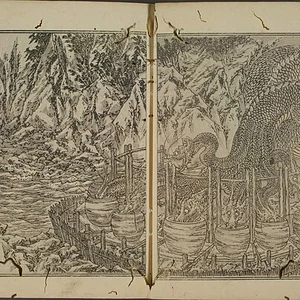
To trap the dragon, the god Susanoo prepared eight vats of rice sake brewed eight times over (hitoyo no kiku no sake) — the strongest drink imaginable. Each of the monster's heads grew drunk at its own vat before being decapitated: this is one of the earliest uses of intoxication as a trick in all of world literature.
In one of the slain dragon's tails, Susanoo discovered a magnificent sword he named Ame-no-Murakumo-no-Tsurugi, meaning 'Sword of the Gathering Clouds of Heaven.' This sword was offered to the sun goddess Amaterasu and is known today as Kusanagi-no-Tsurugi. It is one of the three Imperial Treasures of Japan and is said to be kept at Atsuta Jingū in Nagoya.
Before facing the dragon, Susanoo had been banished from Takamagahara (the Plain of High Heaven) by his sister Amaterasu for his violent behavior. By slaying Yamata no Orochi and rescuing the young Kushinadahime — whom he would later marry — he achieved his redemption: the defeated monster also marks a god's path toward wisdom.
The elderly couple saved by Susanoo — Ashinazuchi and Tenazuchi — had already lost seven of their eight daughters over the years, each one devoured by the dragon during its annual visits. This narrative structure of an annual tribute appears in many myths around the world, from the Greek tale of Theseus and the Minotaur to Norse legends.
Primary Sources
Susanoo saw an old man and an old woman weeping, with a young girl between them. He asked who they were. The old man said: 'I am an earthly deity. [...] Every year an eight-headed, eight-tailed serpent comes and devours one of our daughters. The time of its coming is now.'
There was a great serpent with eight heads. [...] Its eyes were red like winter cherries. On its back grew mosses and cypress trees. Its length spanned eight valleys and eight hills. Its belly was constantly inflamed and bleeding.
The sites of Susanoo's battle against the great serpent are referenced in local geographical descriptions, grounding the myth in the real landscape of the Hi no Kawa river and its surroundings.
The sword Kusanagi-no-Tsurugi, drawn from the tail of the great serpent Yamata no Orochi, was passed to Amaterasu and then entrusted to the sovereigns of Japan. It has been enshrined and venerated at Atsuta Shrine since ancient times.
Key Places
A river in present-day Shimane Prefecture where the myth places the encounter between Susanoo and the elderly couple. Its eight tributaries symbolically correspond to the eight heads of the dragon.
One of Japan's oldest and most venerable Shinto shrines, dedicated to Ōkuninushi. It preserves the memory of the myth of Susanoo and the land where Yamata no Orochi once ruled.
An imperial shrine said to house the sword Kusanagi-no-Tsurugi, the treasure extracted from the tail of Yamata no Orochi. A major pilgrimage site for over 1,900 years.
The celestial dwelling of the Shinto deities from which Susanoo was banished before he defeated Yamata no Orochi. This mythical realm forms the foundation of Japanese cosmology.
A sacred peak in the Izumo region associated with local accounts of Susanoo's battle. Popular tradition holds that traces of the dragon's passage can be found there.
Typical Objects

Discovered inside the central tail of Yamata no Orochi by Susanoo, this divine sword is one of Japan's three Imperial Treasures. It symbolizes martial power and the legitimacy of Japanese emperors.

An exceptionally strong fermented drink prepared by Susanoo to intoxicate the dragon's eight heads. Even in ancient Japan, sake already held a ritual and sacred role in Shinto ceremonies.

Susanoo had a cedar fence built with eight gates and placed a vat of sake before each one. These wooden containers symbolize the trap laid by human (or divine) cunning against brute force.

To protect the young Kushinadahime from the dragon, Susanoo transformed her into a comb and tucked her into his hair. This small, everyday object embodies the protective transformation that lies at the heart of the myth.

Described in the Nihon Shoki as covered in moss, cypress trees, and shrubs, the scales of Yamata no Orochi evoke a being as ancient as the mountains themselves, merged with the Japanese landscape.

The great sacred gate of Izumo Grand Shrine (Izumo Taisha) marks the geographical setting of the myth. This shrine is dedicated to Ōkuninushi, son of Susanoo.
School Curriculum
Vocabulary & Tags
Key Vocabulary
Tags
Daily Life
Morning
Each morning — or rather at each annual dawn — Yamata no Orochi emerges from the deep waters of the Hi no Kawa, its eight heads stretching across eight valleys. The myth describes a cosmic being whose awakening merges with the seasonal flooding of the river, covering cultivated lands in mud and destruction.
Afternoon
In the mythological imagination, the dragon patrols its river territories, its eight tails sweeping through cedar forests. The villagers of Izumo Province lived in terror of its annual passage, dreading which of their children would be offered as tribute to appease its hunger.
Evening
The night of the myth is the night of defeat: lured by eight vats of sake brewed eight times over, each head drinks deeply until completely drunk. It is in this inebriated darkness that Susanoo strikes off all eight heads in a single assault, putting an end to years of terror.
Food
Yamata no Orochi fed on young women offered as annual tribute by families of Izumo Province. In the symbolic reading of the myth, this human tribute represents the sacrifices that farming communities made in order to survive the river's devastating floods.
Clothing
As a mythological being, Yamata no Orochi wears no clothing, but the Nihon Shoki describes its body as a living landscape: mosses, conifers, and shrubs grow along its back and sides, making it as much a walking mountain as a serpent.
Housing
The dragon dwells in the river itself and the steep gorges framing the Hi no Kawa. Its body occupies eight valleys and eight hills simultaneously: it has no fixed lair, for it IS the landscape — an incarnation of the chaotic and destructive forces of untamed nature.
Historical Timeline
Period Vocabulary
Visual Style
Style Yamato-e et Nihonga avec pigments minéraux, perspectives aplaties et contours puissants, dominant les tons vermillon, bleu azurite, noir d'encre et feuille d'or sur fond brumeux.
Sound Ambience
Ambiance de vallée fluviale japonaise ancienne sous l'orage, mêlant les eaux tumultueuses du Hi no Kawa, le vent dans les forêts de cèdres et la présence sourde, terrifiante, d'un être colossal.
Liens externes & ressources
Références
Œuvres
Kojiki (古事記)
712 apr. J.-C.
Nihon Shoki (日本書紀)
720 apr. J.-C.
Pièce de théâtre Nô : Yamata
XIVe-XVe siècle
Izumo no Kuni Fudoki (出雲国風土記)
733 apr. J.-C.
Représentations dans l'art ukiyo-e
XVIIe-XIXe siècles