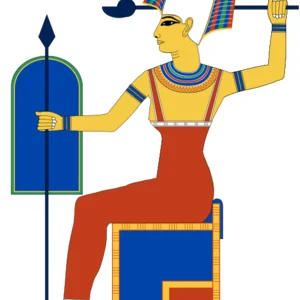
Yhi is the goddess of the sun, light, and creation in the mythology of the Aboriginal peoples of Australia, particularly the Karraur. Asleep at the beginning of time, her awakening illuminated the world and brought all life on Earth into being.
Yhi
Yhi
8 min read
Frequently asked questions
Key Facts
- Yhi is a central figure of the Dreamtime, the founding cosmology of the Aboriginal peoples of Australia
- According to the myth, Yhi slept in the primordial darkness; her awakening brought light and warmth to the world
- By walking upon the Earth, she caused plants, insects, fish, and animals to spring forth from the ice and caves
- She is associated with both the visible sun and the spiritual light that guides the living
- The myth of Yhi reflects an oral tradition more than 50,000 years old, among the oldest in human history
Works & Achievements
By opening her eyes for the first time, Yhi dispels the primordial darkness and brings forth light. This founding act is the Australian equivalent of the great theogonies of world mythology.
By walking across the entire Earth, Yhi causes all vegetation to spring into being. This cosmic journey is the founding narrative of the relationship between Australian Aboriginal peoples and the natural world.
Yhi enters the dark underworld and awakens insects, fish, and animals. This episode explains the origin of the diversity of life according to the Karraur tradition.
By breathing her light into matter, Yhi creates man and woman, entrusting them with the responsibility of keeping the world alive. This final act completes the work of creation.
By transforming herself into the sun, Yhi establishes the rhythm of day and night that structures the lives of all beings. Her daily journey across the sky is the very foundation of time itself.
Anecdotes
At the beginning of time, according to the mythology of the Karraur people of Australia, Yhi lay sleeping in absolute silence, her body of light folded in upon itself. When she opened her eyes for the first time, a golden flood spread across an empty, frozen world, dispelling the primordial darkness. Rocks, earth, and waters began to tremble under the effect of that first dawn.
Yhi descended to the Earth and began walking across the still-empty continents. Wherever her feet brushed the ground, plants sprang up spontaneously: grasses, ferns, trees, and flowers burst forth in her wake. Only after traversing the entire surface of the world did she rise back into the sky, leaving behind an Earth entirely covered in vegetation.
To complete her work, Yhi descended into the dark underground caves where sleeping forms lay. With her light, she awakened the insects, fish, and animals that still slumbered in the primordial darkness. Every creature she touched came to life and joined the surface of the world — and so, says the tradition, the entire animal kingdom was born.
According to Karraur tradition, Yhi one day observed that her creatures remained dissatisfied and lonely. She breathed her energy into a particular form, from which the first man was born; then, from the shadow cast by him, the first woman emerged. This final act gave the world its guardians, charged with honoring the solar light that had brought them into being.
Yhi did not disappear after creation: she transformed herself into the sun to continue lighting the world each day. Aboriginal peoples saw in the sunrise the goddess's daily awakening, and in her setting her descent into the underworld to renew the forces of life. This eternal cycle symbolizes the continuity between creation, death, and rebirth, at the heart of the Dreamtime cosmogonies.
Primary Sources
Yhi, the sun goddess, lay sleeping in the Dreamtime until the great moment when she opened her eyes. Light streamed from her in all directions, flooding the empty world with warmth and radiance, and wherever she walked, plants sprang from the barren earth.
The stories of the great spirit beings who shaped the world during the Dreamtime were passed from elders to children around the fire, each telling carrying the memory of how light, life and law came into being on this land.
The sun, personified as a goddess of light and creation, traversed the sky each day as a living reminder of the original act of creation. Her daily journey mirrored the mythological walk she had undertaken across the newly born Earth, bringing life wherever her light fell.
Key Places
A dark primordial space where all living forms lay dormant before Yhi descended to awaken them. In Karraur cosmogony, this invisible realm is the womb of the world, the source of all life.
The traditional territory of the Karraur people, around the Murray River and Lake Alexandrina, where the mythological stories of Yhi were passed down orally from generation to generation.
After bringing life to Earth, Yhi rose into the sky to become the sun. Her daily journey from east to west shapes time and the cosmos in Australian Aboriginal mythology.
A major collection of Australian rock paintings depicting Dreamtime beings, including solar and creation figures. These works testify to the vitality of the cosmogonic traditions to which Yhi belongs.
A sacred monolith at the heart of Australia and a meeting point of songlines and Dreamtime stories. It stands as a universal symbol of the connection between Earth, sky, and creator beings such as Yhi.
Typical Objects

Mineral pigments used in ceremonies and rock art to represent solar light and the fire of Yhi. Red ochre evokes the blood of life that the goddess breathed into her creatures.

Sacred oval objects made of wood or stone, engraved with symbolic patterns connected to the beings of the Dreamtime. Some tjurunga represent the paths traveled by Yhi during her creative walk across the world.

A tool used to kindle fire through friction, symbolizing the solar light given by Yhi to humanity. The flame it produces echoes the first illumination of the world when the goddess awakened.

During corroboree ceremonies, dancers cover their bodies with ochre and radiating circular patterns evoking the sun-Yhi. These paintings are created according to traditions passed down from generation to generation.

An ancient wind instrument whose deep vibrations accompany religious ceremonies connected to the Dreamtime. Its low, continuous drone symbolizes the voice of creator spirits such as Yhi.

Seeds represent the creative power of Yhi: in Karraur mythology, every seed that germinates repeats the gesture of the goddess walking across the virgin Earth and coaxing plant life into being.
School Curriculum
Vocabulary & Tags
Key Vocabulary
Tags
Lieu
Daily Life
Morning
Each morning, according to Karraur tradition, Yhi awakens at the eastern horizon and begins her ascent across the sky. Her rising is celebrated with songs and ceremonies by the people, who see in each dawn the repetition of the original act of creation. The Elders teach the young to greet the rising sun as one would greet the goddess herself.
Afternoon
At the zenith of her course, Yhi unfolds the full power of her creative energy: this is the hour when her light is most intense, when plants and animals receive the maximum of her vital energy. In traditional ceremonies, midday is a time of contemplation and gratitude toward the solar goddess who keeps life in motion.
Evening
The setting of the sun marks Yhi's descent into the underworld, where she renews the forces of life each night in preparation for the next day. Far from being a death, this daily withdrawal is seen as a gestation: in the darkness, the goddess prepares a new dawn and a new cycle of creation.
Food
As a Dreamtime deity, Yhi is sustained by primordial light and the vital energy of the cosmos, not by human food. Her nourishment is symbolically represented by plant offerings — seeds, flowers, fruits — laid down by the Karraur during ceremonies as a reminder of the plants born from her creative walk.
Clothing
Yhi is described in oral traditions as a being of pure light, her body radiating a golden radiance that is both her garment and her very nature. In Aboriginal artistic representations (body paintings, rock art), she is evoked through radiating motifs in yellow ochre and white, the colors of sunlight.
Housing
Yhi's dwelling is the sky itself, which she traverses each day from east to west. At night, she resides in the underworld, the mythological space of origins. Caves and rocky hollows are considered gateways to this inner realm, and certain Karraur natural sites are revered as places of contact with the goddess.
Historical Timeline
Period Vocabulary
Liens externes & ressources
Références
Œuvres
L'Illumination du monde
Temps du Rêve
La Marche créatrice et l'éveil du règne végétal
Temps du Rêve
La Descente dans les grottes et l'éveil du règne animal
Temps du Rêve
La Création de l'humanité
Temps du Rêve
Institution du cycle solaire quotidien
Temps du Rêve