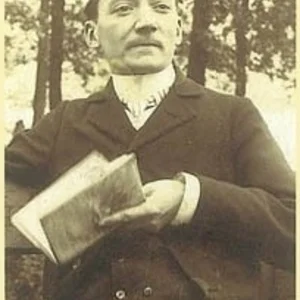
Greek poet and diplomat, a major figure of the “Generation of the 1930s” that renewed modern Greek poetry. He was the first Greek to receive the Nobel Prize in Literature, in 1963.
Yorgos Seferis
Giorgos Seferis (Yorgos Seferis), born Georgios Seferiadis
6 min read
Frequently asked questions
Famous Quotes
« Wherever I travel, Greece wounds me.»
Key Facts
- Born in 1900 in Smyrna (Vourla), in the Ottoman Empire, within the Greek world of Asia Minor
- Published his first collection, Strophi (Turning Point), in 1931, renewing Greek poetry
- Pursued a long diplomatic career, notably as Greece's ambassador to London (1957-1962)
- Received the Nobel Prize in Literature in 1963, the first Greek writer so honored
- Publicly took a stand in 1969 against the dictatorship of the colonels; died in Athens in 1971
Works & Achievements
First collection, which marks a break and brings a modern sensibility into Greek poetry. It contains the famous poem “Arnisi”.
A long meditative poem on hidden water and the inner life. A step toward the maturity of his poetic language.
A sequence of twenty-four poems blending ancient myths and modern disarray. Regarded as his masterpiece and a high point of twentieth-century Greek poetry.
A Greek version of Eliot's great poem, which introduced Anglo-Saxon modernism to Greece and influenced an entire generation.
Three collections written over the course of exile and diplomatic travels, the third of which is inspired by Cyprus.
A major postwar poem, a dialogue between memory, light and Homeric myth.
Collections of critical essays on poetry, language and the Greek tradition, which reveal him as a great thinker on literature.
Anecdotes
Born near Smyrna, Seferis had to flee with his family during the Great Catastrophe of 1922, when the Greek city of Asia Minor was destroyed. He never truly saw his native land again, and the loss of this vanished world haunts all his work: his poems are peopled with broken statues, seas, and lost homelands.
Seferis led a double life. By day, he was a career diplomat under his real name, Georgios Seferiadis, negotiating on behalf of Greece in embassies. By night, he became the poet “Seferis,” a shortened name he had chosen to keep his verse separate from his official role.
In 1963, he became the first Greek to receive the Nobel Prize in Literature. In his speech, he paid tribute to his “small country” with its immense tradition, stressing that a poet speaking a language spoken by few people could still carry a universal voice.
In 1969, while the dictatorship of the colonels was silencing Greece, Seferis broke his own silence in a resounding statement broadcast by the BBC. This act of courage from a hitherto reserved man had an enormous moral impact in the oppressed country.
His funeral in 1971 turned into a demonstration against the junta: an immense crowd followed the procession through the streets of Athens singing “Arnisi” (“Denial”), his poem set to music by Mikis Theodorakis and banned by the regime.
Primary Sources
I belong to a small country. A rocky promontory in the Mediterranean, it has nothing to distinguish it but the efforts of its people, the sea, and the light of the sun. It is a small country, but its tradition is immense.
Everyone has learned by now, and everyone knows, that in the case of dictatorial regimes the beginning may seem easy, but tragedy awaits, inevitable, in the end.
I woke with this marble head in my hands; it exhausts my elbows and I do not know where to set it down.
On the secret shore, white as a dove, we grew thirsty at noon; but the water was brackish.
Key Places
Greek coastal village in the Ottoman Empire where Seferis was born in 1900. This world was destroyed during the Catastrophe of 1922, becoming the lost paradise of his work.
Greek capital where he lived, worked at the Ministry of Foreign Affairs, and died in 1971. His funeral there turned into a demonstration against the junta.
City where Seferis studied law from 1918 to 1925. There he discovered modern European poetry, notably symbolism and later the work of T. S. Eliot.
Capital where he served as Greece's ambassador from 1957 to 1962, at the height of his diplomatic career. It was there that he was living when he was honored with the Nobel.
Island he discovered in the 1950s, which inspired an entire collection. There he saw a living Hellenism, the source of great poetic fervor.
City where he received the Nobel Prize in Literature on December 10, 1963, the first Greek to be so honored. There he delivered his famous speech about the “small country” with an immense tradition.
Typical Objects

An everyday tool of the poet and the diplomat, used to draft official dispatches as well as to put down verses. Seferis tirelessly wrote and reworked his poems by hand.

For decades Seferis kept a detailed diary, published under the title Days (*Meres*). In it he recorded his readings, travels, encounters and reflections on writing.

A document attesting to his role as an agent of the Greek state around the world. It accompanied him from Paris to London, from Albania to Egypt, according to his postings.

An award presented in Stockholm in 1963, making him the first Greek laureate in literature. It marked the worldwide recognition of modern Greek poetry.

Seferis loved to gather stones, pebbles and shards of ancient marble on the Greek shores. These objects fed his meditation on memory and the continuity of Hellenism.

Small volumes such as *Strophi* or *Mythistorema*, often initially printed in very few copies. They spread free verse and modernism in the spoken Greek language.
School Curriculum
Vocabulary & Tags
Key Vocabulary
Tags
Daily Life
Morning
Seferis's mornings were often those of a civil servant: he would head to the ministry or the embassy to handle dispatches, files, and diplomatic meetings. Administrative rigour took up most of his working hours.
Afternoon
The afternoon blended official duties, receptions, and reading. Whenever he could, he slipped away to visit museums, ancient sites, or shorelines, which nourished his poetic reflection.
Evening
The evening was the time for writing: he composed and crossed out his poems, kept his journal, and read poets ancient and modern. Poetry was an activity of the shadows, kept apart from his public career.
Food
He shared in the Greek Mediterranean diet: bread, olive oil, vegetables, fish, cheeses, and fruit, accompanied by wine. While posted abroad, he also frequented the official tables of diplomatic dinners.
Clothing
In his official role, he wore the dark suit and tie of a statesman, sometimes ceremonial dress for receptions. In private life, he preferred plain, understated attire.
Housing
He lived in apartments in Athens and in the diplomatic residences of his various postings, from London to Africa. His homes held his books, his notebooks, and his collection of ancient stones and fragments.
Historical Timeline
Period Vocabulary
Liens externes & ressources
Références
Œuvres
Strophi (Tournant)
1931
I Sterna (La Citerne)
1932
Mythistorema
1935
Traduction de La Terre vaine de T. S. Eliot
1936
Imerologio Katastromatos (Journal de bord)
1940-1955
Kichli (La Grive)
1947
Dokimes (Essais)
1944