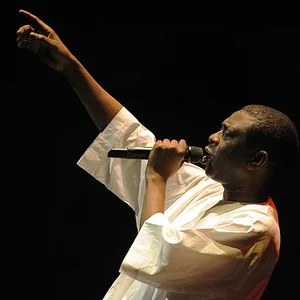

Youssou N'Dour is a Senegalese singer and composer born in 1959, a major figure in African music and a popularizer of mbalax. Having become a global star, he also entered politics, holding several ministerial positions in Senegal.
Youssou N'Dour(1959 — ?)
Youssou N'Dour
Sénégal
5 min read
Frequently asked questions
Key Facts
- Born on October 1, 1959, in Dakar, Senegal
- Popularizes mbalax, a fusion of traditional Senegalese rhythms and modern music, from the 1980s onward
- World-famous duet “7 Seconds” with Neneh Cherry in 1994
- Wins the Grammy Award for Best World Music Album in 2005 for “Egypt”
- Appointed Minister of Culture and Tourism of Senegal in 2012
Works & Achievements
The album that revealed his talent internationally and evokes the plight of Senegalese emigrants in Europe.
His first major album distributed worldwide, which made him known outside Africa.
An emblematic album whose title, tied to an urban cleanliness movement in Dakar, blends music with social commitment.
A worldwide hit singing against racial prejudice, one of the greatest successes in world music.
The album that contains “7 Seconds” and cemented his stature as a global star.
An album dedicated to Senegalese Sufism, awarded a Grammy Award in 2005.
The founding of the band with which he popularized and modernized mbalax over the course of decades.
Anecdotes
At the age of 12, Youssou N'Dour was already singing at neighborhood ceremonies in the Médina district of Dakar. His mother being a griotte, he inherited an oral tradition in which song transmits the history and memory of families, shaping very early on his exceptional voice with its high-pitched timbre recognizable among all.
In 1994, his duet with the Swedish singer Neneh Cherry, “7 Seconds,” became an enormous worldwide hit, selling millions of copies and reaching number one in several European countries. The song, which blends French, English, and Wolof, denounces the racial prejudice that children face from birth.
With his band the Super Étoile de Dakar, Youssou N'Dour popularized mbalax, a style that fuses the traditional rhythms of sabar drums with pop, jazz, and funk. He turned Senegalese music into a danceable phenomenon that filled venues in Dakar as well as in Paris.
In 2012, after attempting to run for president (his candidacy having been invalidated), Youssou N'Dour became Senegal's Minister of Culture and Tourism. A global music star thus joined his country's government, a rare event in African history.
His album “Egypt,” released in 2004 and devoted to Sufi Islam and the brotherhoods of Senegal, earned him a Grammy Award in 2005. Yet the album had at first been poorly received at home, as some considered it disrespectful to sing about faith over music; the international award changed those views.
Primary Sources
“7 seconds away / Just as long as I stay, I'll be waiting” — the song evokes the first seconds of a child's life, still unaware of the color of their skin and the injustices to come.
In it he explains that he wanted to show an Islam of peace, tolerance and spirituality through the figures of the Senegalese Sufi brotherhoods, going against the conflations that followed 2001.
“I have decided to run for the presidential election” — announcement made by Youssou N'Dour, marking his formal entry into national political life.
Key Places
Working-class neighborhood of Dakar where Youssou N'Dour grew up and sang at his first ceremonies. The cradle of his musical calling.
Capital of Senegal where he founded the Super Étoile, his Thiossane club, and his studio. The center of all his musical and political activity.
Nightclub and concert hall he opened in Dakar, which became a major venue for mbalax. Senegalese crowds flock there to dance to his rhythms.
City that inspired the album Egypt, recorded in part with Arab musicians. A symbol of his dialogue with the Muslim world.
City where he recorded several international collaborations, notably with Peter Gabriel and the British music industry. A springboard for his global career.
Typical Objects

A traditional Wolof drum played with the hand and a stick, at the heart of the mbalax rhythm. It has accompanied festivals, dances and songs in Senegal for centuries.

A small underarm drum whose string tension is altered to mimic the inflections of the voice. It “speaks” and converses with singers on stage.

An essential tool for the international pop singer, amplifying his distinctive high-pitched voice before immense crowds. A symbol of his career as a global star.

A flowing, often richly embroidered West African robe, worn by Youssou N'Dour on stage and at ceremonies. It asserts Senegalese elegance and identity.

A trophy from the American music industry, awarded in 2005 for the album Egypt. It marks worldwide recognition of Senegalese music.

A recording studio founded by Youssou N'Dour in Dakar, equipped with mixing desks and instruments. There he produces his albums and supports young Senegalese artists.
School Curriculum
Vocabulary & Tags
Key Vocabulary
Daily Life
Morning
While on tour, the morning of a star like Youssou N'Dour is devoted to rehearsals, sound checks, and interviews with the press. In Dakar, he often begins the day with matters related to his press group and his businesses.
Afternoon
The afternoon is split between studio work, composing new pieces, and meetings, notably during his time in ministerial office. He also meets young musicians whom he encourages.
Evening
Evening is the time for concerts, which sometimes last deep into the night in the clubs of Dakar or in great venues all over the world. The mbalax scene comes alive to the frantic rhythm of the sabars.
Food
He shares in Senegalese cuisine, dominated by rice, fish, and vegetables, such as the famous *thiéboudiène* (fish and rice). Mint tea (*attaya*), served in several rounds, punctuates moments of conviviality.
Clothing
On stage, he alternates between Western suits and ample embroidered *boubous* that affirm his African identity. In daily and political life, he cultivates an understated, refined elegance.
Housing
He lives mainly in Dakar, a cosmopolitan city blending modern buildings, bustling markets, and working-class neighborhoods. His success affords him a comfortable life while remaining anchored in his native city.