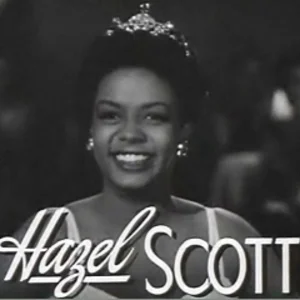

Jazz pianist and singer of Trinidadian and American descent, a virtuoso known for her arrangements blending classical music and swing. A star of nightclubs and the silver screen, she was also a civil rights activist who refused to perform for segregated audiences.
Hazel Scott(1920 — 1981)
Hazel Scott
États-Unis
6 min read
Frequently asked questions
Key Facts
- Born on June 11, 1920, in Port of Spain (Trinidad), she emigrated to New York as a child and entered the Juilliard School at a very young age
- In the 1930s and 1940s, she became a star of New York's jazz clubs, famous for her “swung” interpretations of Bach, Chopin, and Liszt
- She demanded by contract not to perform for segregated audiences and refused stereotyped film roles
- In 1950, she became the first African American woman to host her own television program, “The Hazel Scott Show”
- Accused of communist sympathies during McCarthyism, her show was cancelled that same year; she died on October 2, 1981, in New York
Works & Achievements
Her signature style, blending great classical composers with jazz, which made her famous and set her apart for its originality.
Films like “The Heat's On” and “Rhapsody in Blue,” in which she insisted on playing herself rather than maid characters.
The first national television program in the United States hosted by an African American woman.
A courageous statement denouncing the anti-communist blacklists and the slandering of artists.
A renowned jazz album recorded with Charles Mingus on double bass and Max Roach on drums.
Tours and concerts in Paris and across Europe, where she performed freely before unsegregated audiences.
Anecdotes
At the age of eight, Hazel Scott auditioned at the prestigious Juilliard School in New York. She was too young to be admitted officially, but a teacher, dazzled by her perfect pitch, granted her a scholarship and private lessons.
On the stage of Café Society, she would begin a piece by Bach or Chopin in all seriousness, then suddenly transform it into a wild boogie-woogie. Audiences loved this shift from “classical” music to swing. She would even play two grand pianos at the same time.
In Hollywood, where Black actresses were often allowed only the roles of servants, Hazel Scott demanded by contract to appear solely as herself, elegant, at the piano. During the filming of “The Heat's On” in 1943, she refused to let Black extras wear dirty aprons and held up production until they were given dignified costumes.
In 1950, she became the first African American to host her own national television program, “The Hazel Scott Show.” But a few weeks later, at the height of McCarthyism, her name was named in an anti-communist pamphlet and the show was abruptly cancelled.
Hazel Scott wrote into her contracts that she refused to perform before audiences where Black and white people were segregated. In 1949, in Washington State, she was refused service in a restaurant because of the color of her skin: she then decided to file a complaint.
Primary Sources
Actors, musicians, artists, composers, all the men and women of the arts are eager to help and to serve. Our country needs us now more than ever before. We should not be struck off the lists by the hateful slanders of small and petty men.
This anti-communist pamphlet lists 151 artists — including Hazel Scott — suspected of communist sympathies, without offering any proof. Its publication leads to the dismissal of many artists from radio and television.
A few days after the pianist's testimony before HUAC, the DuMont network ended her show. The press reported the sudden disappearance of the program hosted by the first Black woman to have her own show on American television.
Key Places
Hazel Scott's birthplace, in the Caribbean, then under British rule.
The African American neighborhood where her family settled and where she grew up in a musical environment; she died in New York in 1981.
The prestigious conservatory where, as a child prodigy, she was spotted and trained thanks to an exceptional scholarship.
New York's first non-segregated nightclub, where she became a jazz star in the late 1930s.
The restaurant where she was refused service because of the color of her skin in 1949, prompting her to file a lawsuit.
The city where she settled in the late 1950s, acclaimed by European audiences far from American segregation.