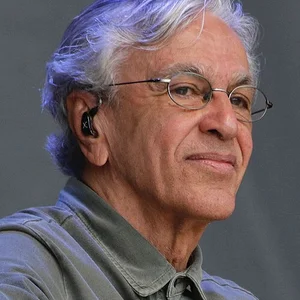

Caetano Veloso (born 1942) is a Brazilian singer, songwriter, and musician, a central figure of the Tropicália movement in the 1960s. Blending Brazilian popular music, rock, and avant-garde, he was exiled by the Brazilian military dictatorship.
Caetano Veloso(1942 — ?)
Caetano Veloso
Brésil
8 min read
Frequently asked questions
Key Facts
- Born on August 7, 1942, in Santo Amaro da Purificação, Bahia, Brazil
- Co-founded the Tropicália movement with Gilberto Gil in 1967–1968
- Arrested and exiled to the United Kingdom by the Brazilian military dictatorship in 1969
- Returned to Brazil in 1972 and continued an international career
- Author of the autobiographical and essayistic work *Verdade Tropical* (1997)
Works & Achievements
The first major Tropicalist hit, this song with its rock rhythm and fragmented poetic lyrics revolutionized MPB. Its performance at the Festival Internacional da Canção caused a scandal and marked the beginning of the Tropicalist movement.
The manifesto album of the Tropicalist movement, co-created with Gilberto Gil, Gal Costa, Os Mutantes, and Tom Zé. A true declaration of cultural independence, it blends bossa nova, rock, fairground music, and concrete poetry.
An experimental, avant-garde album recorded shortly after his return from exile, it pushes the boundaries of sound by incorporating noise, atonal structures, and references to musique concrète. Unsettling upon its release, it is now regarded as a cult work.
One of Veloso's most accessible and acclaimed albums, recorded as a duo with Gilberto Gil. It reconciles experimentation with popular appeal and reflects the exceptional artistic bond between the two central figures of Tropicalism.
A major intellectual memoir in which Veloso traces the origins of the Tropicalist movement, analyzes Brazilian culture, and recounts his exile. Translated into several languages, the book has become an essential reference for understanding Brazilian music and politics of the 1960s and 1970s.
Released alongside his autobiography, this album musically captures Veloso's artistic maturity, weaving together poetry and songs for voice and acoustic guitar in a spare, introspective style.
A Mexican bolero by Tomás Méndez, masterfully reinterpreted by Veloso and brought to worldwide fame through Almodóvar's film *Talk to Her* (2002). This version reveals the full extent of his ability to transcend musical and cultural boundaries.
Anecdotes
In 1967, at the Festival Internacional da Canção de São Paulo, Caetano Veloso took the stage accompanied by the rock group Os Mutantes to perform 'Alegria, Alegria'. The crowd was scandalized: blending electric guitars with Brazilian popular music was seen as a cultural betrayal. This defining moment marked the public birth of the Tropicália movement.
On December 27, 1968, a few weeks after the military dictatorship signed the AI-5 decree, Caetano Veloso was arrested at his home in São Paulo without an official warrant. He spent several months in prison, sometimes in solitary confinement, before being forced into exile. He would only learn the precise reasons for his arrest much later, as the dictatorship never provided any official explanation.
Exiled in London between 1969 and 1972, Caetano Veloso discovered glam rock, David Bowie, and the British musical avant-garde. Living in a small apartment in Notting Hill with Gilberto Gil, he learned English, explored new sounds, and composed songs that would allow him to profoundly renew his musical language upon his return to Brazil.
The name 'Tropicália' was not coined by Caetano Veloso: he borrowed it from an installation by Brazilian visual artist Hélio Oiticica presented in 1967, which criticized the superficial exoticism associated with Brazil. By adopting this title for a song, Veloso transformed a contemporary art concept into the rallying cry of a cultural movement that would shape an entire generation.
In 1998, his song 'Cucurrucucú Paloma', performed in Almodóvar's film 'Talk to Her' (2002), brought him sudden international recognition. Millions of European viewers discovered his voice for the first time, making this reimagined Mexican bolero one of the world's gateways into the vast body of work of an artist already legendary in Brazil.
Primary Sources
I wanted the electric guitar to be Brazilian, not American or English. I wanted Brazil to embrace the world without ceasing to be itself. That was Tropicália.
We do not reject bossa nova, we do not reject baião, we do not reject rock. We want to devour everything, digest everything, and make something radically new out of it.
I was arrested without being told why. They kept me in silence. The dictatorship cannot tolerate artists who think out loud.
Brazilian music is a synthesis of everything humanity has been through in this corner of the world: Africa, indigenous Europe, violence and joy. I merely listened to it.
I return to Brazil not defeated, but transformed. London taught me that resistance can also be a gentle song.
Key Places
Caetano Veloso's hometown, where he grew up immersed in Afro-Brazilian music, Catholicism, and the traditions of the Recôncavo baiano. This region of Bahia profoundly shaped his artistic and cultural identity.
The cultural capital of Bahia, where Veloso made his first musical forays in the 1960s before moving to São Paulo. A city of intense Afro-Brazilian vitality that left a lasting mark on his relationship with music and national identity.
The metropolis where Veloso settled in the 1960s and where the Tropicália movement truly came to life. It was here, at the heart of Brazil's industrial modernity, that the decisive music festivals were held and the group of Tropicalist artists took shape.
The London neighborhood where Caetano Veloso and Gilberto Gil lived during their exile between 1969 and 1972. This forced stay became a period of intense creative renewal, shaped by contact with British rock and European counterculture.
The city where Veloso settled after returning from exile and where he has primarily lived ever since. A symbol of *cultura carioca* — carnival and music — Rio is the backdrop for his public life and many of his most significant artistic collaborations.
Typical Objects

Symbol of tropicalist provocation, Veloso's introduction of the electric guitar into MPB in 1967 shocked nationalist audiences. The instrument embodies the deliberate fusion of Anglophone rock and Brazilian popular music.

The primary medium for musical distribution in the 1960s–1970s, Veloso's vinyl albums such as 'Tropicália ou Panis et Circencis' (1968) are cultural manifestos as much as musical works, crafted with care down to their graphic sleeve design.

Tropicalist artists deliberately adopted colorful and exuberant clothing, simultaneously parodying and reclaiming Brazil's exotic image. This attire became a sign of cultural resistance against the austerity imposed by the dictatorship.

Veloso's everyday tool for composing his texts, poems, and letters during his London exile. Before computers, it allowed him to craft his lyrics with a poet's precision, treating each word as a weapon against censorship.

At the time of his arrest in 1968, the military authorities confiscated his passport — a concrete symbol of the deprivation of freedom imposed on dissident artists. The travel document here embodies forced exile and political surveillance.

In 1960s Brazil, the transistor radio was the primary means for Brazilians of all social classes to access music. It was through this ubiquitous object that Veloso's songs entered homes — including those monitored by the dictatorship.
School Curriculum
Vocabulary & Tags
Key Vocabulary
Tags
Daily Life
Morning
In the 1960s, Caetano Veloso would rise late, as many artists on the São Paulo music scene did. After a strong coffee and a slice of buttered white bread, he would spend his mornings writing lyrics or reading Brazilian poets such as Oswald de Andrade, whose ideas directly fed into Tropicalism.
Afternoon
Afternoons were often taken up with rehearsals alongside fellow musicians of the Tropicalist movement — Gilberto Gil, Gal Costa, Os Mutantes — in apartments and studios across São Paulo. Artistic and political discussions blended naturally into the music-making, since under the dictatorship every cultural act was inherently political.
Evening
In the evenings, Veloso performed at festivals, clubs, and theatres, or attended friends' shows. The musical nightlife of São Paulo and Rio de Janeiro was intense: it was in these spaces that Tropicalist ideas took shape before live audiences, sometimes under the watchful eye of government censors.
Food
Caetano Veloso's eating habits reflect his Bahian roots: he has a deep attachment to the Afro-Brazilian cuisine of Bahia, rich in palm oil (*dendê*), dried shrimp, cassava, and spices. In São Paulo and London, he would sometimes cook dishes from his childhood himself, so as not to lose touch with his origins.
Clothing
During the 1960s and 1970s, Veloso embraced the provocative, colourful outfits typical of Tropicalism: floral shirts, kitsch suits, sometimes drawing on the British glam rock he discovered in London. This flamboyant style was a political statement: it mocked the exotic image the world projected onto Brazil while reclaiming it with irony.
Housing
In São Paulo before his exile, Veloso lived in modest shared apartments with other musicians, in an atmosphere of constant creative bohemia. In London, he and Gilberto Gil rented a small flat in Notting Hill — then a working-class, multicultural neighbourhood — living simply off concert earnings and royalties.