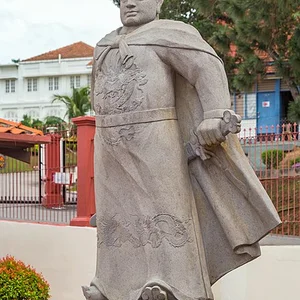

Chinese mariner, explorer and diplomat (1371–c. 1434)
Zheng He(1371 — 1433)
Zheng He
dynastie Ming
8 min read
Frequently asked questions
Key Facts
Works & Achievements
A major expedition to East Africa and the Indian Ocean with an impressive fleet of ships known as 'treasure junks'. This expedition aimed to establish Chinese naval supremacy and forge diplomatic relations.
A series of seven monumental expeditions across the Indian Ocean, reaching the East African coast, Arabia, and India. These voyages were the greatest naval achievements of the 15th century and demonstrated the maritime power of Ming China.
Expeditions that enabled China to reach and explore the coasts of East Africa, establishing trade and diplomatic relations with kingdoms previously unknown to them.
Construction and command of giant vessels (junks) exceeding 130 metres in length, representing an unprecedented technological feat that enabled the transport of precious goods and diplomatic delegations.
Establishment of diplomatic relations with more than 30 states and kingdoms, promoting trade and strengthening Chinese influence across the Indian Ocean region.
Detailed documentation of maritime routes, coastlines, and peoples encountered during the expeditions, contributing to advances in geographical and cartographical knowledge of the known world.
Anecdotes
Zheng He commanded ships known as 'treasure junks' that measured around 130 meters in length — far larger than the European caravels of the time! These enormous vessels could carry up to 28,000 people and extraordinary cargo. With these legendary ships, he sailed as far as East Africa, long before Europeans ventured those same routes.
Between 1405 and 1433, Zheng He led seven monumental maritime expeditions on behalf of the Ming emperor. These voyages explored the Indian Ocean, visiting Arabia, East Africa, and India. At each port of call, he distributed gifts and established diplomatic ties rather than seeking to conquer territories — a very different approach from the European expeditions that came later.
Although he became one of the world's greatest explorers, Zheng He was once a captive slave, taken prisoner during a rebellion. The Ming emperor recognized his exceptional talents and made him first a warrior, then an admiral — a remarkable story of social mobility in ancient China.
Zheng He's expeditions brought back to China exotic animals never seen there before, such as giraffes from East Africa. These fascinating creatures were displayed at the imperial court, symbolizing the power and wealth of the emperor's reign.
Paradoxically, after the death of the emperor who supported him, his successors halted the maritime expeditions and burned Zheng He's records. China turned inward, and these extraordinary voyages were forgotten for centuries — until modern historians rediscovered them.
Primary Sources
The eunuch Zheng He, with his great ships and vast crews, crossed the Southern Seas, visiting distant kingdoms and bringing the benefits of Chinese civilization to foreign peoples.
The Treasure Ships, the largest ever built, measured four hundred feet in length and one hundred and eighty feet in width. They carried soldiers, merchants, and interpreters, establishing China's maritime supremacy.
Zheng He undertook seven major voyages to the Southern Seas, reaching East Africa and Arabia, strengthening the naval power and diplomatic prestige of the Empire.
By the grace of the protecting Goddess, Zheng He led his fleets safely through the perils of the seas, fulfilling the missions entrusted to him by the Emperor.
Key Places
Birthplace of Zheng He in 1371. This region of Yunnan, in southwestern China, is where the future admiral was born into a Muslim family of Mongol descent.
Major river port and capital of the Ming dynasty, where Zheng He organized and launched his seven monumental maritime expeditions between 1405 and 1433. It was the logistical heart of his voyages.
An important Swahili port on the East African coast, visited during several of Zheng He's expeditions. The Chinese fleets established significant diplomatic and commercial ties there.
A strategic port on the Gulf of Aden and a crucial waypoint on Zheng He's voyages toward Africa and the Indian Ocean. It was a major commercial crossroads of maritime trade at the time.
A major Indian trading port on the Malabar Coast, regularly visited by Zheng He's fleets. It was a key center for the spice trade and Asian commercial exchange.
A strategic maritime passage controlled during Zheng He's expeditions, linking the Indian Ocean to the South China Sea. It was an essential trade route throughout all seven voyages of exploration.
Typical Objects

A large Chinese merchant vessel of the 15th century, measuring up to 130 meters in length. This is the type of ship Zheng He used for his monumental maritime expeditions across the Indian Ocean.

A Chinese navigational instrument refined during the Middle Ages, essential to Zheng He's voyages. The compass made it possible to determine direction at sea — a technology that Europeans had not yet developed in the 15th century.

Detailed maps of the coastlines and sea routes of the Indian Ocean, charted during Zheng He's expeditions. These documents greatly expanded the geographical knowledge of Ming China.

Fine porcelain from the Ming dynasty that Zheng He presented as gifts to the kingdoms he visited, symbolizing Chinese prestige and power. These objects also represented the trade and commercial exchanges that defined his expeditions.

Instruments used to measure the position of stars and navigate the open sea. Zheng He relied on these tools to determine latitude and longitude during his long voyages.

An official banner representing the authority of the Ming emperor, flown on Zheng He's ships. It symbolized imperial power and the diplomatic standing of his expeditions.

Sturdy anchors used on Zheng He's junks to moor in ports across the Indian Ocean. They stand as evidence of China's advanced naval technology in the 15th century.

Handwritten documents recording observations, routes, trade exchanges, and diplomatic encounters from the expeditions. These writings are invaluable primary sources on Zheng He's voyages.
School Curriculum
Daily Life
Morning
Zheng He wakes before dawn in his quarters at the imperial palace or aboard his flagship. He performs ritual ablutions and engages in meditation or prayer according to his religious beliefs, before reviewing his nautical charts and administrative reports on expedition preparations.
Afternoon
His afternoons are devoted to diplomatic meetings, inspecting ships and crews, or overseeing the shipyards. He reviews navigation routes, manifests of precious cargo destined as diplomatic gifts, and holds formal audiences with dignitaries from the imperial court.
Evening
Evenings often find him with his officers and scribes, discussing trade routes, geographical discoveries, and diplomatic reports to be drafted for the emperor. He shares formal meals during which future expedition strategies and the outcomes of past missions are discussed.
Food
His diet consists of refined rice, dried fish, braised meats, cultivated vegetables, and exotic fruits in season. As a high-ranking Muslim dignitary at an imperial court, he observes Islamic dietary practices and abstains from pork. During expeditions, he has access to specially preserved provisions and reserves of fresh water.
Clothing
Zheng He wears the official robes of his office: embroidered silk tunics in imperial colors, high-ranking sashes, and ceremonial shoes. As an admiral, he displays the insignia of his status, including prestigious motifs. While at sea, he opts for practical garments in linen or lightweight silk, better suited to the maritime climate.
Housing
He resides primarily at the imperial palace in Beijing, in apartments reserved for senior court dignitaries. His quarters enjoy royal comforts: spacious rooms, refined furnishings, and libraries of maps and manuscripts. Aboard his expeditions, he has a large cabin on his flagship, equipped to serve both administrative and navigational purposes.
Historical Timeline
Period Vocabulary
Visual Style
Un style pictural fusionnant l'esthétique des rouleaux peints Song-Ming avec l'iconographie navale chinoise. Dominance de teintes chaudes (or, rouge vermillon) et de bleus profonds évoquant les mers conquises, encres nuancées pour les paysages marins dramatiques, lumières dorées transcendant l'ambiance de grandeur diplomatique et exploratrice.
Sound Ambience
Une ambiance maritime immersive évoquant les grandes expéditions de Zheng He : alliance de bruits océaniques majestueux, de voix chinoises anciennes et d'instruments traditionnels, créant une atmosphère d'exploration épique et diplomatique.
Liens externes & ressources
Références
Œuvres
Première expédition maritime
1405-1407
Les sept voyages (Voyages du Trésor)
1405-1433
Exploration de l'Afrique de l'Est
1417-1420
Flotte de jonques au trésor
1405-1433
Missions diplomatiques et commerciales
1405-1433
Cartes et récits de voyage
1417-1434