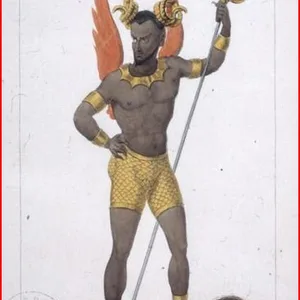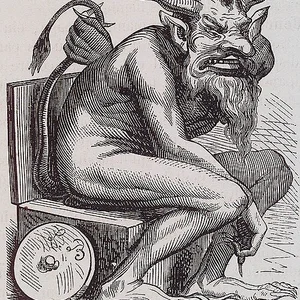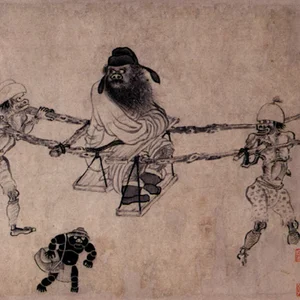

Zhong Kui is a deity from Chinese mythology, a demon-slayer and protector of households. Depicted as a fierce-looking bearded man, he is invoked to ward off evil spirits. His image is traditionally painted on house doors during festivals.
Zhong Kui
Zhong Kui
8 min read
Frequently asked questions
Key Facts
- Legendarily associated with the reign of Emperor Xuanzong of the Tang dynasty (713–756)
- His image is painted on doors during the Dragon Boat Festival (5th day of the 5th lunar month)
- He is depicted as a judge of the underworld commanding an army of 80,000 demons
- His image has been used as a protective talisman since at least the 8th century to drive away evil spirits
- An iconic figure in traditional Chinese painting, depicted by great masters such as Guo Xu (15th–16th century)
Works & Achievements
Original painting commissioned by Emperor Xuanzong according to tradition, now lost but with surviving Song copies. It forever established the canonical iconographic features of the demon queller.
Hanging scroll preserved at the National Palace Museum in Taipei, showing Zhong Kui leading a procession of submissive demons. A major witness to Song iconography and the codification of his attributes.
Ink painting scroll illustrating a legendary episode that humanizes Zhong Kui. This work, housed at the Freer Gallery of Art in Washington, is considered one of the masterpieces of medieval Chinese painting.
Mass production of printed images intended to be pasted on doors during the New Year. The democratization of these prints ensured the spread of the cult across all levels of Chinese society.
Several popular plays depicted Zhong Kui's exploits on stage, helping to enrich and popularize the legendary cycle of the character beyond the literate elite.
Anecdotes
According to the most widespread legend, Zhong Kui was a scholar of hideous ugliness but exceptional intelligence. He supposedly earned the top rank in the imperial examinations under the Tang dynasty, but the emperor rejected him because of his frightening appearance. Humiliated, he committed suicide on the palace steps. The emperor, overcome with remorse, granted him an imperial funeral in recognition of his merit.
Emperor Xuanzong (712-756) fell gravely ill and had a troubling dream: a small demon was stealing his lute and his favorite concubine. Suddenly, a large bearded demon appeared, captured the small demon, and devoured it. Waking up cured, the emperor asked the painter Wu Daozi to portray the large demon according to his description — this painting became the canonical representation of Zhong Kui.
The painter Wu Daozi, considered one of the greatest artists of medieval China, supposedly painted the portrait of Zhong Kui in a single breath of inspiration, without any corrections. This painting made such an impression that the emperor ordered copies to be made and distributed to high officials as protective talismans during the New Year festivities.
From the Song dynasty (960-1279) onward, the custom of pasting or painting the image of Zhong Kui on house doors during the Lunar New Year spread throughout the empire. He was depicted holding a sword or a brush, sometimes in the act of swallowing a demon. This protective tradition continues even today in some regions of China and Taiwan.
A popular tale in Chinese folklore recounts that Zhong Kui commands an army of 80,000 demons under his will, which he himself uses to hunt down malevolent spirits. This paradox — a demon hunter commanding demons — illustrates the complexity of Chinese religious thought, where evil can be turned against itself by a higher authority.
Primary Sources
The author mentions the imperial tradition of offering reproductions of Zhong Kui's portrait to officials for the New Year, attesting to the antiquity and official nature of the cult under the Tang.
The catalogue lists several paintings of Zhong Kui attributed to Wu Daozi and his successors, documenting the iconographic spread of this figure in the Song imperial collections.
This collection of customs from the city of Hangzhou describes the practice of hanging Zhong Kui's image on doors at the end of the year to expel demons and protect the home.
The encyclopedia of seasonal festivals details the ritual of the Zhong Kui portrait associated with year-end purification ceremonies, with references to earlier Tang texts.
Key Places
Sacred mountain range near Chang'an, legendary site of Zhong Kui's origin or retreat. A major Taoist center, it is associated with exorcism practices and hermits.
Imperial capital of the Tang dynasty, birthplace of the Zhong Kui legend according to Emperor Xuanzong's dream. It is where Wu Daozi is said to have painted the founding portrait.
Capital of the Southern Song dynasty, where the cult of Zhong Kui was particularly vibrant. The *Mengliang Lu* documents its rituals and the spread of his image during New Year festivals.
Holds several painted scrolls of Zhong Kui from the Song, Ming, and Qing dynasties, allowing us to trace the iconographic evolution of the figure over more than a thousand years.
Type of Taoist sanctuary where Zhong Kui is frequently venerated alongside other protective deities. These temples were centers of popular religious life in medieval Chinese cities.
Typical Objects

Zhong Kui's primary weapon in his role as demon queller. It appears in nearly all his iconography, symbolizing his divine authority over evil forces.

Zhong Kui is invariably dressed in the black robe of imperial officials, recalling his status as a meritorious scholar and his posthumous recognition by the emperor.

A black silk headdress worn by Tang officials, which Zhong Kui retains in the afterlife. It reinforces the idea that he holds an administrative role in the spirit world.

An alternative attribute to the sword in some depictions, highlighting Zhong Kui's scholarly nature. It symbolizes the power of words and incantations against demons.

A scroll or print bearing Zhong Kui's image pasted on door panels at New Year. This is the central ritual object of his folk cult, protecting the home from evil spirits.

A frequent accessory in festive depictions of Zhong Kui, associated with celebrations and popular joy. It recalls that the victory over demons is celebrated in conviviality.

A symbolic animal often depicted around Zhong Kui, a symbol of happiness in Chinese (the word sounds like 'fu', meaning happiness). Its presence reinforces the protective and benevolent nature of the deity.
School Curriculum
Vocabulary & Tags
Key Vocabulary
Tags
Daily Life
Morning
In mythology, Zhong Kui spends his mornings inspecting the registers of evil spirits that his subordinate demons deliver to him. As the official he was in his earthly life, he examines the reports methodically, brush in hand, before organizing the day's patrols in the invisible world.
Afternoon
His afternoons are devoted to exorcism expeditions: at the head of his army of allied demons, he travels the spirit world to track down and neutralize malicious entities that attack humans. His appearances are often associated with boundary areas — door thresholds, crossroads, cliffs — places of passage between worlds.
Evening
In the evening, according to folklore, Zhong Kui watches over homes where his image has been hung. It is at nightfall that demons are most active, and thus at this hour his protective power is most called upon by Chinese families.
Food
As a deity, Zhong Kui receives food offerings during rituals: fruits, rice cakes, millet wine, and incense. In some legendary tales, he is depicted drinking wine in the company of his vanquished demons, celebrating his victories in a supernatural banquet.
Clothing
Zhong Kui is invariably depicted in the black official robe of Tang officials, with the characteristic silk hat (futou) of that period. His rumpled and sometimes torn clothes bear witness to his battles against evil forces, contrasting with the impeccable attire expected of a scholar.
Housing
Legend places him in an underground palace in the spirit realm, designed in the image of the Tang imperial court from which he was excluded during his lifetime. There he rules as a minister of supernatural justice, surrounded by his demon generals in a grotesque and grandiose parody of the imperial bureaucratic hierarchy.
Historical Timeline
Period Vocabulary
Visual Style
Style peinture à l'encre des dynasties Tang et Song, avec un trait expressif et dramatique, dominantes noires et rouges sur fond de soie vieillie, évoquant la frontière entre le monde des vivants et celui des esprits.
Sound Ambience
Ambiance sonore d'un temple taoïste médiéval chinois mêlant rituels d'exorcisme, cérémonies du Nouvel An et pratiques de protection contre les esprits malfaisants.
Liens externes & ressources
Références
Œuvres
Portrait de Zhong Kui — Wu Daozi
vers 720-730, dynastie Tang
Zhong Kui conduisant les démons (钟馗驱鬼图) — Su Hanchen
XIIe siècle, dynastie Song
Zhong Kui déménageant sa sœur pour son mariage (钟馗嫁妹图) — Gong Kai
1282, fin de la dynastie Song
Estampes xylographiques de Zhong Kui (新年门神版画)
À partir du Xe siècle, dynasties Song-Ming
Pièces de théâtre zaju mettant en scène Zhong Kui
XIIe-XIIIe siècles, dynasties Song et Yuan