Kids interview Ai Weiwei
by Charactorium · Ai Weiwei (1957 — ?) · Visual Arts · Politics · Society · 5 min read
Two 12-year-old students visit an exhibition with their class. In front of a huge wave of assembled bicycles, a long-bearded man approaches with a smile. It's Ai Weiwei, and he agrees to answer their questions.
—How old were you when your family had to go live in the desert?
I was very small, my child. My father was Ai Qing, a beloved poet. But one day he was accused of being a bad citizen, and we were sent far away, to the Xinjiang desert. Imagine a dry land, without a tree, where the wind fills your mouth with sand. We lived in a hole dug in the ground, like a burrow. And my father, that great poet, had to clean the village's public toilets. I grew up there, learning very early that a word could cost you your entire home.
I learned as a child that a word could cost you your home.
—Were you scared at night, in that hole?
A little, yes. But you know, children get used to everything. The cold bit at night, and the Xinjiang winter is terrible. We huddled together to stay warm. What hurt me most wasn't the cold: it was seeing my father humiliated. He had been punished during the Cultural Revolution, that great upheaval launched in 1966 that persecuted artists and thinkers. I understood that power could crush even the gentlest. I still carry that wound. It became the heart of everything I make.
Seeing my father humiliated hurt me more than the desert cold.
—Is it true you designed the big Olympic stadium?
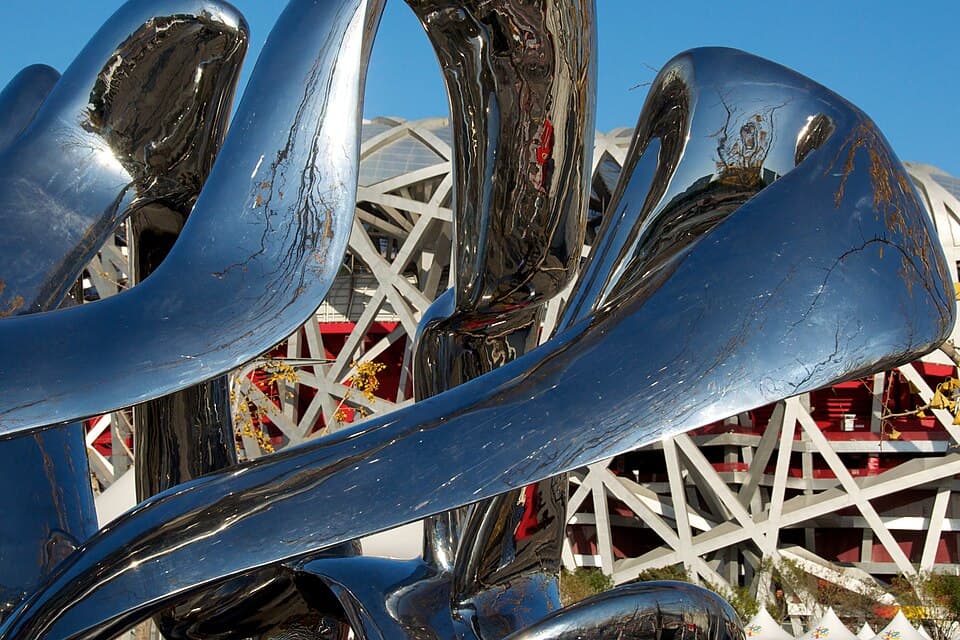
It's true! In 2008, I helped imagine the Beijing stadium with two Swiss architects. People call it the Bird's Nest, because it looks like a huge nest made of interwoven beams. I was proud of that building. But very quickly, I saw that they wanted to use it to make the whole world believe everything was fine in China. That's called propaganda: showing a pretty picture to hide the truth. So I withdrew. An artist must not lend his hands to dress up a lie.
An artist does not lend his hands to dress up a lie.
—Why did you want to find the names of the dead children?
In 2008, an earthquake struck the Sichuan region. Schools collapsed because they were poorly built, and thousands of schoolchildren died. The government hid their names, as if those children had never existed. I couldn't accept that. With volunteers, I searched everywhere, and we found over 5,000 names. Then I covered the facade of a museum in Munich with 9,000 children's backpacks. From afar, they formed a sentence, like a great cry of colors. Every child deserves to have their name spoken.
Every child deserves to have their name spoken.
—Did the police hurt you when you were looking for those names?
Yes, my child, and it was serious. In 2009, in Chengdu, police officers struck me on the head during the night. At the time, I didn't understand how serious it was. A few weeks later, in Germany, I had a brain hemorrhage. Doctors had to operate urgently to stop the bleeding. That's the price I paid for asking questions. But you know, it didn't silence me. On the contrary: fear, once you go through it, loses some of its power over you.
Fear, once you go through it, loses its power over you.
—Is it true you were locked up for 81 days?
Yes. In 2011, agents arrested me at Beijing airport, and I disappeared. For 81 days, no one knew where I was: not my family, not my friends. I was in a small room, watched day and night by two guards, even when I slept or washed. Time becomes strange in there; hours stick like mud. Outside, people around the world demanded my release with the question 'Where is Ai Weiwei?'. That detention taught me, as I said afterward, the fragility of life and the necessity of defending human dignity.
In a guarded cell, hours stick like mud.
—How can you make an artwork out of a prison?
Good question! When I got out, no one wanted to believe what I had been through. So I decided to show it. I built six large iron boxes, like dollhouses, but chilling. Inside, little figurines represented me: me eating, me sleeping, me showering, always with two guards glued to me. I called it S.A.C.R.E.D. Visitors had to bend down to look through a hole, and suddenly they were in my cell with me. Art, you see, is used to make people feel what words alone cannot say.
Art is used to make people feel what words alone cannot say.
—Is it true there were a hundred million seeds in a museum hall?
A hundred million, yes! In 2010, I filled a huge hall at the Tate Modern in London with a carpet of sunflower seeds. But come closer: they are not real seeds. Each one is porcelain, and each was hand-painted by artisans from the city of Jingdezhen. Imagine the work: thousands of people, for months, with a tiny brush in hand. Take a single seed: it is unique. Pour them all together: it disappears into the mass. That's exactly the question I ask about my country and its people.
A single seed is unique; poured together, they disappear into the mass.
—Why do you make such huge things?
Because I want people to be unable to look away, my child. Look at that wave of bicycles behind you: they are Forever brand bicycles, a brand every Chinese person knows. Alone, a bicycle is nothing. But thousands piled up become a mountain, a frozen crowd movement. In China, we are very numerous, and I like to remind people of the strength and beauty of that multitude. Large scale is my way of saying: 'Stop. Look. There is something important here.' A small drawing is forgotten; a mountain, never.
A small drawing is forgotten; a mountain, never.
—Are you sad that you can no longer live in China?
That question touches my heart. After my detention, my passport was confiscated for four years. When it was returned in 2015, I left China for Berlin, Germany. Yes, I miss my country: its language, its cuisine that I love to cook myself for my friends around a large table. Exile is living far from home without knowing if you can return. But I carry China within me wherever I go. And I wrote my memories in a book, to connect my exiled father's story to my own struggle.
I carry my country within me wherever I go.
—If we want to be like you later, what should we do?
First, keep your eyes open, my child. Many people see injustice and look away. True courage is to keep asking questions, even when it's uncomfortable. You don't need to be famous for that: start by noticing what is wrong around you, and refuse to pretend. My tools are my hands, my porcelain seeds, my bicycles. Yours might be words, or drawings, or simply your honesty. As I often say: everything is art, everything is politics.
True courage is to keep asking questions.
This imaginary interview was generated by artificial intelligence from sources documented in Ai Weiwei's profile. It dramatises what the figure might have said based on what we know about them, but does not constitute attested historical testimony. For primary sources and factual documentation, refer to the full profile.