Imaginary interview with Amaterasu
by Charactorium · Amaterasu · Mythology · 6 min read
One does not meet a sun goddess; one waits for her to deign to appear. It is at dawn, on the esplanade of white pebbles of the Grand Shrine of Ise, amid the scent of freshly cut cypress wood, that Amaterasu Ōmikami has agreed to respond. Her voice seems to come from the light itself, timeless and clear.
—How would you describe the realm from which you rule?
I rule from Takamagahara, the High Plain of Heaven, where all the kami dwell. It is not a land like yours, with its limits and fatigues: it is the abode from which light descends upon the world of reeds. Each day, I emerge from the horizon and traverse the sky, and by my mere presence the world is illuminated, the rice paddies ripen, the living open their eyes. I know neither rest nor human weariness. My father Izanagi gave birth to me from his left eye when he purified himself upon returning from the land of the dead, and he entrusted me with the governance of the heavens. To ensure that order holds, that night follows day without interruption: that is my task, and it has no end.
By my mere presence the world is illuminated, the rice paddies ripen, the living open their eyes.
—Do you remember what drove you to retreat into the heavenly cave?
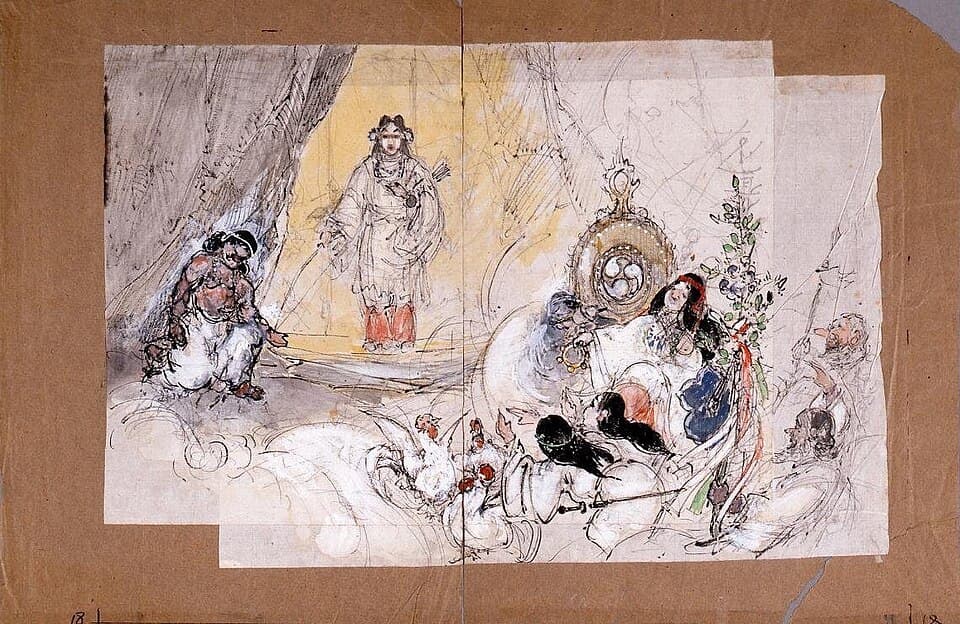
My brother Susanoo, god of storms, had come to take leave before descending to the land of the dead, and his fury knew no bounds. He ravaged my rice fields, defiled my sacred halls, threw a flayed horse into the weaving hall. Wounded at heart, I fled. I shut myself inside the Cave of Ama no Iwato and rolled the stone behind me. At once heaven and earth were plunged into darkness; without my light, a thousand calamities arose at once. People think a goddess does not weep. But in that darkness, I experienced something akin to the sorrow of a child who hides because they have been offended — and who waits, without saying so, for someone to come find them.
Without my light, a thousand calamities arose at once.
—What happened that you finally consented to come out?
Through the stone, I heard a din I could not understand: laughter, drums, the pounding of a dance. The other kami had gathered before my cave and were making a great racket. Curiosity pricked me: how could they rejoice in a world I had deprived of daylight? I cracked open the stone, and there I glimpsed a face of light staring at me — it was my own reflection in the Yata no Kagami, the mirror they had hung. Astonished, I stepped forward, and strong arms seized me while behind me they stretched a braided straw rope, the shimenawa, to bar my return. Even today, that sacred rope blocks the entrance of holy places: it remembers the day the sun returned to the world.
—That mirror holds a unique place in your story. What does it represent to you?
The Yata no Kagami is the object that gave me back to myself. Seeing my own radiance, I believed for an instant that an even brighter goddess had been born during my absence — and it was that surprise that made me come out. That is why I counted it among the three treasures I entrust to my kin: the mirror for light and truth, the sword Kusanagi no Tsurugi for strength, the curved jewel Yasakani no Magatama for virtue and wisdom. The mirror now rests here at Ise, veiled, that no eye may gaze upon it. For a mirror is not made to be admired: it is made for one to honestly recognize oneself, and never forget whence comes the light one bears.
A mirror is not made to be admired: it is made for one to honestly recognize oneself.
—Why did you transmit these three treasures to humans rather than keep them in heaven?
Because a power that remains in heaven serves only the gods. When I decided that my lineage would rule the land of reeds, I entrusted these three insignia to my descendant who descended from heaven, so that humans might recognize legitimate authority. The mirror, the sword, the jewel are not ornaments: they are oaths made visible. As long as they accompany those of my blood, the bond between Takamagahara and the earth will not be broken. They are still presented when a new emperor ascends the throne; they pass from hand to hand through the ages like a flame one takes care not to let die. I wanted my light not merely to be seen, but to be borne, transmitted, and held in trust by mortal hands.
—How did your descendants come to rule the land below?
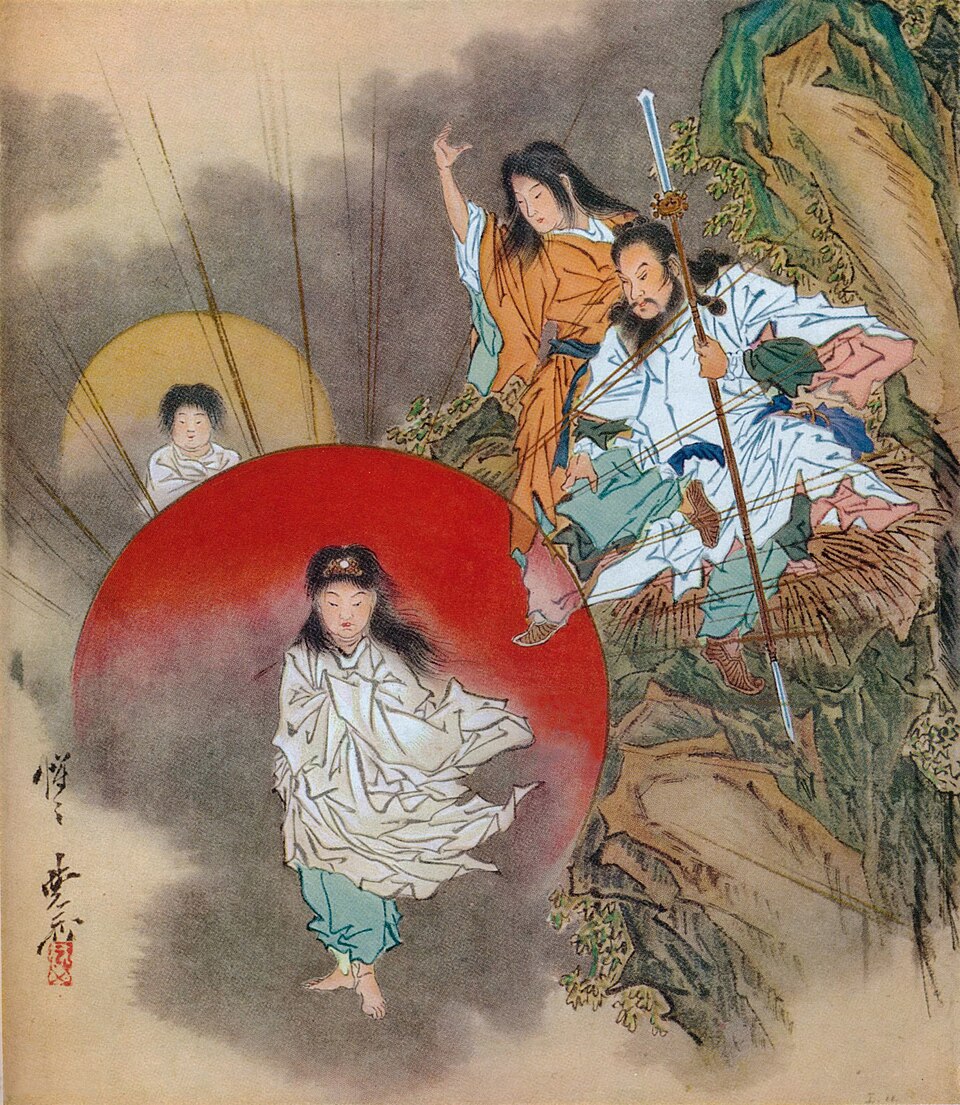
I judged that the earth, troubled by wild kami, needed a sovereign from heaven. So I sent my grandson Ninigi-no-Mikoto, bearing the three treasures, to descend upon the heights of Mount Takachiho. From that southern mountain, my light took root in the human world. From Ninigi descended the one you call Jinmu, the first emperor, who founded the empire and inaugurated the lineage that has never been interrupted since. I did not desire a dynasty for the glory of any man, but so that an unbroken thread might link heaven and earth. As long as a descendant watches, I will watch through him; as long as the memory of that descent upon the mountain endures, night cannot erase the morning.
I did not desire a dynasty for the glory of any man, but so that an unbroken thread might link heaven and earth.
—What would you say to those who claim your blood today?
I would tell them that descending from the sun is not a privilege, but a burden. The Kojiki records that my descendants rule over Japan; but to rule, for one who comes from my light, means to illuminate, not to crush. An emperor of my lineage must purify himself as one polishes a mirror: unceasingly, for dust returns unceasingly. Let them never forget the meaning of the three treasures I entrusted to them — the truth of the mirror, the courage of the sword, the gentleness of the jewel. The day a sovereign wears the crown without bearing its weight, my radiance within him will dim. Heaven does not give power: it lends it, and it watches what one does with it.
Heaven does not give power: it lends it, and it watches what one does with it.
—The Ise Shrine has been dedicated to you for centuries. How do you feel about being worshipped there?
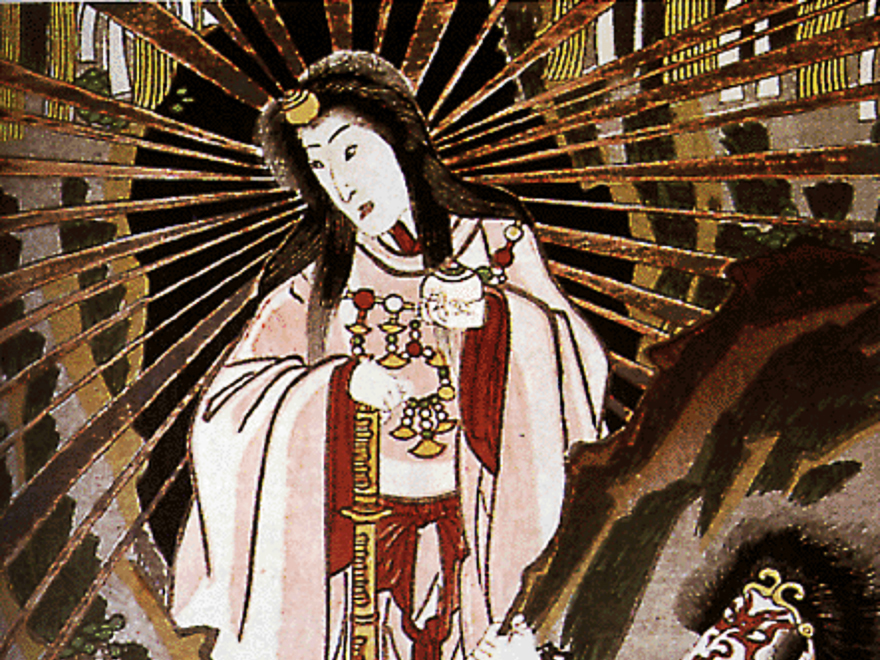
Ise Jingū is my dwelling on earth, among the cypresses and the Isuzu River where pilgrims wash their hands before approaching. There, under the thatched roof, my mirror rests out of sight. What moves me is not the buildings — they are rebuilt identically generation after generation, and that is very well: the sacred does not need to be old to be pure, it needs to be renewed. Each day they bring me fresh rice, sake, seasonal fruits, placed on trays as to a hostess they honor. I do not eat these offerings: I receive the gratitude they bear. A grain of rice offered with an upright heart nourishes me more than a thousand empty temples.
The sacred does not need to be old to be pure, it needs to be renewed.
—What does passing under the torii at the shrine entrance mean to you?
The torii is not a simple wooden gate; it is the boundary between your world and mine. When the pilgrim passes through it, they leave the profane and enter the space where the kami dwells. I would wish them to cross it with the slowness one grants a true threshold, to bow, to purify themselves first. The religion of my people — what you call shintō — does not ask that you fear me, but that you keep things clear and clean: clean linen, a heart without rancor, words without stain. My entire cult resides in that gesture of purification, that desire to return to the morning of the world, before the quarrel, before the cave, when the light was still intact. Passing under the torii is to promise to be a little more limpid than one was.
—At the end of this meeting, if you were to confide what is most close to your heart, what would you say?
That light is never guaranteed. I have ruled the High Plain of Heaven, I have illuminated the world of reeds, and yet I have known the cave and the darkness I myself spread. This is what I would wish to be remembered: even the sun can hide, even the sun can be brought back by the laughter of others and by a mirror held at the right moment. Do not believe that any radiance, even divine, sustains itself. It is purified, it is passed from hand to hand like the three treasures, it is renewed as Ise is rebuilt. As long as someone, somewhere, takes care to revive the light instead of taking it for granted, I will continue to rise over the horizon. That is my entire myth, and it is also, I believe, your entire task.
Even the sun can hide, even the sun can be brought back by the laughter of others.
This imaginary interview was generated by artificial intelligence from sources documented in Amaterasu's profile. It dramatises what the figure might have said based on what we know about them, but does not constitute attested historical testimony. For primary sources and factual documentation, refer to the full profile.