Imaginary dialogue between Susanoo (Susanoo no Mikoto) and Amaterasu
by Charactorium · Amaterasu · Mythology · 5 min read
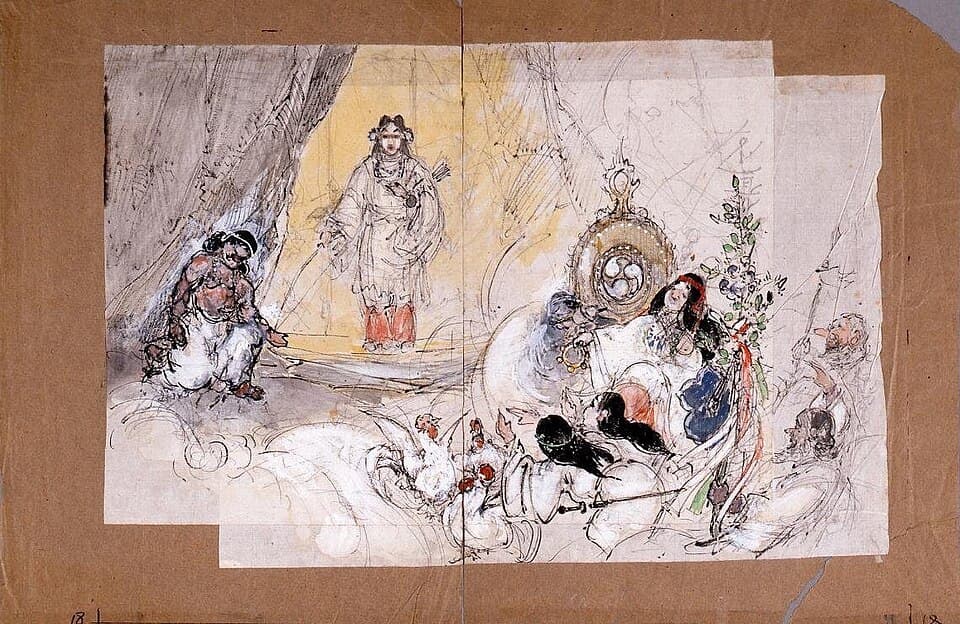
It is before the entrance of the Ama no Iwato cave, where the rock still holds the memory of darkness, that Susanoo meets his elder sister again. The braided straw rope, the Shimenawa, still hangs across the opening, and the returned light bathes the plain of Takamagahara. The two deities have known each other since their common birth from the divine Izanagi, and their old quarrel floats between them like an ember not yet extinguished. This time Susanoo comes without a storm, to listen to the one whose brightness he once made flee.
—Elder sister, we were born on the same day, from the face of our father Izanagi. What do you remember of that moment?
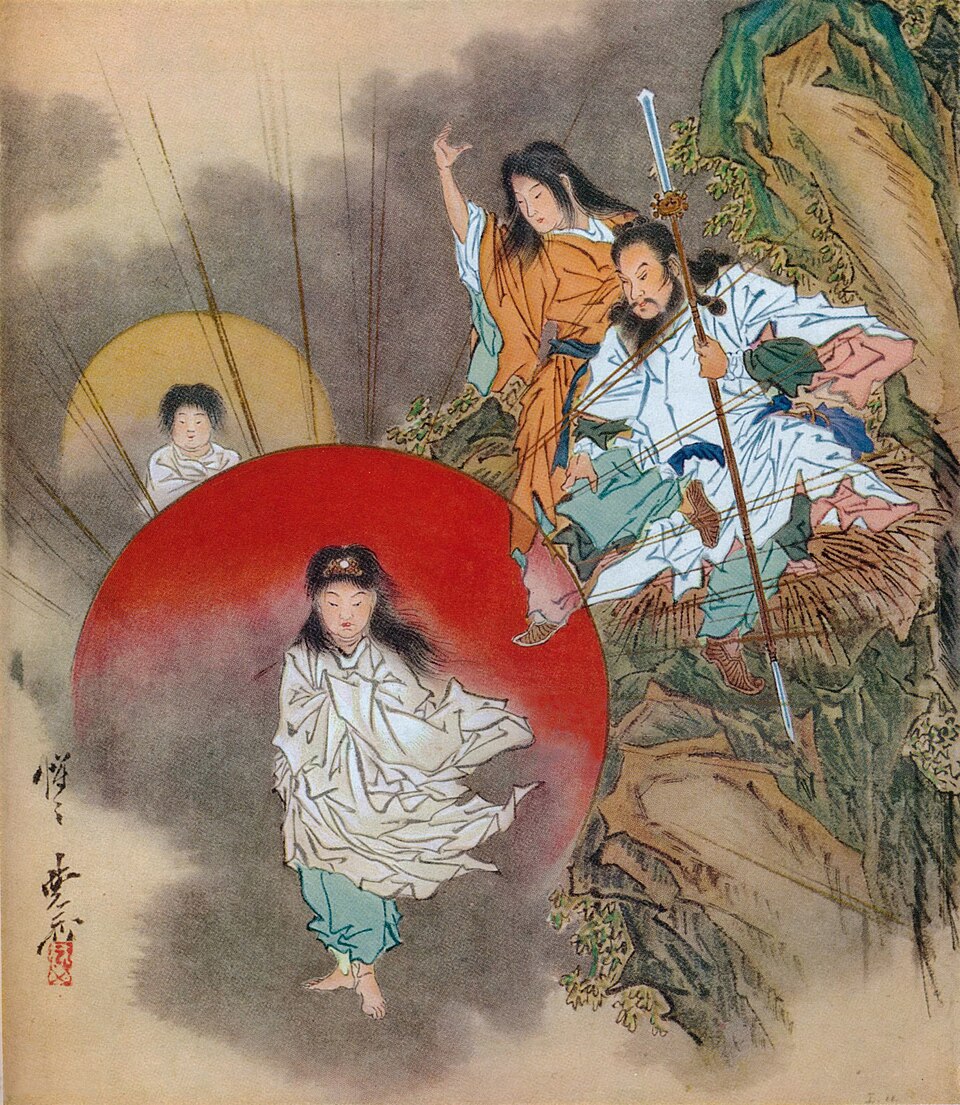
You who were born from his nose as I was born from his left eye, you know we had no mother to carry us. Izanagi was returning from the land of the dead, defiled by what he had seen, and it was while purifying himself in the river that he brought us forth. From that purifying water I emerged, already luminous, and he immediately entrusted me with the High Celestial Plain. I did not choose my charge: it was given to me as one gives a necklace of jewels to the eldest. To you, he gave the seas, and you know what dispute that sowed between us. But at the beginning, my brother, there was only clear water and the gaze of a father who wanted to wash the shadow from his eyes.
From the purifying water I emerged, already luminous, and he entrusted me with the High Celestial Plain.
—You who traverse the sky without rest, tell me: what does it feel like to illuminate the world each day?
I do not know the fatigue that earthly beings know, brother. At dawn I emerge from the horizon, and my mere presence suffices to awaken the fields, the waters, and even the most discreet kami. All day I watch over the order of the world, I cross the sky, then I descend back to Takamagahara when evening comes. It is not a task: it is what I am. Rice ripens because I shine, men lift their eyes because I shine. But this light is not a given — you saw well, the day I withdrew, how cold and mute the world becomes without it. Shining is my way of holding the universe upright.
Rice ripens because I shine, men lift their eyes because I shine.
—Let us talk about it, sister. When I ravaged your rice fields and defiled your dwelling, you shut yourself in. Why that silence?
Because your fury, Susanoo, was not mere insolence of a younger brother. You destroyed the dikes of my fields, you threw a flayed horse into my sacred weaving hall, and one of my weavers died from it. Faced with such violence, I did not respond with violence: I withdrew into the cave of Ama no Iwato and rolled the stone shut. It was not fear, it was a refusal. The world went dark instantly, shadows covered everything, and calamities multiplied. I wanted everyone to measure the worth of the light they scorn. One does not sack the house of her who lights the sky with impunity.
I wanted everyone to measure the worth of the light they scorn.
—And what made you open the stone again? They say a noisy celebration drew you from your hiding place.
The other kami are cunning, and they know me. Before the cave, they staged festivities: songs, laughter, the wild dance of Ame no Uzume, such a tumult that curiosity pricked me. How could they revel while the world was plunged into night? I cracked open the stone, and there they had hung the mirror, the Yata no Kagami. I saw a radiance I took for a deity more brilliant than myself. Intrigued, I leaned out — and a powerful hand pulled the stone away, while behind me they stretched the sacred rope, the Shimenawa, to prevent me from re-entering. Light returned in a flash to the world. That is how a ruse and a mirror overcame my anger.
I thought I saw a deity more brilliant than myself: it was only my own radiance.
—Today you are honored at the Grand Shrine of Ise. What do you expect from these shrines that men raise to you?
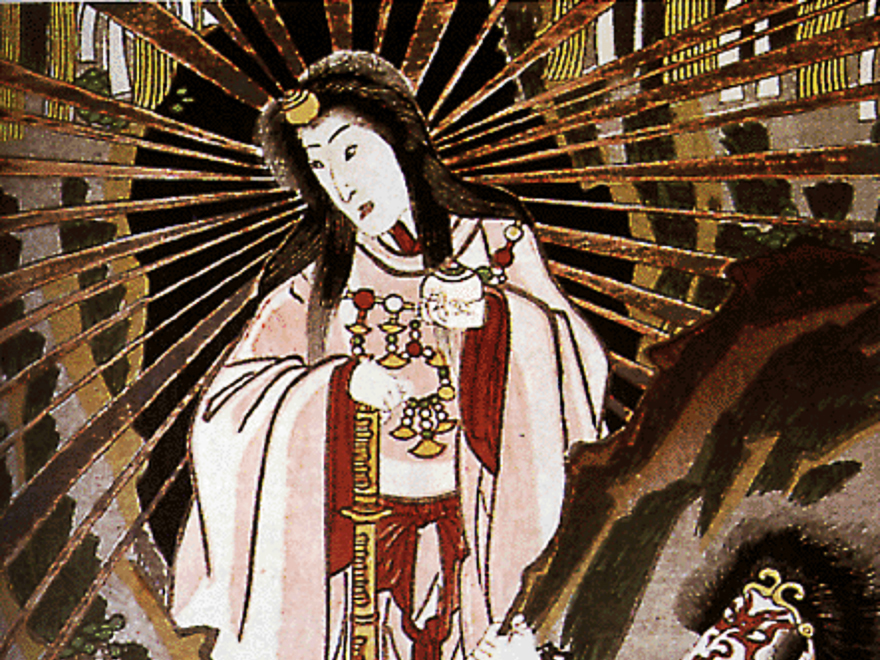
Men cannot touch me, brother, but they can offer me their gratitude. At Ise, they have made the Yata no Kagami the heart of the shrine, and they bring me what the earth produces: rice, sake, fruits, offered with pure gestures. These offerings do not nourish me — a goddess does not eat like a mortal. But they signify the covenant between Heaven and earth, between the kami and the living. The shrine is the place where my presence can be approached without burning. As long as the rites of purification continue, as long as the sacred rope marks the pure space, the bond we forged at the world's beginning remains unbroken.
Men cannot touch me, but they can offer me their gratitude.
—You entrusted three treasures to your descendants. Why hand over the mirror, the sword, and the jewel to mortals?
Because a world without sovereign light falls back into chaos, brother — you saw it with your own eyes. When the time came for the earth to be ruled, I sent my grandson Ninigi-no-Mikoto down from Heaven to Mount Takachiho. I gave him three insignia: the mirror Yata no Kagami, where my reflection dwells, the jewel Yasakani no Magatama, and the sword you know well. These three treasures are not jewels: they are proof that power comes from Heaven and not from the strength of men. From Ninigi was born the lineage that will rule over these islands. Thus my light does not stop at heaven's threshold: it descends to govern the earth through the blood of my descendants.
These three treasures are not jewels: they are proof that power comes from Heaven.
—That sword I once offered you — the one drawn from the serpent — is among your treasures. Do you remember?
How could I forget? After our quarrel, when you were banished from the High Celestial Plain, you wandered the earth and slew the great serpent Yamata no Orochi. From its tail you drew a wondrous blade, and you sent it to me as one offers a gift of reconciliation. I accepted that sword, and it became one of the three insignia I passed to my descendants. See what a strange path: what was born of your violence and bravery is now a symbol of legitimate power. Between us, brother, there was never anything but storm and light — and yet your gift now rests at the heart of my lineage. Even kami know how to pay homage to one another.
What was born of your violence and bravery is now a symbol of legitimate power.
—When you shut yourself in, the world dies of cold; when you return, it revives. Do you measure your own weight?
I measured it the day the stone closed behind me. Before that moment, I believed light was a given, like water flows. But when darkness covered Takamagahara and the land of men, when evil spirits began to buzz like summer flies and calamities sprang up everywhere, I understood that the entire order of the world rested on my course. This is not vanity: it is an overwhelming burden. Each morning I emerge from the horizon, I hold the balance of things in my hands. The red disk that men will one day paint to represent me speaks this simple truth: without the sun, there is neither time, nor harvest, nor life.
Each morning I emerge from the horizon, I hold the balance of things in my hands.
—Human chroniclers are already recording our tales. What do you want them to remember of you, sister?
Let them remember order, not caprice. They will record our quarrel, my retreat into the cave, the three treasures, and the descent of Ninigi — let them record them faithfully, for these tales explain why the world is as it is. I do not want them to make of me a distant, silent goddess. I am she who illuminates, she who withdraws when wounded, she who returns because the world needs her. If men keep that, they will understand that light is both a gift and a demand for purity. You who have known my two faces, the outraged sister and the forgiving goddess, you know better than anyone that my story is inseparable from yours.
I am she who illuminates, she who withdraws when wounded, she who returns.
This imaginary interview was generated by artificial intelligence from sources documented in Amaterasu's profile. It dramatises what the figure might have said based on what we know about them, but does not constitute attested historical testimony. For primary sources and factual documentation, refer to the full profile.