Imaginary interview with Amenhotep III
by Charactorium · Amenhotep III (1399 av. J.-C. — 1350 av. J.-C.) · Politics · Visual Arts · Spirituality · 5 min read

West bank of Thebes, at the hour when the sun dips behind the Libyan hills. Pharaoh Amenhotep III receives us in a hall of Malkata palace, barefoot on a floor painted the color of Nile water. Outside, on the lake dug for his wife, a barge awaits dawn; inside, surrounded by blue faience scarabs, he consents to speak as no living god ever does — in the first person.
—How did you come up with the idea of engraving your deeds on these little faience scarabs rather than on temple stone?
Stone endures, but it endures where it is erected. A scarab, however, travels. I had more than two hundred fired in blue-green faience, the color of rebirth, and I cast them like seeds: as far as the courts of Syria, as far as the temples of Nubia. Each bore a bulletin of the reign — my marriage, my hunts, the digging of the lake. Thus the scribe of a distant king who will never enter Karnak yet holds in his palm the voice of Nebmaâtrê. The dung beetle rolls its ball and makes the sun rise each morning; my scarabs roll my name from one end of the known world to the other.
I cast them like seeds: as far as the courts of Syria, as far as the temples of Nubia.
—One of these scarabs announces that you killed one hundred and two lions. Why keep such a tally?
Because a number is a prayer made visible. One hundred and two lions by my own hand, between year one and year ten of my reign — the scarab says it plainly. The beast is not merely an animal; it is the disorder that prowls at the edges, the enemy of maât. When my bow draws and the arrow flies, it is not a hunter taking aim, it is Ra pushing back the night. The people who receive this scarab do not count trophies: they learn that their king still holds chaos by the throat. That is why I engrave the number, precise, as one seals an oath.
A number is a prayer made visible.
—You married Tiye, daughter of a provincial noble and not of royal blood. What guided this choice?
I have been reproached enough in silence. Tiye was not born of a line of kings: her father is Yuya, her mother Tuya, people of quality but provincial. And yet I made her Great Royal Wife, and I proclaimed it on a scarab sent to the entire empire, naming her parents as one names a frontier — from Karoy in the south to Naharina in the north. Let the whole world know whence my queen comes. I did not choose a womb, I chose an intelligence; she reads state affairs over my shoulder, and foreign kings themselves write to her. Blood makes princesses; the mind makes queens.
Blood makes princesses; the mind makes queens.
—Do you remember the inauguration of the lake you had dug for her?
Like a morning stolen from the gods. I had ordered, for Tiye, in her father's town, a lake three thousand seven hundred cubits long — the work of a few days only, so many were the arms. In the third month of the first season, on the first day, the water was where there had been only sand. I had the barge named Aton-gleams launched, and we sailed, she and I, on a stretch born of my sole word. Think of it: a king says “Let there be a lake,” and the next day the wind ripples new water. That day I knew that Malkata would be my home for eternity.
A king says “Let there be a lake,” and the next day the wind ripples new water.
—At Soleb, in Nubia, you dedicated a temple to your own divinity. How does a man worship himself?
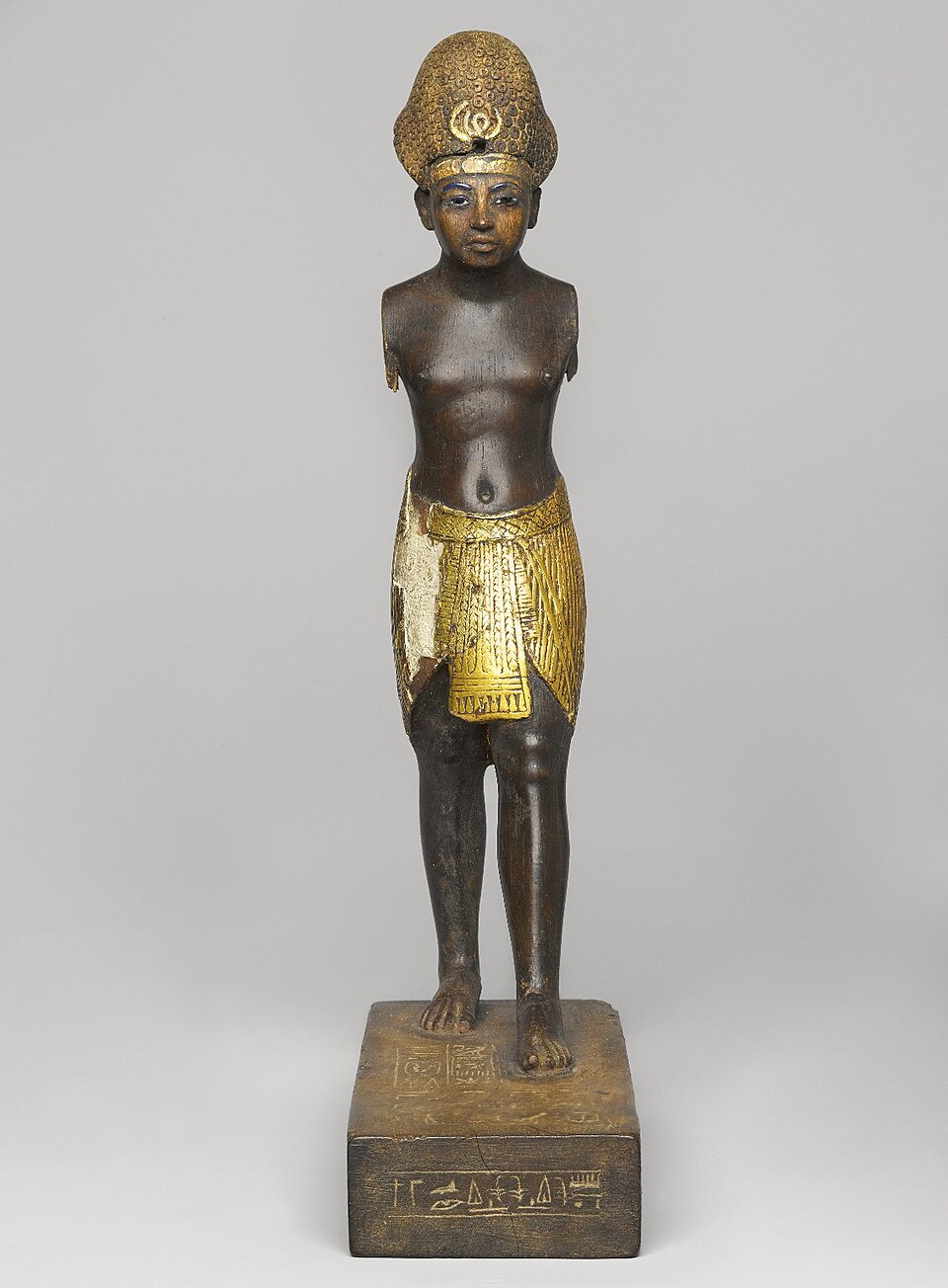
You speak of a man; I speak of the son of Amun-Ra. Since always the pharaoh is the bridge between gods and the living — but at Soleb, I let the truth take its full measure. On the reliefs, one sees me officiating, incense in hand, before my own radiant effigy, that of Nebmaâtrê, lord of Nubia. This astonishes you: that the priest and the god have a single face. But who, better than I, knows the offering due to my divine part? No pharaoh before me had gone so far in his lifetime. I usurp nothing: I merely reveal, in broad daylight and in Nubian stone, what the throne has contained from the beginning.
This astonishes you: that the priest and the god have a single face.
—What do you reply to those who find it excessive for a king to make himself a god before his death?
That the excess would be to do less. I celebrated not one but three Heb-Sed jubilees, those festivals that regenerate power after thirty years of reign; each time, my divine vitality was renewed before the eyes of the high priests. A pharaoh worn by age who is reborn three times — that is not rationed. My very name, Nebmaâtrê, means “Lord of maât is Ra” — I do not carry justice, I am it. The temples I raise, from Luxor to Soleb, are not boasts: they are the material proofs that through me the order of the world holds firm. Remove the god from the king, and Egypt is no more than a land among lands.
I do not carry justice, I am it.
—The king of Babylon demanded an Egyptian princess in marriage. How do you govern through these letters exchanged between sovereigns?
Every afternoon at Malkata, tablets pile up before my scribes like the flood deposits its silt. Kadashman-Enlil of Babylon presses me: why have I not sent him one of my daughters? Let him give me one, he writes, and gold will flow in return. I answer without anger, but I do not yield: never does a daughter of the king of Egypt leave the Two Lands for a foreign bed — that is our law, and the gold I already send in quantity is better than a princess. With Mitanni, with Arzawa, it is the same patient game: I take their daughters, I give my gold, I do not give mine. They think me peaceful; I am simply richer, and wealth is an army that does not bleed.
Wealth is an army that does not bleed.
—Why refuse so firmly to marry your daughters abroad, when that would seal powerful alliances?
Because a pharaoh's daughter carries within her a part of the god, and the god is not exported. The kings of Mitanni willingly send me theirs, and I welcome them into my harem with their attendants and dowries; the gold from my Nubian mines goes out in whole convoys eastward. The exchange is already generous — what more do they demand? To yield an Egyptian princess would be to admit that another throne equals mine, and none does. I weave peace with gifts, tablets, and incoming marriages; I do not weave it with the sacred blood of my house. A clever king gives much in order never to give the essential.
A pharaoh's daughter carries within her a part of the god, and the god is not exported.
—On the west bank, two colossi of eighteen meters guard your funerary temple. What did you intend to build there?
The greatest temple Egypt ever bore — so vast one might have thought to house eternity itself at Kom el-Hetan. Before its entrance, I had two giants of red quartzite erected, eighteen meters high, pulled from the ground and dragged to Thebes by thousands of men. They represent me seated, hands on my knees, gaze toward the east, guardians of my mansion of millions of years. Around them crowded hundreds of statues, sphinxes, stelae — a stone multitude to escort my name beyond death. Let the floods erode the rest; these two will keep watch when the whole temple has melted into silt.
Two giants of red quartzite, guardians of my mansion of millions of years.
—It is said that one of these colossi begins to sing at daybreak. What does this voice born of stone inspire in you?
In my lifetime they are silent, and that is well: a god need not explain himself. But if one of them should one day raise its voice at the first ray of dawn, I would see Ra himself greeting me through my image, the order of the morning answering the order I upheld all my life. I am told that travelers from very far away hear the lament of a hero mourning his mother the Dawn — no matter what story they lodge in it. The essential is that the stone still speaks when the king's mouth is silenced. A pharaoh succeeds at his death the day his silence continues to make noise.
A pharaoh succeeds at his death the day his silence continues to make noise.

This imaginary interview was generated by artificial intelligence from sources documented in Amenhotep III's profile. It dramatises what the figure might have said based on what we know about them, but does not constitute attested historical testimony. For primary sources and factual documentation, refer to the full profile.