Imaginary dialogue between Kadashman-Enlil Ier de Babylone and Amenhotep III
by Charactorium · Amenhotep III (1399 av. J.-C. — 1350 av. J.-C.) · Politics · Visual Arts · Spirituality · 5 min read

It is beneath the still-fresh colonnades of the Temple of Luxor, on the shore of the lake of Malkata where the barque Aton-gleams shimmers, that Kadashman-Enlil I of Babylon is received by his "brother" of Egypt, Amenhotep III, in the year of grace c. 1370 BC. The air smells of kyphi and Nile silt; blue faience scarabs gleam on a low table, offered to the distinguished guests. The two sovereigns have been writing to each other for years, quarreling over gold, princesses, and prestige — and the king of Babylon has come, tablet in hand, to claim his due and to fathom the mystery of this neighbor who calls himself a god.
—My brother, in my tablets I asked you for one of your daughters in marriage, and you turned me down. Why do you refuse to a king what you take from others?
Brother of Babylon, you know better than anyone the price of that gold I send you in whole convoys — it flows in my land like desert dust. But a daughter of Pharaoh, none has ever left Egypt for a foreign bed: such is the rule of my fathers, and I am not the one to break it. I gladly take your princesses from Mitanni and Arzawa, for they enter my Great House and become part of it. But to give is to diminish the maat of which I am the guardian. Do not mistake my refusal for contempt: I offer you gold, vases, statues — everything except my own blood.
Gold flows in my land like desert dust; but a daughter of Pharaoh, never.
—You speak of gold, Nebmaâtrê. When my messengers return from your court, they complain that you detain them. Is that how one treats the envoy of a brother?
Your messengers, I receive them in the afternoon, when I have finished the rituals of Amun and my two viziers have cleared the affairs of the North and the South. I do not detain them out of bad faith, brother: I seat them at the banquets of Malkata, I cover them with gifts so that you may see, upon their return, with what friendship I honor you. The roads between our two kingdoms are long, the deserts full of bandits; it is better to have a well-treated envoy than a hasty convoy. Write to me what you want — gold, more gold, I know it — and you shall have it. But leave me the time to do things properly, as befits great kings.
It is better to have a well-treated envoy than a hasty convoy.
—Those little blue scarabs you put on my table have reached my court in Babylon. What use are they to you, these engraved toys you scatter everywhere?
Take one, brother, and read. They are not toys: they are my heralds of faience. When I married my Great Wife Tiye, when I slew one hundred and two lions, when I had her lake dug, I had the event engraved on hundreds of these scarabs and sent them as far as Syria, as far as Nubia — and as far as you, as you see. Thus, with the same gesture, all the kings of the earth learn what the Lord of the Two Lands does. No ruler before me has spoken in his own voice throughout the entire world. These little faience creatures are my official journal, distributed from one end of the nations to the other.
These little faience creatures are my official journal, distributed from one end of the nations to the other.
—I have been shown one of those scarabs where you boast of having killed one hundred and two lions in ten years. Must a king really run after wild beasts like that?
You smile, brother, but listen well: the lion is not just an animal. It is the chaos that prowls at the edges of the world, the one that the god Ra vanquishes every night so that the sun may be reborn. When I slay one hundred and two lions with my own hand, I do not hunt for pleasure — I repeat the god's deed, I push back disorder far from Egypt. My bow and arrows are instruments of maat as much as my scepter. A king who could no longer vanquish the beast would be a king devoured by chaos. You who guard your borders against nomads understand this better than anyone.
The lion is the chaos that prowls at the edges of the world; to slay it is to repeat the god's deed.
—Since you refuse to marry off your daughters, let us speak of your wife. They say your Tiye is not of royal blood. How does a pharaoh elevate a commoner to his side?
Tiye is the daughter of Yuya and Tuyu, nobles of the provinces, not of kings — I have never hidden it, I even had it engraved on the scarab of our wedding, with the names of her parents so that none may doubt. I have been reproached for it in whispers. But I tell you, brother: I have not found under the sky a woman more worthy to wear the double crown at my side. For her I had dug near Malkata a lake of three thousand seven hundred cubits, in just fifteen days, and I sailed upon it in the barque Aton-gleams on the day of its opening. A king marries not only blood: he marries strength. Tiye rules in my council as much as in my heart.
A king marries not only blood: he marries strength.
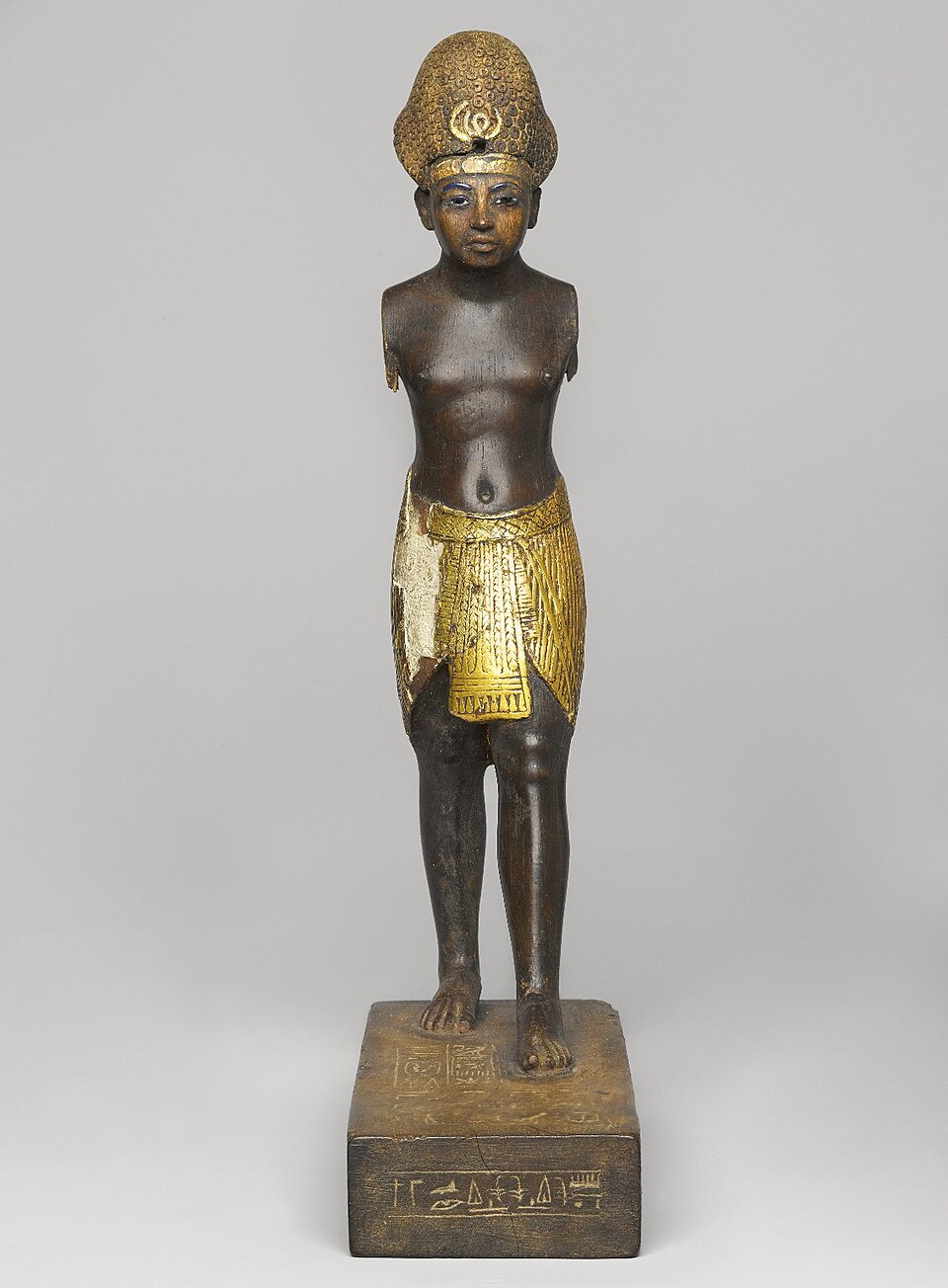
—A lake dug in fifteen days for a woman! In my land, they would whisper that a king is ruining himself. What did this expense bring you, my brother?
What did it bring me? Look around you, brother: peace, gold, temples rising, kings writing to me calling me their brother. Egypt has never been so great, and Tiye is at the prow of this greatness. Digging a lake for my Great Wife is not ruining myself, it is showing all the earth that the Lord of the Two Lands commands water as he commands silt. The day the barque cut through those new waters, all my people saw that nothing resists my will — not even the desert ground. An expense that inspires trembling admiration is worth more than a buried treasure.
An expense that inspires trembling admiration is worth more than a buried treasure.
—From my barque on the Nile, I saw two stone colossi taller than ten men. Tell me, how did your workers erect such mountains?
Those two giants of red quartzite, eighteen cubits of a man high, guard the entrance of my mortuary temple at Kom el-Hetan — the largest ever built on this earth. I had those blocks hauled from the quarries, brought upriver on barges, erected by thousands of arms to the chant of foremen. Behind them stood a forest of statues, sphinxes, and stelae. And at Karnak, I raised the third pylon; at Luxor, these colonnades with papyrus capitals where we sit. Building is not vanity, brother: every stone I lay is an offering to the gods and a rampart against oblivion. The pharaoh who does not build lets maat crumble.
Every stone I lay is an offering to the gods and a rampart against oblivion.
—You build for the gods, you say. But all this stone, all this gold from your projects — where does the wealth come from that allows you never to stop?
From well-guarded maat, brother, and nothing else. My fathers extended Egypt to the Euphrates and chained Nubia; I no longer have to wage war — I harvest. The gold of Nubia comes upriver, the tributes of the provinces fill my granaries, the caravans of the Near East pass through Memphis. The peace I maintain is worth a thousand victories: a kingdom at war spends, a kingdom at peace accumulates. That is why I can build Luxor, Soleb, and my palace without exhausting the treasury. You who demand gold from me know that I give it without it being missed: such is the reward of a reign where disorder has no hold.
A kingdom at war spends, a kingdom at peace accumulates.
—Here is what troubles me most, Nebmaâtrê. At Soleb, in Nubia, I am told you built a temple not to the gods, but to yourself. Can a living king be a god?
You touch the heart of the mystery, brother, and I will not hide it. At Soleb, I consecrated a temple to Amun-Ra — and to my own divinity, living. The reliefs show me offering incense before my own deified image: Amenhotep, god of Nubia. No pharaoh before me dared this in his lifetime. But understand well: the pharaoh has always been son of the gods, mediator between heaven and men. I only made visible what was already true. My very name, Nebmaâtrê, says that the maat of Ra dwells in me. When I open the naos at dawn, it is no longer quite a man who touches the statue.
No pharaoh before me dared this in his lifetime; I made visible what was already true.
—You celebrated the Sed festival three times, I am told, when a single jubilee suffices after thirty years. Why renew your own kingship so many times?
The Heb-Sed jubilee magically regenerates the king's power; it is celebrated after thirty years of reign, when a man's strength declines. I, brother, have celebrated it three times. Not out of vanity, but to proclaim that my divine vigor does not weaken despite the years. Each Sed festival is a rebirth: I run the ritual course, I take up the double crown, I show my people and the gods that the Lord of the Two Lands is as fresh as on the first day. A living god does not age like men — he renews himself. You who may see me grow old, remember: at Soleb, my youth is carved in stone for eternity.
A living god does not age like men — he renews himself.

This imaginary interview was generated by artificial intelligence from sources documented in Amenhotep III's profile. It dramatises what the figure might have said based on what we know about them, but does not constitute attested historical testimony. For primary sources and factual documentation, refer to the full profile.