Imaginary interview with Angela of Foligno
by Charactorium · Angela of Foligno (1248 — 1309) · Spirituality · Literature · 5 min read
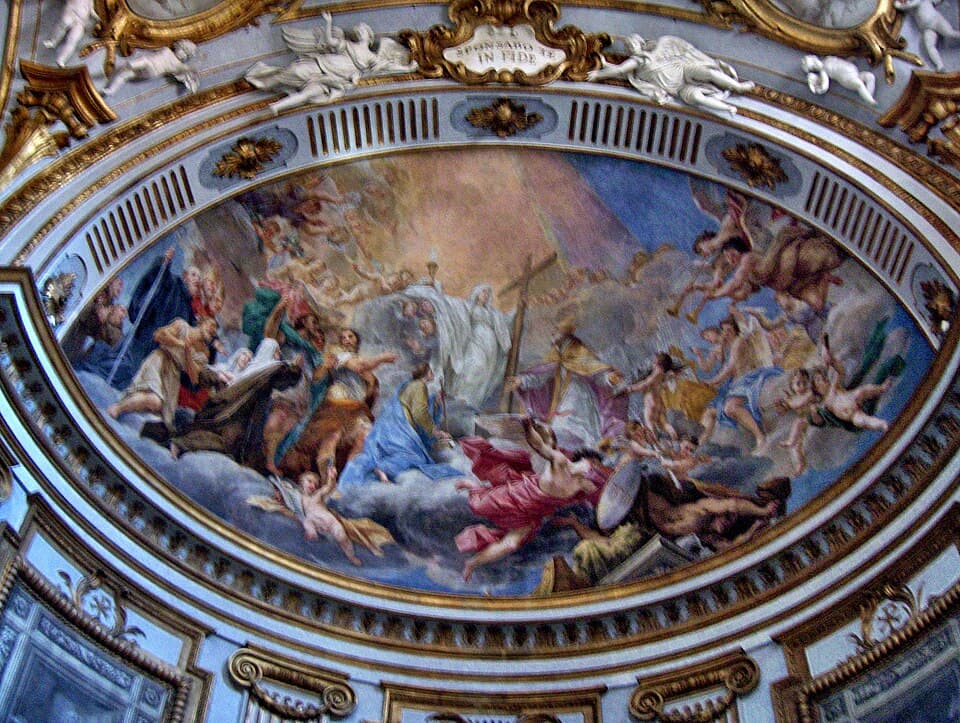
Foligno, in Umbria, at the turn of the 14th century. In a bare house where only a crucifix adorns the wall, a woman in a grey woolen habit receives her visitor after a long vigil. Brother Arnold, her confessor, already holds the parchment, ready to record every word.
—Do you remember the moment your former life collapsed?
I will never forget those months of 1285. My mother first, then my husband, then my children — death took them one after another, like leaves torn from the same branch. Once I was the wife of a merchant of Foligno, surrounded by comfort, fine clothes, laden tables. People will think I mourned these losses as a misfortune: the truth is otherwise. I saw in that great void a finger pointing the way, a hand loosening my ties one by one. I sold what I owned, gave it to the poor, and put on the cord of the tertiaries. They thought me mad. I was finally breathing.
Death took them one after another, like leaves torn from the same branch.
—Why choose poverty when you had everything?
Because comfort is a weight you only feel when you set it down. As long as I possessed, I thought I was possessing; in reality my coffers held me. The day I joined the Third Order of Saint Francis, I exchanged my finery for a grey woolen habit, worn, patched on purpose. I began to fast, often on bread and water, and to visit the sick of the city. Those who pitied me did not understand that I had never been so rich. Poverty is not deprivation: it is the place one makes for God when one has emptied the house of everything else.
Comfort is a weight you only feel when you set it down.
—What happened during your pilgrimage to Assisi?
I had come to pray at the Portiuncula, that little chapel of Santa Maria degli Angeli where Saint Francis himself received his vocation. Upon crossing the threshold, something seized me that I cannot name. I began to cry out, to roll on the stone floor, unable to contain myself. My companion, Brother Arnold, was so ashamed that he first thought of distancing himself from me, as one steps away from a woman seized by madness. He did not yet know that God had just made him my pen. That day, in the Franciscan sanctuary, my mystical vocation was sealed before men, whether they liked it or not.
He did not yet know that God had just made him my pen.
—How did the brother who wanted to flee you become your scribe?
Shame is sometimes the first step of faith. Arnold, my confessor at the church of Sant'Angelo, had seen my ecstasy at Assisi and had turned away. But God does not let go so easily of those He harnesses. He returned, wary, and asked me to tell what I had seen. Then I spoke, and he, on his parchment, wrote under my dictation in his school Latin, correcting, doubting, reading my own words back to me to verify that he had added nothing. From that patient mistrust was born the Liber. Without this brother, initially embarrassed, my darkness would have died with me.
Shame is sometimes the first step of faith.
—You speak of a 'divine darkness.' What do you mean by that?
That is the hardest thing to say, for it is precisely what exceeds all speech. I have contemplated a darkness so total that I no longer remembered any of the works of God, nor the Trinity, nor anything. And yet — listen closely to this paradox — in that darkness I saw the Trinity. No image, no figure, no word: nothing but that fulfilled night. The ancients called it the negative way, and the old Dionysius had sensed it. God is not at the end of our ideas; He is beyond, where the mind must consent to become blind in order to see at last.
The mind must consent to become blind in order to see at last.
—How can you put into words an experience you say is ineffable?
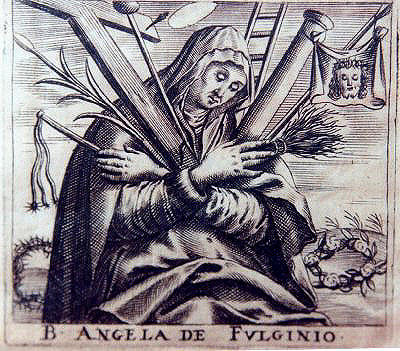
One cannot, and that is my sorrow as much as my joy. When I dictated my Memoriale to Brother Arnold, I understood that the soul contemplating God can in no way speak of Him, because everything that can be said of Him remains far below the truth. The words I deliver are ashes after the fire. Arnold was distressed, thinking he transcribed poorly; I reassured him: no one transcribes the infinite well. What the parchment retains is not the vision, only its trace, as the sand holds the imprint of a footstep without keeping the walker.
The words I deliver are ashes after the fire.
—You have been called 'mistress of theologians.' How do you receive that title?
With a smile, for see the irony: I am a woman without school Latin, a merchant's widow, and yet doctors come to sit at my feet. In Foligno, a small community of men and women formed around me, whom I guided as best I could. My Spiritual Instructions are nothing more than that: letters, words given to my sons and daughters to keep them on the path. I did not teach them arguments, but an experience — how to love the Passion of Christ, how to strip oneself. Knowledge puffs up; love alone builds up. If I am called mistress, it is because God delights to instruct the learned through the ignorant.
God delights to instruct the learned through the ignorant.
—You repeat to your disciples that poverty is 'the royal road.' Why that word?
Because a royal road leads to the King, and our King mounted a cross. I say it and say it again in my Instructions: whoever chooses poverty has chosen the cross of Christ, and whoever has chosen the cross has chosen Christ himself. This is not a doctrine I recite; it is the path I have trodden barefoot. My disciples sometimes wanted consolations; I showed them instead the crucifix hanging on my wall, the sole ornament of my bare house. Renunciation is not the goal: it is the narrow gate. Whoever refuses to lose everything always keeps something between God and himself.
A royal road leads to the King, and our King mounted a cross.
—What are your days of penance like in Foligno?
They begin before dawn. I rise for Matins and Lauds, then go to church for Mass, where sometimes I am seized and lose track of the hours. The afternoon is for silent prayer, meditating on the Passion, visiting the poor. In the evening, after Vespers and Compline, I often prolong the vigil all night, insensitive to the cold, my rope of penance at my belt. I fast severely — sometimes bread and water alone for days. In periods of intense grace, the Eucharist suffices for all nourishment; my body forgets itself, and what should exhaust me keeps me standing.
What should exhaust me keeps me standing.
—Are not these fasts and vigils a violence to your body?
I am reproached for it, and I understand the objection. But I do not hate my body: I want to conform it to that of Christ. When I meditate long before the crucifix, contemplating his wounded limbs, I cannot remain sated and soft while he suffered everything. The discipline, the rope, the dry bread are not tortures I inflict out of disgust for life — they are ways to unite my small pain to his great pain. The body is an instrument: tuned too slack, it gives no sound; stretched toward the Passion, it sings. I do not seek to die. I seek to love to the end.
Tuned too slack, the body gives no sound; stretched toward the Passion, it sings.
This imaginary interview was generated by artificial intelligence from sources documented in Angela of Foligno's profile. It dramatises what the figure might have said based on what we know about them, but does not constitute attested historical testimony. For primary sources and factual documentation, refer to the full profile.