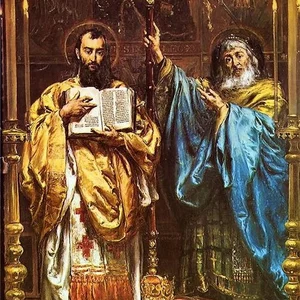

Cyril and Methodius were two Byzantine brothers of the 9th century, Christian missionaries among the Slavic peoples. They created the Glagolitic alphabet to translate liturgical texts into the Slavic language, laying the foundations of Slavic written culture.
Cyril and Methodius
Cyril and Methodius
5 min read
Frequently asked questions
Key Facts
- Born in Thessalonica (Salonica), Constantine (the future Cyril) around 826-827 and Michael (the future Methodius) around 815
- In 863, sent by the Byzantine emperor Michael III to Great Moravia at the request of Prince Rastislav
- Around 863, Cyril created the Glagolitic alphabet to transcribe the Slavic language and translate the Scriptures
- Cyril died in Rome in 869, and Methodius died in Moravia in 885
- Proclaimed co-patrons of Europe by Pope John Paul II in 1980
Works & Achievements
Creation of the first writing system adapted to the Slavic language, the foundation of all Slavic written culture.
The first written record of sacred texts in the language of the Slavic people, making the faith accessible.
Adaptation of prayers and church services into Slavic, allowing Mass to be celebrated in the local language.
A poem attributed to Cyril celebrating the value of writing in one's mother tongue, the first Slavic literary monument.
The work of Methodius, who became archbishop and structured the young Slavic Church despite the opposition of the Frankish bishops.
Methodius continued translating the Old Testament and collections of laws, enriching the Slavic heritage.
Anecdotes
Cyril's real name was actually Constantine: he only took the name Cyril at the very end of his life, when he became a monk in Rome a few weeks before his death in 869. It is under this monastic name that history has remembered him.
Before leaving on his mission to the Slavs, Constantine was nicknamed “the Philosopher” because he taught at the imperial school of Constantinople, one of the most prestigious of his time.
To translate the Bible and the liturgy into the Slavic language, Cyril invented an entirely new alphabet from scratch, the Glagolitic script, whose letters resembled no existing writing system. It was a colossal challenge because Slavic had sounds unknown to Greek.
Pope Adrian II officially supported the two brothers and authorized the liturgy in Slavic, which was revolutionary: at the time, only Latin, Greek, and Hebrew were considered worthy of celebrating God in the West.
After Cyril's death, Methodius carried on the work alone and was appointed Archbishop of Moravia. He spent nearly three years in prison, locked up by Frankish bishops hostile to the Slavic liturgy.
Primary Sources
“Constantine set himself to prayer with his collaborators, and soon God revealed the letters to him, and he began to write down the words of the Gospel.”
“The pope received the Slavonic books, consecrated them, and laid them in the church of Saint Mary.”
“We command that in this Slavonic tongue the praises and the works of Christ our Lord be sung.”
Key Places
Great Byzantine city where the two brothers were born, at the crossroads of the Greek and Slavic worlds. From childhood they learned the Slavic language there.
Capital of the Byzantine Empire where Constantine taught and received his training as a “Philosopher.” It was from here that the Moravian mission set out.
Slavic principality in Central Europe where the brothers carried out their main mission from 863 onward. There they translated the liturgy and trained disciples.
City where the brothers obtained papal approval of the Slavic liturgy and where Cyril died in 869. He is buried in the Basilica of San Clemente.
Roman church housing the tomb of Cyril. It has become a place of remembrance for the two saints.
Typical Objects

The first alphabet created by Cyril to write the Slavic language, made up of letters with rounded, original shapes. It was used to transcribe the Gospels and the liturgy.

A liturgical book containing the Gospels translated into Slavic, copied by hand by the brothers and their disciples. It made it possible to celebrate Mass in the language of the people.

A scribe's instruments used to trace the first Slavic letters onto parchment. The work of writing was slow and painstaking.

A curved staff symbolizing Methodius's authority as Archbishop of Moravia. It marked his role as a shepherd of souls.

Bones attributed to Pope Clement, found in Crimea by Constantine and solemnly brought back to Rome. This gift smoothed the brothers' welcome by the pope.

A holy image painted according to the Orthodox tradition, an aid to prayer brought by the Byzantine missionaries. It accompanied the teaching of the faith.
School Curriculum
Vocabulary & Tags
Key Vocabulary
Daily Life
Morning
The brothers' day began before dawn with prayer and the monastic offices. Constantine then devoted himself to the study of languages and to perfecting the Slavic letters.
Afternoon
The afternoon was divided between teaching the young Moravian disciples and the long work of translating the Gospels. Each word had to find its equivalent in a language that still had no writing.
Evening
The evening gathered the community for vespers and a frugal meal. It was also the time for discussions about translation choices and the training of the future Slavic priests.
Food
Like Byzantine monks, they followed a simple diet: bread, vegetables, fish and water, with frequent fasts tied to the liturgical calendar. Meat was avoided most of the time.
Clothing
They wore the dark tunic and cloak of the Eastern monks, and sometimes the chasuble to celebrate the liturgy. Methodius later bore the insignia of an archbishop.
Housing
On their missions, they lodged in princely residences, monasteries or modest houses near the churches they founded. Their life remained that of itinerants devoted to preaching.
Historical Timeline
Period Vocabulary
Liens externes & ressources
Références
Œuvres
Alphabet glagolitique
vers 863
Traduction des Évangiles en slave
863-867
Traduction des textes liturgiques
vers 864
Proglas (Préface aux Évangiles)
vers 863-867
Organisation de l'Église morave
870-885
Traduction de textes juridiques et bibliques
vers 880-885