Kids interview Angela of Foligno
by Charactorium · Angela of Foligno (1248 — 1309) · Spirituality · Literature · 5 min read
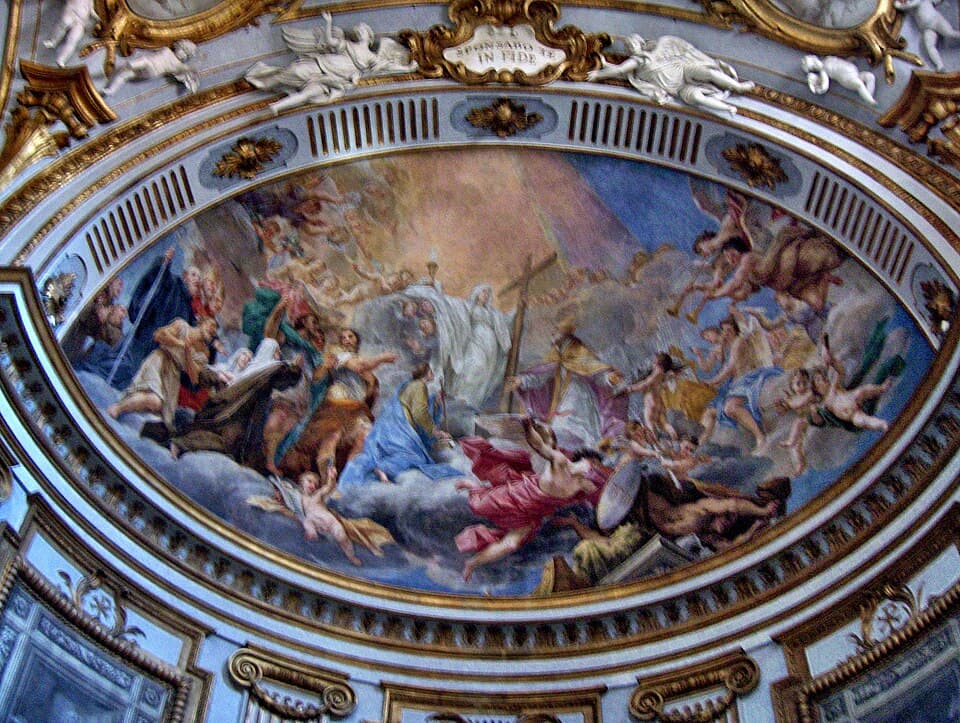
That morning, two students from a school trip push open the door of a small stone church in Umbria. A woman in a grey wool habit waits for them, a gentle smile on her lips. Her name is Angela, and she lived in Foligno a very long time ago.
—What was your life like before you became a woman of prayer?
You know, my child, I first lived as a wealthy lady. I was the wife of a merchant in Foligno, and I loved fine dresses, parties, comfort. Imagine a house full of cushions and good meals, where you lack nothing. I prayed little, and I thought mostly of myself. That lasted for years. The God I served then was my own pleasure. I had not yet understood that a heart too full of things has no room for what matters. It took my life breaking apart for me to finally turn toward Heaven.
A heart too full of things has no room for what matters.
—Is it true that you lost your whole family? Were you sad?
Yes, my child, and I will not lie to you: it was terrible. Around the year 1285, in a short time, my mother died, then my husband, then my children. Imagine a house where, season after season, one chair empties, then another, until silence. I wept, of course. But in the depths of that night, I heard something like a call. I did not see it as a punishment, but as a hand opening a path for me. So I gave everything to the poor, and I joined the Third Order of Saint Francis, those laypeople who live the ideal of Saint Francis without entering a monastery. Grief had set me free.
In the depths of that night, I heard something like a call.
—What was your journey to Assisi like? Did something strange happen?
Ah, Assisi! I went there on pilgrimage, my child, to the city of Saint Francis. Before the little chapel called the Portiuncula, something seized me. A joy so strong, so burning, that I could no longer contain it. I began to cry out, to roll on the ground, unable to restrain myself. Imagine that you suddenly feel all the love in the world in your chest: your body no longer knows what to do with it. This is called an ecstasy, when the soul seems to leave the body to join God. The people around me were quite embarrassed, I think. As for me, I saw only One thing.
Imagine all the love in the world at once in your chest.
—And the monk next to you, how did he react? Was he ashamed?
Oh yes! Poor Brother Arnold! He was my confessor, a Franciscan from Foligno. When he saw me crying out like that in front of everyone in Assisi, he was so ashamed that he thought of leaving me for good. Imagine his face: a churchman, calm and discreet, next to a woman screaming! But God has a good sense of humor, my child. Instead of fleeing, Arnold stayed. And he became the one who wrote down my visions on parchment, with a quill, under my dictation. Without him, you would know nothing of me today. Sometimes, the one who wants to flee becomes the most faithful.
Sometimes, the one who wants to flee becomes the most faithful.
—You said you saw God. What did it look like?
That is the hardest question, my child, and I will tell you the truth. Seeing God was not seeing a light or a face. I dictated this to Brother Arnold: 'I saw something so dark that I do not remember any of the works of God, nor the Trinity, nor anything else. And I no longer saw anything of bodily things... and in that darkness I saw the Trinity.' Imagine that you close your eyes in the deepest blackness, and in that blackness you feel held, loved, fulfilled. That is it. It is called the divine darkness.
In that darkness, I saw the Trinity.
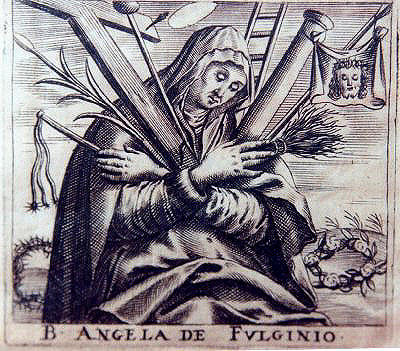
—But why is it dark if it is God? Darkness is usually scary.
You are right, my child, darkness is usually scary. But listen carefully. God is so great, so beyond everything, that no image can contain Him. So when you truly draw near to Him, all images go out, like candles blown out one by one. There remains a darkness, but a fullness of darkness. I understood this: 'that soul which contemplates God cannot speak of Him in any way, because everything one can say of Him is far inferior to the truth.' Imagine trying to put the ocean into a small glass. It is impossible. So we are silent, and we adore.
All images go out, like candles blown out one by one.
—Is it true they called you 'mistress of theologians'? What does that mean?
I was given that beautiful nickname, yes, my child, and it almost made me blush. A theologian is a scholar who studies God from books. As for me, I was only a woman with little education, a simple tertiary. But in Foligno, men and women came to listen to me, and among them very learned people. They left saying that I had understood, through the heart, what they sought in their studies. Imagine a child explaining the sea to sailors because he has truly crossed it. It was not my knowledge that spoke, my child, it was my experience.
It was not my knowledge that spoke, it was my experience.
—And your disciples, what was the most important thing you taught them?
I guided them in the church of Sant'Angelo, in Foligno, where we gathered. And what I repeated most was to let go of everything for God. I told them what I believe with all my soul: 'Poverty is the royal way. Whoever has chosen it has chosen the cross of Christ, and whoever has chosen the cross has chosen Christ himself.' Imagine a traveler emptying his too-heavy sack to walk faster: that is poverty of heart. I did not promise them an easy life, my child. I promised them a true life. And many followed me on that steep path.
A traveler empties his too-heavy sack to walk faster.
—What did you wear? And what did you eat in the morning?
Look at my dress, my child: it is coarse grey wool, a rough fabric, without any ornament, with a cord at the waist. It is the habit of Franciscan tertiaries, patched, worn, as Saint Francis wanted. In the morning? Very little. Often only bread and water, for I fasted much. Imagine an almost empty bowl, and a piece of hard bread dipped to soften it. I did not eat for pleasure, but just to keep going. That may seem harsh to you. But when the heart is full of God, you see, the stomach demands less. I had chosen to lack everything so as to lack only Him.
I had chosen to lack everything so as to lack only Him.
—Why did you always gaze at the crucifix? Didn't it make you sad?
The crucifix, my child, was the heart of my days. I spent hours contemplating the suffering Christ on His cross. You ask if it made me sad. A little, yes. But above all, it brought me closer to Him. Imagine that you keep vigil at the bedside of someone you love who is in pain: you do not leave, you stay, and your presence becomes love. That is what I did. By looking at His sufferings, I learned to bear my own, and to no longer flee the pain of others. The cross was not for me an image of death, but a lesson in love to the very end.
The cross was not an image of death, but a lesson in love.
This imaginary interview was generated by artificial intelligence from sources documented in Angela of Foligno's profile. It dramatises what the figure might have said based on what we know about them, but does not constitute attested historical testimony. For primary sources and factual documentation, refer to the full profile.