Imaginary dialogue between C. V. Raman and Anna Mani
by Charactorium · Anna Mani (1918 — 2001) · Sciences · 4 min read
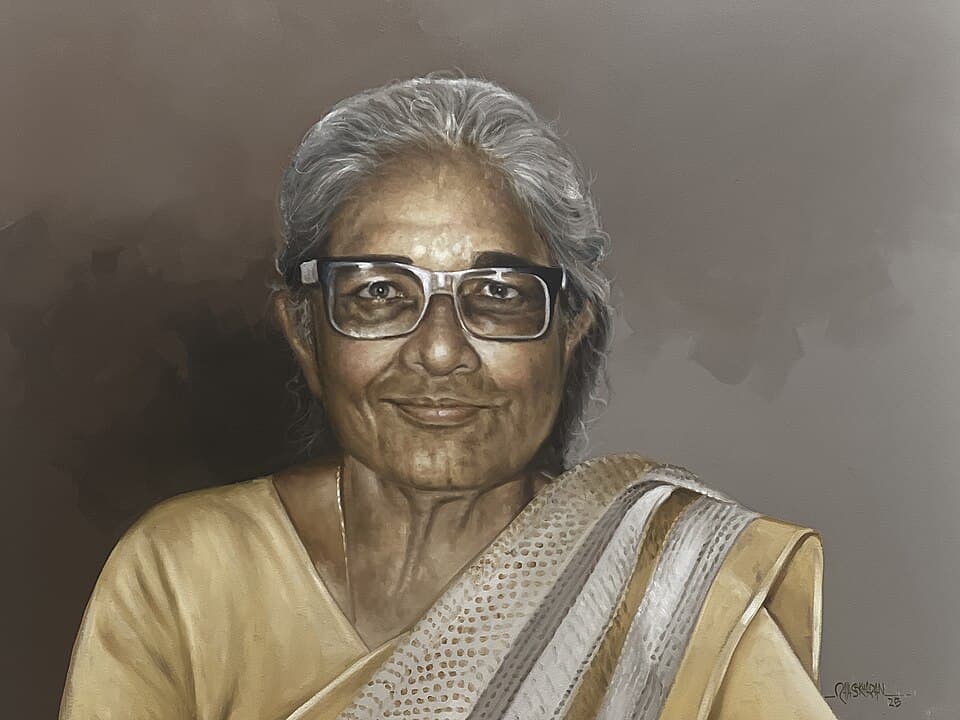
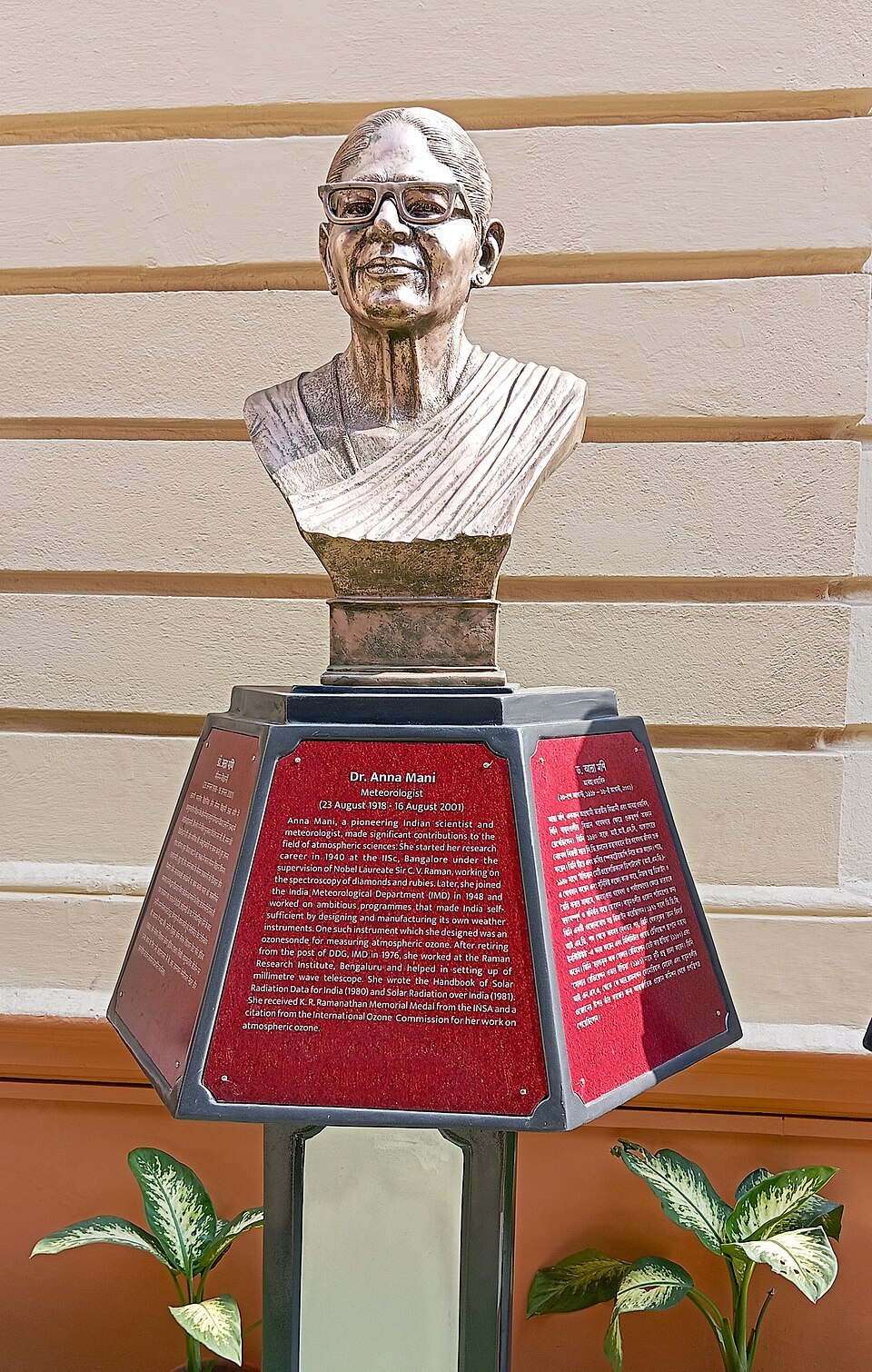
It is in the gardens of the Raman Research Institute, in Bangalore, that the old master meets his former student one afternoon in 1968. Light falls on the paths, and somewhere a forgotten prism on a windowsill splits a ray into a rainbow. They have known each other since the early 1940s, when Anna Mani was measuring the spectra of diamonds in his laboratory; today she directs networks of instruments across India. C. V. Raman has come to hear her speak of that journey — from the child who read everything to the instruments that measure the Sun.
—Anna, they say that as a little girl, you refused diamond earrings. Is that true, that story about an encyclopedia?
It is perfectly true. For my eighth birthday, my family wanted to give me diamond earrings, as they did for all the girls. I flatly refused: I wanted the Encyclopædia Britannica, those big volumes that contained, it seemed to me, the whole world. You know, I had already devoured almost all the Malayalam books in our library before I was eight, and English books before twelve. Jewelry never said anything to me; books, on the other hand, opened doors. I think that day, without knowing it, I chose my life. They offered me something to adorn myself with; I preferred something to understand.
They offered me something to adorn myself with; I preferred something to understand.
—Do you remember our years at the Institute, when you spent your nights on the spectra of diamonds and rubies? What exactly were you looking for?
How could I forget them? It was in your laboratory, at the Indian Institute of Science, that I truly learned my craft. I decomposed the light that passed through diamonds and rubies, noting every absorption line, every missing color. You, who discovered how light is scattered in matter, taught me that patience: to see what the eye does not see. I derived five articles from it, between 1942 and 1945. Those crystals taught me that matter speaks, if you know how to question its light. Without those years with you, I would never have dared, later, to build my own instruments.
Those crystals taught me that matter speaks, if you know how to question its light.
—You had written your thesis, published your work. And yet the university denied you the title of doctor. How did you experience that?
With bitterness, I admit, but without dwelling on it long. I had done the work, written my thesis, published my five articles — and they told me that, lacking an official master's degree, I would not get the title. I was missing a paper, not knowledge. I could have resented it all my life; I preferred to leave for London in 1945 to learn meteorological instruments. A title, you see, measures neither wind nor Sun. I decided that my reputation would be made by what my instruments could measure, not by the letters attached to my name. I think I did not lose out.
I was missing a paper, not knowledge.
—Our country had just been born free. You decided that it would manufacture its own instruments rather than buying them from afar. Why that choice?
Because a nation that buys all its instruments from abroad remains dependent, even politically free. When I joined the India Meteorological Department in 1948, almost everything came from Europe, expensive and slow. I supervised the standardization of about a hundred instruments — anemometers, radiation sensors, probes — so that India could produce them itself. It was not just technology: it was a way to make our independence real, right down to our laboratories. A country that can measure its own sky no longer has to beg for its numbers. I brought to it the same rigor as in your laboratory: a poorly calibrated instrument lies, and a wrong number is worse than no number at all.
A country that can measure its own sky no longer has to beg for its numbers.
—They say you are uncompromising on precision. In Pune, your young engineers apparently dread your checks. Are you so strict?
Strict, no; demanding, yes, and I own it. A measuring instrument has only one virtue: to tell the truth about the world. If it is off by a hair, everything that follows is skewed — maps, forecasts, decisions. So yes, I check every adjustment, I make them redo it, I have little tolerance for approximation. My young people sometimes complain, but they learn that in science, rigor is a form of respect: respect for reality and for those who will rely on our numbers. You, who spent your life tracking a spectral line, know that a tenth of a degree can change a conclusion. I am merely passing on that discipline.
In science, rigor is a form of respect.
—Now you are measuring the Sun itself, across the entire subcontinent. What do you hope to gain from this energy that falls from the sky?
The Sun is India's foremost wealth, and we ignored it for lack of measurement. Since the International Geophysical Year of 1957, I have been setting up stations across the country that record, day after day, the solar energy received at the ground. With the pyranometer, we quantify what the sky gives us. These records will serve to understand our climate, our monsoons, and one day to capture this energy for our villages. A tropical country that does not know its own radiation deprives itself of its most abundant treasure. I patiently gather this data; others, after me, will know what to do with it. It is an ant's work, but the India of tomorrow may run on the light we are counting today.
The Sun is India's foremost wealth, and we ignored it for lack of measurement.
—You have been seen launching balloons into the high atmosphere and placing instruments all the way to the rocket station at Thumba. What are you looking for up there?
Up there, part of Earth's fate is played out. I developed the ozonesondes, those sensors that a balloon carries to measure ozone in the upper layers of the air — that thin gas that protects us from the Sun's rays. Until now, few countries monitored this composition; India is now taking its place. At Thumba, near the magnetic equator, I installed meteorological instruments to accompany our first launches. Measuring wind, ozone, radiation is preparing the ground for any venture into the sky. Meteorology and space exploration go hand in hand: you launch nothing without first understanding the atmosphere you are crossing.
You launch nothing without first understanding the atmosphere you are crossing.
—I always see you dressed in khadi, that hand-spun cotton. It is Gandhi's cloth. What does it represent for you?
It represents a loyalty. I grew up in a country fighting for its freedom, marked by the Salt March of 1930 and by the figure of Gandhi. Khadi, that hand-spun and hand-woven cotton, was the fabric of that struggle: wearing khadi meant refusing the cloth imposed by the empire, affirming swaraj, our self-rule. I have continued to wear it all my life, in simple saris, without ornament. It is not a coquetry or nostalgia: it is my way of reminding myself every morning why we wanted this independence. You do not build a free science by forgetting where the freedom that makes it possible comes from.
You do not build a free science by forgetting where the freedom that makes it possible comes from.
—You remained unmarried, you live simply, surrounded by books. People sometimes wonder about that. Do you care?
Not in the least. People have often wanted to tell me what a woman should do — marry, wear jewelry, stay in her place. I declined all that, just as I declined the earrings at eight. My life consists of few things: my instruments, my books, music in the evening, and nature, which I love to observe while traveling. My homes have always been modest, cluttered with documents rather than furniture. I have never had a taste for luxury or a need for approval. The freedom I demanded for my country, I simply took for myself as well. I believe one lives well only in harmony with what one is.
The freedom I demanded for my country, I simply took for myself as well.
This imaginary interview was generated by artificial intelligence from sources documented in Anna Mani's profile. It dramatises what the figure might have said based on what we know about them, but does not constitute attested historical testimony. For primary sources and factual documentation, refer to the full profile.