Imaginary interview with Anna Mani
by Charactorium · Anna Mani (1918 — 2001) · Sciences · 6 min read
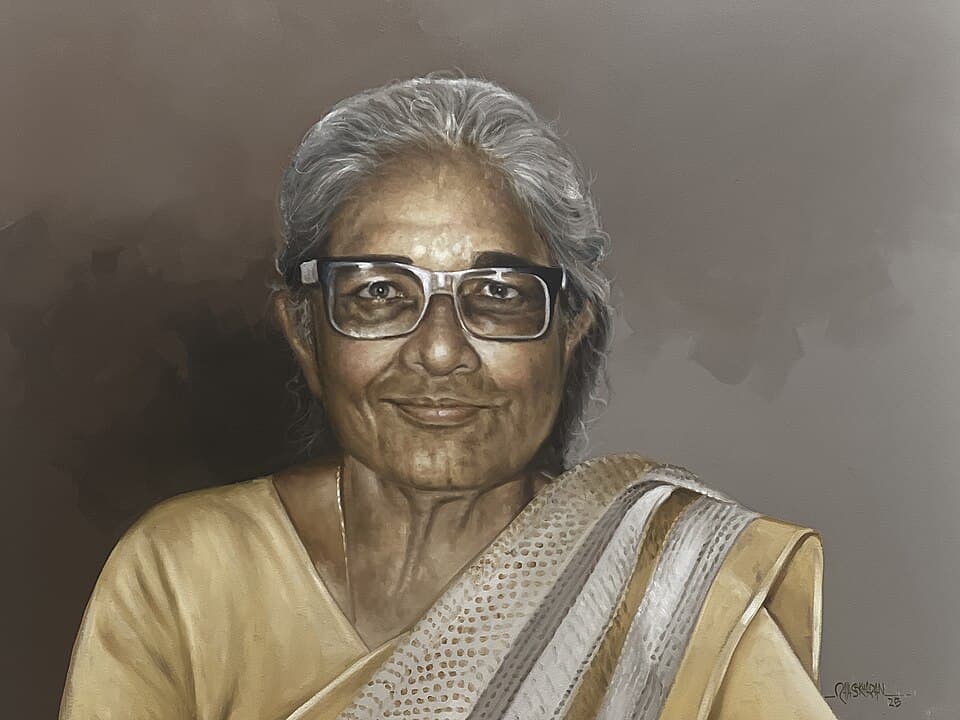
Thiruvananthapuram, an afternoon in 2000. In a living room overflowing with books and radiation maps, a small woman in an ecru cotton sari receives us, a pyranometer sitting on the table like a paperweight. Anna Mani, eighty-two years old, speaks of instruments as others speak of friends.
—Do you remember the gift you asked for your eighth birthday?
They brought me, according to the custom reserved for the daughters of the house, a pair of diamond earrings. I refused. Instead, I demanded a complete set of the Encyclopædia Britannica. My parents must have thought me a little mad, in Peermade, in those cardamom hills where a girl was expected to shine at her neck, not in her head. But I had already devoured almost all the Malayalam books in the town library before age eight, and I would swallow those in English before twelve. A piece of jewelry is worn once and then sleeps in a box; an encyclopedia, you return to all your life. I believe that day I chose, without formulating it, between what a woman was supposed to appear and what she wanted to know.
A piece of jewelry is worn once and then sleeps in a box; an encyclopedia, you return to all your life.
—Did this hunger for reading stay with you even in your scientific work?
Always. I wake up early and start by reading — it has remained my morning ritual, even before heading to the lab. I've long been described as stern, unable to tolerate approximations, and it's true: a poorly recorded observation irritates me like a spelling mistake. But this rigor comes from the little girl who had read an entire library before she had her permanent teeth. Reading, measuring, verifying — it's the same gesture: refusing to take things on faith. In the evening, when the instruments fall silent, I return to my books and my scientific correspondence. I never had children or a husband, and I was pitied for that; but I never lacked company, between a page and a correct number.
Reading, measuring, verifying — it's the same gesture: refusing to take things on faith.
—Tell us about your years with physicist C. V. Raman in Bangalore.
I worked at the Indian Institute of Science under C. V. Raman, the man who had given his name to an effect of light scattering. My task: to break down the light of diamonds and rubies with a spectrograph, to read in their spectra the secrets of their structure. Between about 1942 and 1945, I produced five scientific papers and a doctoral thesis from this. Raman's lab was demanding, buzzing with crystals and ambition, and I felt I belonged there. I learned there that the hardest material, diamond, can still be interrogated by a simple well-decomposed beam. That is a lesson I later carried to the sky: measuring is making speak what seems mute.
The hardest material, diamond, can still be interrogated by a simple beam.
—How did you experience the refusal to grant you the title of doctor?
Bitterly, then with a sort of cold laugh. I had published five papers, written my thesis in the lab of a Nobel laureate — and the university refused me the doctorate on the grounds that I did not hold an official master's degree. So a piece of paper was worth more than the work itself. I had my B.Sc. in physics and chemistry, obtained at Madras in 1939, and that was not enough before the regulation. I could have broken myself against it; I preferred to leave. In 1945, I went to Imperial College in London to study meteorological instruments. Since they denied me a title for the light of rubies, I would go measure that of the Sun over an entire country. They never gave me that doctorate; I never asked them for it again.
So a piece of paper was worth more than the work itself.
—Upon returning from England, why were you so insistent that India manufacture its own instruments?
I returned in 1948, a year after independence, and joined the India Meteorological Department in Pune. Everywhere equipment was imported: anemometers, sensors, probes from Europe, expensive, slow to repair, dependent on the goodwill of foreign suppliers. That seemed absurd to me for a nation that had just freed itself. A country that cannot measure its own wind and its own sun remains under tutelage, otherwise than by arms. So I undertook, in the fifties and sixties, the standardization of about a hundred instruments made in India. It wasn't national pride; it was elementary sovereignty. An Indian thermometer is worth an English thermometer if it is well calibrated — and ours, we could repair ourselves.
A country that cannot measure its own wind and its own sun remains under tutelage.
—How did you work day after day on these instruments?
My afternoons were spent designing and testing devices: adjusting an anemometer, checking the sensitivity of a radiation sensor, sending an ozonesonde under a balloon to probe the upper atmosphere. An instrument is tested to exhaustion, pushed, compared, refused to be declared good until it lies by one percent. I also trained young scientists, and I think I terrified them a bit with my intransigence. But a national network rests on trust: if a station in Pune and a station in Kerala do not measure the same way, all data becomes noise. Standardization, that dry word, is in reality a pact of truth between dozens of observers who will never meet.
—You covered a subcontinent with stations to measure the Sun. What did you hope to read there?
I set up, from the fifties to the seventies, a network of stations that measured the energy sent by the Sun at ground level, each equipped with a pyranometer. The idea was to draw, station by station, a map of the light received across India. People think they know the Sun because it dazzles them; in truth they ignore how much energy it really deposits on a field in Rajasthan or a paddy in Kerala. Yet on that figure depends everything: agriculture, climate, and one day the energy that will be drawn from that very light. The International Geophysical Year of 1957 gave these measurements a global impetus, and I threw myself into it. Measuring the Sun was not contemplating; it was inventorying a wealth that no chest can contain.
Measuring the Sun was not contemplating; it was inventorying a wealth that no chest can contain.
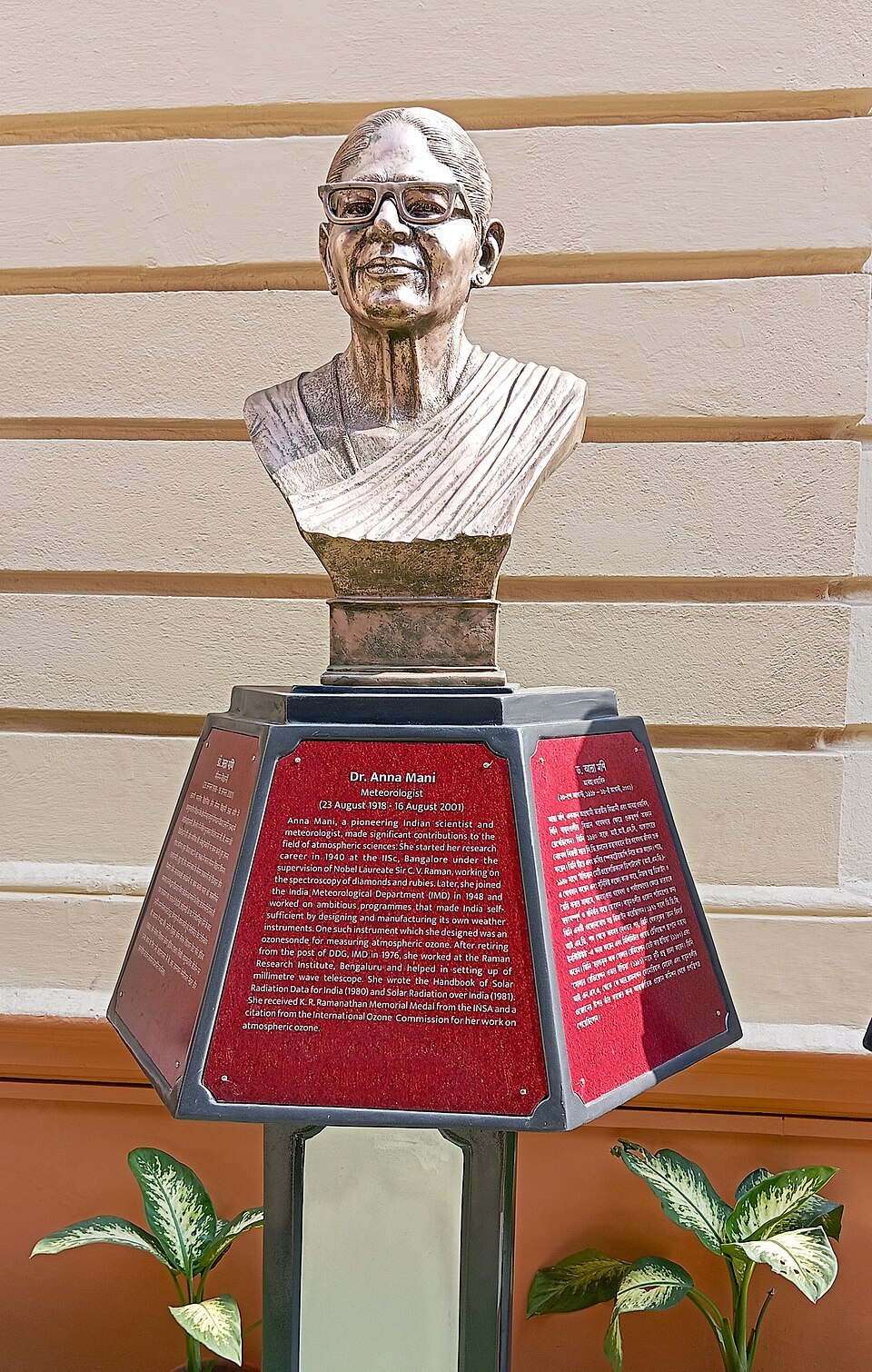
—Your solar radiation manuals are still used. What do they represent for you?
In 1980, I compiled the measurements collected by the network into the Handbook for Solar Radiation Data for India, then the following year I published Solar Radiation over India, which maps the solar energy of the territory. These are not books to read by the fireside: they are tables, maps, columns of numbers wrested from the sky for decades. But each number is a day of observation, a verified instrument, an observer faithful to his post. If engineers still use them to build solar installations, then these arid pages outlive me. I see there my true descendants: not children, but correct data, bequeathed to those who will know what to do with it.
Not children, but correct data, bequeathed to those who will know what to do with it.
—All your life you wore khadi. What did this clothing choice mean?
Khadi, that hand-spun and hand-woven cotton, was the fabric of Gandhi and the movement for swaraj, our self-rule. I wore khadi saris all my life, simple, unadorned — the same ones I already refused, as a child, to trade for diamonds. It was not inverted coquetry. Spinning and weaving one's own cloth, rather than buying the fabric of English mills, was the humblest and most stubborn political act there was. And I was doing exactly that with my instruments: refusing imports, making at home, relying on our own hands. The khadi on my shoulders and the Indian anemometer on its mast said the same thing — a nation stands upright when it produces itself what it needs.
The khadi on my shoulders and the Indian anemometer said the same thing.
—You have been described as a woman of great sobriety. Where did this rejection of the superfluous come from?
From the same source as everything else, I believe: that little girl from Peermade who preferred books to jewelry. I lived in modest lodgings, according to my postings, cluttered mainly with books and work documents. My table was that of southern India — rice, vegetables, coconut, the cardamom of the hills of my childhood. Luxury never tempted me, not out of displayed virtue, but because it bored me. I was known for my rigor and my refusal of the conventions imposed on women; these are two sides of the same thing. Cutting away the superfluous, in a wardrobe as in a measurement, is to let the essential appear. A khadi sari, a correct instrument: I never asked for more.
Cutting away the superfluous, in a wardrobe as in a measurement, is to let the essential appear.
This imaginary interview was generated by artificial intelligence from sources documented in Anna Mani's profile. It dramatises what the figure might have said based on what we know about them, but does not constitute attested historical testimony. For primary sources and factual documentation, refer to the full profile.