Kids interview Anna Mani
by Charactorium · Anna Mani (1918 — 2001) · Sciences · 4 min read
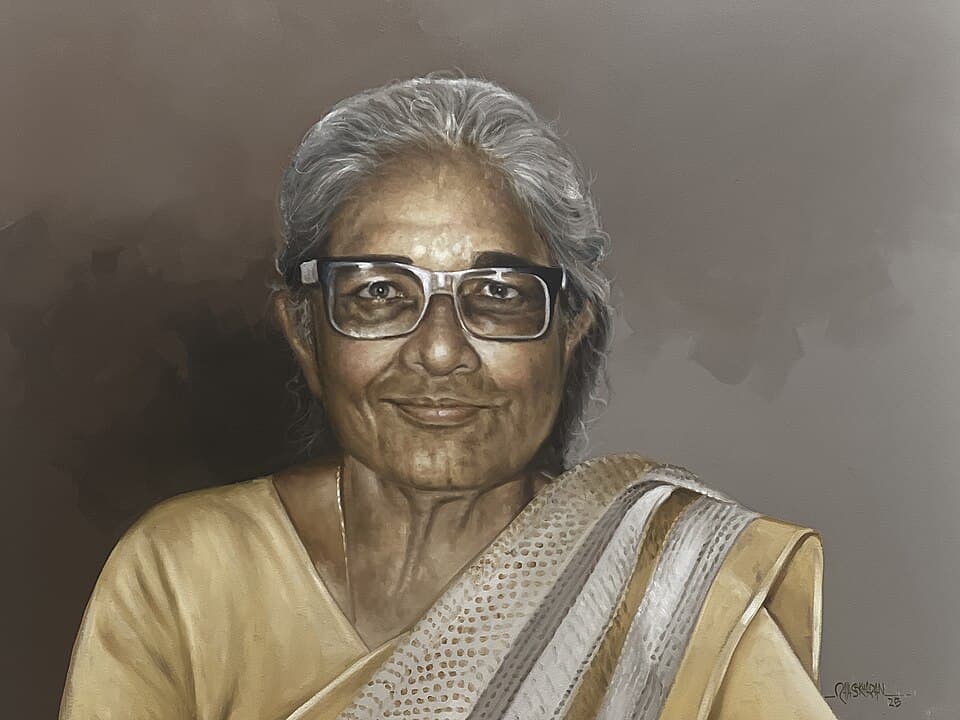
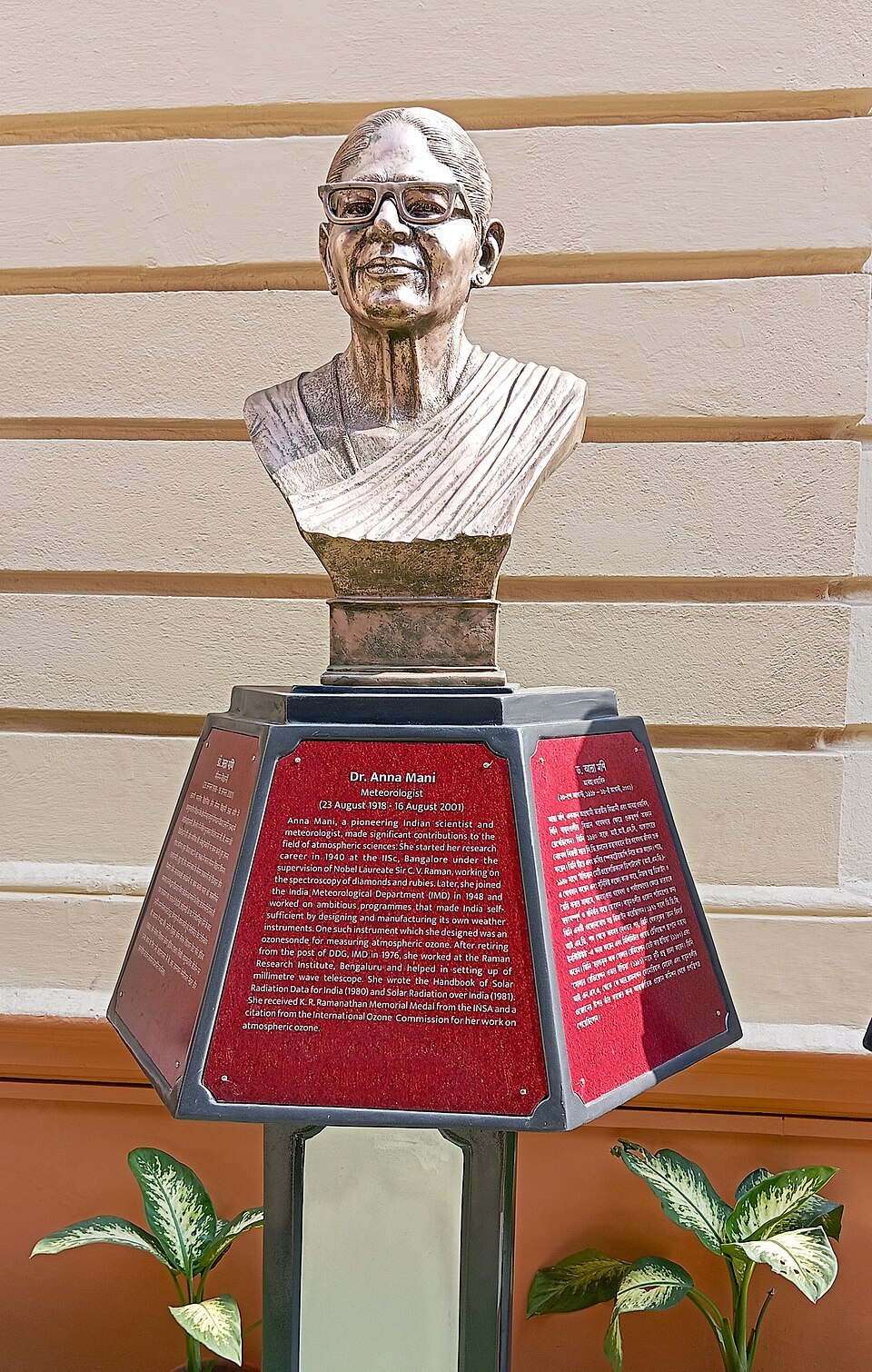
Two twelve-year-old students step through the door of an office filled with books and strange measuring instruments. An elderly lady, dressed in a simple cotton sari, puts down her magnifying glass and smiles at them. Her name is Anna Mani, and she spent her life measuring the sun, the wind, and the air of all India.
—Is it true that on your birthday, you refused a gift?
Yes, it's quite true! I was eight years old. In my family, girls were given beautiful diamond earrings. Everyone thought that was normal. I said no. I wanted something else: a complete set of the Encyclopædia Britannica, you know, those big volumes filled with knowledge about the whole world. Imagine a little girl who prefers heavy books to shiny jewelry! I had already read almost all the books in Malayalam in my town. Diamonds, you look at them. Books, they fill your head forever.
Diamonds, you look at them. Books, they fill your head forever.
—Did you really read that much when you were little?
Oh yes, my child, I devoured everything! Before I was eight, I had read almost all the books in Malayalam — that's the language of my home, in Kerala. Then, before I was twelve, I had tackled books in English. Imagine a house filled with cardamom, that fragrant spice my family grew, and a little girl sitting in a corner, nose buried in a book from morning till night. I didn't play outside much. My real adventure was in the pages. That curiosity never left me, even as an old lady.
My real adventure was in the pages.
—What was it like working with such a famous scientist?
Impressive, you can believe me! I worked in Bangalore, in the laboratory of the great C. V. Raman, a physicist who had won the Nobel Prize. He had discovered a way light changes when it passes through matter — it's called the Raman effect. I studied diamonds and rubies with a spectrograph, a device that breaks light into colors, like a neatly arranged rainbow. It was meticulous, silent, fascinating. I wrote five scientific papers between 1942 and 1945. Each stone told me a secret hidden in its light.
Each stone told me a secret hidden in its light.
—You wrote a whole thesis, but they denied you the title? Why?
Ah, that hurt, I admit. I had written my thesis, published my five papers, done real research work. But the university refused me the title of doctor. The reason? I didn't have an official master's degree, a diploma on paper. Imagine you build a beautiful house with your own hands, and they tell you: 'Sorry, you're missing a stamp.' It was unfair. In my time, they often put obstacles in the way of women who wanted to study. But you know what? I didn't give up. I continued my path another way.
They denied me a title, never the desire to search.
—Why did you absolutely want India to make its own instruments?
Because my country had just become free, in 1947! Before, we were under British rule. To measure the wind or the sun, you had to buy instruments abroad, very expensive. I told myself: an independent India must know how to build its own tools. So, at the meteorological service in Pune, I supervised the development of about a hundred devices: anemometers to measure wind speed, radiation sensors, sondes. Imagine a workshop where you learn to build yourself what you used to buy elsewhere. Being free is not just having a flag. It's knowing how to make your own instruments.
Being free is not just having a flag. It's knowing how to make your own instruments.
—What was your favorite instrument, the one you liked the most?
What a lovely question! I had a soft spot for the pyranometer. It's an instrument that measures the sun's energy received on a surface. Imagine a little cup turned toward the sky, patiently counting each ray that falls on it. I also liked the ozonesonde, a sensor attached to a balloon to go measure ozone way up high — ozone is a gas that protects us from the sun's burning rays. Adjusting these devices to the millimeter was my morning joy. A poorly adjusted instrument is like a crooked ruler: better no measurement at all.
A poorly adjusted instrument is like a crooked ruler: better no measurement at all.
—How do you measure the sun of such a large country?
Patiently, station by station! You don't measure the sun from just one place. I installed, across all India, a network of stations that recorded the solar energy received on the ground every day. Imagine dozens of little lookout posts, from the mountainous north to the tropical south, all eyes turned to the sky. We then gathered these figures into big manuals. I published Solar Radiation over India in 1981: a true map of my country's sun. Even today, it's used to understand the climate and install solar panels in the right place.
A map is not just roads: mine drew the sun.
—What use are all those numbers you collected today?
Much more than you think! When I was measuring solar radiation, I wasn't just thinking about my own time. This data tells where the sun hits hard, where it's gentler. Imagine wanting to place sensors that turn sunlight into energy: you need to know where the sun is most generous. My manuals, like the Handbook for Solar Radiation Data for India from 1980, are still used for that. I also measured wind with my anemometers. Science, you see, is sowing seeds. Sometimes the tree only grows long after you.
Science is sowing seeds: the tree sometimes grows long after you.
—Why did you always wear those simple cotton clothes?
This cotton, my child, is called khadi. It is spun and woven by hand, thread by thread. During our struggle for independence, a man named Gandhi made it the symbol of our country: instead of buying cloth from British factories, we made our own. Wearing khadi was a quiet way of saying: 'I believe in a free India.' So all my life, I wore simple khadi saris, without adornment. Imagine a garment that speaks without making noise. My clothes told my convictions better than a long speech.
My clothes told my convictions better than a long speech.
—If someone met you on the street, what would they notice first?
My simplicity, surely! No jewelry, no luxury — just a khadi sari and a curious gaze that observes everything. I remained single, with my books, my music, and the nature I loved to watch. I worked until I became Deputy Director General of the meteorological service, an important post, but I never liked sloppiness or showiness. In the morning, I read; in the afternoon, I adjusted my instruments with exacting care. You know, you can change the science of your country without ever raising your voice. You just need to be rigorous, curious, and faithful to your ideas.
You can change the science of your country without ever raising your voice.
This imaginary interview was generated by artificial intelligence from sources documented in Anna Mani's profile. It dramatises what the figure might have said based on what we know about them, but does not constitute attested historical testimony. For primary sources and factual documentation, refer to the full profile.